The Year of the Book by Andrea Cheng, illustrated by Abigail Halpin

If anyone could see my face now, they’d know that I’m in quite a bit of agony.  After reading this post, my readers will hopefully understand why I have to break my own rule of not revealing titles of books published in 2012 as I think and write about them while serving on the Newbery award selection committee.  Here it goes:

I really like this charming little middle grade book. I appreciate that it tells a contemporary story with an ABC (American Born Chinese) protagonist that has some Chinese cultural things sprinkled through without making the heritage a “problem” in her life or in her relationship with her friends.  I think Andrea Cheng really captures that 10-year-old-book-lover-in-the-process-of-sorting-out-friendship-and-family-relations spirit and she successfully implies many emotions and events without ever becoming overtly preachy or melodramatic.  The cover is lovely.  The trim size is cozy.  The occasional illustrations cannot be more warm or eye-pleasing.  I think it will be loved by many readers and teachers can happily use it with their students.  After all, there is the subtle mean-girl scenario that is handled so well and there is reading and writing realistically reflecting many students’ experiences.

The possibility of its wide classroom applicability is why I feel obligated, as someone who can read Chinese fluently, to list some of the spelling, factual, and pictorial mistakes in the book, so adults who use this book with children can help them correct these in the book.  Here are the ones I spotted, in page order:

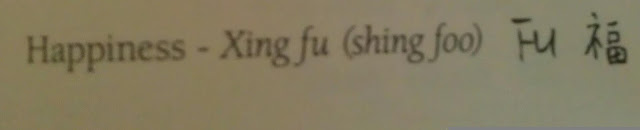
On the page of the Pronunciation Guide: the last word “Happiness” is marked with the correct pin yin “Xing fu” but where there should be the Chinese character “xing” 幸,there is the hand written pin yin of “Fu”
On page 43: The Chinese Characters and the English are mismatched:

The Chinese Characters are

Pumpkin –> Black Cat –> Witch
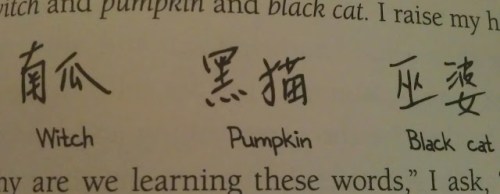
but the English labels read:

Witch –> Pumpkin –> Black Cat

On page 45: When discussing about what the moon is like… Anna says that her mom told her the moon is an old lady… which is definitely news to me.  Traditionally we think of these three characters as long term residents on the moon: The Goddess Chang Eh, the Wood Cutter Wu Gang, and the Jade Rabbit.  Sometimes we also say that there is a magical Toad on the moon.  But, old lady?  Hmm… This could just be the result of different families and the stories they pass down.

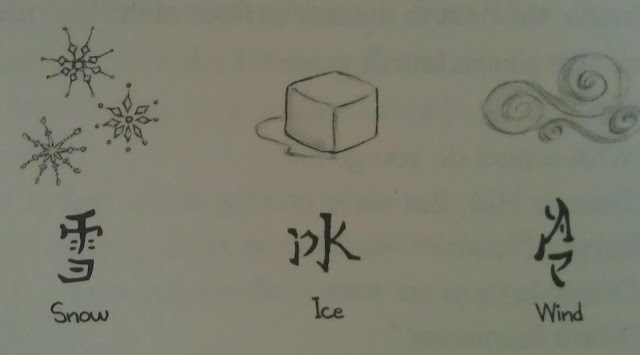
On page 76: The text says that the Chinese teacher is teaching words like snow, ice, and cold.  The illustration shows the Chinese characters of Snow, Ice, and Cold correctly — but the English label shows, Snow, Ice, and Wind.
On page 110: (I verified this with the pronunciation guide and also the author’s own text on page 143.)  The text shows, “We sit at the kitchen table and have my favorite bean paste, bao zia, for a snack.”  Chinese eat sweet bao zi (steamed buns) with red bean paste filling as snacks, but I seldom see people eat bean paste directly … and bean paste is called “dou sha,” not “bao zi.”  Here also, zi is mistyped as zia, which is not a sound found in Chinese words.

On page 131: When discussing the Chinese Zodiac animals, the author lists “Dog, cat, cow, horse, rooster, and rat” where anyone familiar with the Chinese zodiac or the Chinese zodiac stories knows that CAT is excluded from the zodiac.  There is no “Year of the Cat!”

On page 136: When making the timeline, Anna puts down her birth year as 1998 and states that it’s the Year of the Dog.  This is erroneous.  1998 is the Year of the Tiger.  Year of the Dog is either 1994 or 2006.

These are all non plot-essential mistakes and it does not take away the integrity of the character development or the flavor of the setting.  However, in this day and age where we are teaching each other and our children to be culturally sensitive and as accurate as we can be, and where Chinese speaking and writing people who can take a quick look and point out mistakes to be corrected before going to print should not be very hard to find, finding these many mistakes in one small, 146-page book simply stuns me.


9 Comments

Filed under Uncategorized

This slim volume of a verse novel works…

This slim volume of a verse novel works quite well: the poems flow and twist and turn and convey the emotions and the storyline with ease that came obviously from much work and rework of the poet. I enjoyed it even if it didn’t move me deeply. Wondering about verse novels often: what subject matter or storyline is worthy of the distilled and condensed form of poetry telling? This one, although features plenty of potential dangers and stated feelings from the protagonist, does not quite reach the level of emotional depth that I usually associate great verse novels with.

Leave a comment

July 13, 2012 · 1:42 pm

Reading lots of fiction I am under the…

Reading lots of fiction. I am under the impression that publishers have stopped submitting most of their nonfiction titles since 1) there is the Nonfiction award (Sibert) given by the same administrative body (ALSC) and 2) there has not been ample nonfiction titles given the Newbery stickers (albeit superb nonfictions have been expertly produced yearly from all major and minor Houses) and 3) the shrinking marketing budget at each House most likely prevents automatic nonfiction submissions to Newbery members. I’ve heard great things about a lot of nonfiction and plan on getting them from libraries or buying them or ordering them for the fall in my library… but should I be resigned to the fact that most people still think (and believe) that the most prestigious children’s literature award (since it is among the very few awards that actually greatly affect book sales) The Newbery Medal is equivalent to “The Award for Excellent Middle Grade Fiction Books” (that will mostly please teachers and librarians)?

Disclaimer: I am totally aware of how difficult it is to compare many different genres for different age levels and know that each past Committee and my current one have done and will do nothing short of the most conscientious deeds when comparing and contrasting and voting and revoting and persuading and being persuaded about the quality of each of the final nominated books… I am just wondering out loud!

2 Comments

July 13, 2012 · 11:13 am

Why I Love Paper Books

Reposting (with a little editing) my comments from a facebook conversation here:

Regarding the switching over from reading paper books to purely ebooks for whatever reasons: Not that I don’t see that the words and stories and characters are what ultimately most readers want to “get out” of books they read. I too read books on my computer, on my phone, on kindle and iPads and I get about as much joy out of the content as reading a paper book.

However, I cannot stress enough the value of books as objects of art and am always in awe by the artistry of expert book designers and producers: the tactile pleasure that one can gain from touching a specifically selected paper (say, the graph paper quality materials for the Templeton Twins books or the rough cut edged paper for The Tale of Desperaux) or even just simply the weight or trim size that varies from book to book so there is a physical memory of a particular book — holding horizontally Where the Wild Things are and opening it wide when sharing with a child on my lap or carrying the heavy tome of Jonathan Strange and Mr. Norrell. I do not ever want to lose the opportunity to have all these added values that so far only paper books can achieve.

I am holding a dainty book in my hand — it has a lot of white space (because it’s a free verse novel) and the page number is placed in a very unconventional place, with a bit of decorative design (that echoes the theme of the story) around each number… This makes me want to say, “Thank you,” to the book designer, to those who still take great care and artistic pride in making the books perfectly to enrich my life!

When seeing someone else carrying a book I have read and loved and their thorough absorption in the world it opened for them, I feel an instant connection. Alas, with all the e-readers, I can no longer play I-Spy-What-Others-Read on the road or on the subway! I am deprived! I tell you, Deprived!!!

(An added thought about the environment… paper, when produced without extreme logging practice and with effort of recycling, etc. is bio-degradable and can be “regrown” always…. I wonder, sometimes, about the electronic and plastic parts of eReaders and devices: are they more environmentally friendly? When old devices are tossed – recycled – what happens to them, really?)

Leave a comment

Filed under Uncategorized

There is so much to love about book…

There is so much to love about book 55 — chiefly because, I realize that, after closing the book with a very satisfying and lovely closing paragraph, the misfit characters really come to life and are entirely endearing and the stakes are actually high to justify the adventures these characters must embark on. This is a children’s book that features almost no children (although some of the actions taken can be easily seen as childish and can be easily understood by child readers.) I was surprised at the honestly brutal descriptions of some of the violent actions in the book and the cover definitely does not prepare a reader for those moments.

I cannot quite decide how I feel about the emotional gap between my delight at the often jokey and light-hearted (and clever) narrative tone and my dismay at the cruel behaviors a couple of characters exhibit throughout the book. It’s almost dizzying — the changing of pacing and sensibilities. That said, I wasn’t distraught, just aware of the idiosyncrasy.

A few words about the glorious illustrations: Although I’m only to evaluate based on the text as a member of the Newbery committee, I can’t help but responding positively and being impressed by the skill of the book’s illustrator — those few full page illustrations are done flawlessly: I want to scan, print, and frame them!

Leave a comment

July 12, 2012 · 11:01 pm

This is why reading fiction can still teach…

This is why reading fiction can still teach one a LOT of “facts” in life: as I pondered the plausibility of a specific animal’s breeding behavior in book 55, I embarked on an adventure of educating myself something that I had never wondered because I thought I already “knew” the facts — it turned out, I was wrong and now I’m one-fact richer than yesterday :).

Leave a comment

July 12, 2012 · 7:43 pm

Clockwork Three by Matthew J. Kirby

I always wanted to read this book — and more than one teachers at school urged me to read it. Since I can’t really read it this year – I downloaded the audio book read skillfully by Marc Thompson. Thompson definitely did the story justice with expertly designed and executed voices for the many characters in the tale. The story itself satisfied: a wonderful blend of life-or-death/survival scenarios and the warmth of friendship and inter-generational support. Although there are some really despicable adults in the tale, there are also so many caring ones that eventually made the three children’s lives better.

I anticipated a lot more “magic” due to the title and the cover design and felt slightly disappointed when I realized that it’s mostly a tale of young immigrants and their struggles finding their places in the world and supporting their families. All three protagonists’ stories are definitely compelling. Kirby then introduced some magical elements in the form of the golems and the golem’s “heart” for the clockwork man. Being a picky and sometimes narrow-minded genre-purist, I found this mixture a bit disconcerting — although it was quite satisfying to read those fantasy bits. I don’t think any child reader will be bothered by this mixture of historical/realistic story telling and elements of magic.

Leave a comment

Filed under Book Notes

Imag•N•O•Tron Demonstration Video

Moonbot Studio, owned and supervised by William Joyce, illustrator extraordinaire (and now Oscar Winning animation shorts producer) has released something that looks really interesting: their Imag•N•O•Tron App for the iPad — an “experience enhance” device that goes with Moonbot picture books. Of course, right now, all the Moonbot Studio has to offer is the tie-in with The Fantastic Flying Books of Mr. Morris Lessmore – but the potential is definitely here.

Leave a comment

Filed under Uncategorized

I and Book 54 started off on the…

I and Book 54 started off on the totally wrong foot — and I have no idea whether it will get better as I read on. Once again, we have a narrator who is EXTREMELY poetic and literary while has no apparent schooling or environment that fostered such sophisticated usage of language (and … actually, some of the figurative speeches are plain confusing: they sound good but if you stop and consider what they actually try to say…. you are baffled and start questioning the mind of the narrator or the author.) I am going to trudge on since there are a few thematic elements that I feel obligated to explore as my own professional responsibility to the children’s lit. field at large.

Leave a comment

July 10, 2012 · 2:29 pm

Having trouble pinning down my views on book…

Having trouble pinning down my views on book 53. Some of the claims included in book 53 seem much less substantiated by evidence than others. This is due to the fact that the widely-read author includes both highly respected scholarly sources and sources that are out of the left field including claims that are not widely accepted in the academic world. In a way, I admire the author’s reaching to find less conventional sources but since the young readers will not have the knowledge of knowing which sources are more established than the others, the responsibility lies on the biographer’s shoulder to make it clear which source might not be reliable… which the author did in the detailed back matter notes… but not in the body of the text. Are we demanding the young readers to examine the back matter in such details these days that we can leave things less clear in the main body of the text?

I have also found it a bit burdensome as a reader to never know which source (title) by which scholar (author/editor) is cited to support the claims on each page. I can see the benefit of not interrupting the flow of the narrative with parenthetical citations or footnotes, but too many of the (paraphrasing here) “according to one highly respected scholar” or “based on two famous researchers’ data” do become intrusive and mentally exhausting for someone who wonders about how an author obtained his/her facts or made the inferences.

Granted, almost everything is cited and discussed in details in the back matter… but it’s a lot of detective work to figure out anything I had a question for. (I enjoyed it… but don’t know about its effectiveness when used by young folks.) Also — there is at least one incident where the author makes an affirmative claim in the body of the text based on a particular source while in the source notes, the validity of that source is questioned and the young researchers are urged to seek out other sources to further validate (or discount) this source. So, for me, the verdict is still out.

Will keep looking for reviews and seek others’ opinions before really settle on a final verdict — which might never happen. I’m grateful for an intriguing read that made me think really hard on nonfiction/biography writing and the matter of the back matters…

Leave a comment

July 9, 2012 · 9:27 pm

Reading a heavy hitting nonfiction biography and am…

Reading a heavy-hitting nonfiction (biography) and am totally engrossed.

Leave a comment

July 7, 2012 · 8:44 pm

Finished the slim volume of book 52 with…

Finished the slim volume of book 52 with a smile on my face. This is indeed a fun book for beginning competent readers: there is quite a bit of smart humor and definitely enough action to keep the reader’s interest high. The thematic query of whether fate determines (or should determine) the course of one’s life is presented in ways that will inspire young readers (7 or 8) to ponder without overwhelming them with confusing ideas. Well done.

Leave a comment

July 6, 2012 · 11:25 am

Book 51 gave me such pleasure that I…

Book 51 gave me such pleasure that I didn’t stop to take notes (except to jot down some really fun and fresh phrases and observations and a couple of wise advices) or to consider if it is “worthy.” It definitely is quite a wonderful book and I can see recommending it to kids and teachers alike. It has the right tension, the right “heart,” and the right comic relief — all in the right times and places. This is a tale unlike most I’ve read, this year or another, mostly because it has a really likable and unique young narrator who never shape-shifts into a much older author-in-disguise persona and also because the makeshift family is so unusually quirky and warm. It’s a contemporary American tall tale (for those who might not quite believe some of the turns of events — here you go, it’s a tall tale!) The author keeps so faithfully and dexterously to the view point and the mindset of this young narrator — a stark contrast to book 50’s unbelievable young person’s tone.

1 Comment

July 5, 2012 · 8:14 pm

Another one that makes me ponder if the…

Another one that makes me ponder if the choice of a child first person narrative voice is the best for certain books or stories… book 50 is giving me a lot of trouble right now because there is a fairly young and not the most worldly child who keeps using highly sophisticated words (which might be explained away by her being super bright… being into words… being a storyteller, etc.) AND has so many incredibly mature observations about people, self, and the world. It just sounds suspiciously like the author – and not the child character – talking to the readers.

Leave a comment

July 3, 2012 · 10:40 pm

Book 49 Good very realistic with great characters…

Book 49: Good… very realistic with great characters and full of tender hearts…. I’ll def. put it in my YA section because I think 7th grade and up readers are needed to appreciate the scenarios and dilemmas presented here. I am unsure of one particular character’s dialog (done to reflect his strong regional accent) — it really stopped the flow of the reading because there is SO much inconsistency (ya, yer, you, your — all in one stretch of the same speech… — plus other awkward spellings that simply do not give me a great mental “sound picture” — I am baffled as to why this author felt the need to highlight this particular supporting character’s accent while where the character originally came from has no bearing in the story whatsoever, and while everyone else in the story has no special speech patterns at all.

Leave a comment

July 3, 2012 · 9:55 pm

I was just going to give this author…

I was just going to give this author some brownie points of describing not quite traditionally or lazily this strikingly beautiful girl who has some distinctive features that definitely made me “see” her (and she’s NOT blond!) when I read that she also has “the palest blue eyes in the world.” Haha. I just can’t win. But, hey, I also can’t deny the fact that I find icy blue eyes (since they are non-existent in my youth amongst my friends in Asia and since blue IS a beautiful color in my opinion) highly attractive, too!

Leave a comment

June 30, 2012 · 5:52 pm

Those Piercing, Icy, Deep, and Baby Blue Eyes….

I have been paying closer attention to character descriptions as I read the 2012 American children’s books for consideration of the 2013 Newbery award, since it is one of the major criteria that one may base one’s assessment when examining these books. What I have noticed is that blue-eyed characters are still quite prevalent in these books — even when there is little need for detailed physical descriptions of a particular character (be he/she a major or a minor one,) the almost throw-away lines of “piercing blue eyes,” “icy blue eyes,” “pale blue eyes,” show up frequently. In one lovely book by a famous author about family and inter-generational relationship, the characters were not physically described except for one sentence where the reader sees “his eyes sharp blue.”

I must confess that up till that point, I wasn’t assigning a race, ethnic heritage, or skin color to the entire family. I was engrossed in their loving and very warm relationships and the quirky habits of some of the family members — and it did not matter to me what they actually look like from the outside. Books can do that — allowing readers to see inside the characters, bypassing the surfaces and sometimes the assumptions that come with those surfaces. But, with those three words, “eyes sharp blue,” a whole lot of readers just realized that no matter how imaginative or willing they are, they cannot read themselves easily into that story any more.

I’m reading book 49 and liking it quite a bit — liking the easy style and the potential of a soul searching, heart warming tale of a young person…. but even on the second page of chapter 1, the most popular kid in the school was introduced by the following attributes (in order): by height (tall), hair color (blond), eye-color (blue), and then the personality (easy-going) that makes him so well loved.

I’ve also been listening to an audio book of Grimm’s fairy tales — and of course, anyone with golden hair and blue eyes is automatically kind, good natured, and deserving of the best fortune at the end of the tale.

It just makes me wonder… do children’s authors still on this traditional, auto-pilot mode when it comes to describing physical attributes of characters and how these attributed are associated with their status ascribed by their peers? (Any middle school kid is going to swoon over someone with blue eyes, isn’t she?) Do they know that there are many physically attractive young people who are not blond and are not blue-eyed? And do they know that it is all right, sometimes, to not get into detailed and often pointless physical descriptions of their characters — there are plenty of other ways to bring the characters vividly to life, especially by their actions and words? And do they know that according to a 2008 study, only 1 in 6 young Americans has blue eyes (http://www.nytimes.com/2006/10/18/world/americas/18iht-web.1018eyes.3199975.html) and that their readership is comprised of many different ethnic backgrounds.

If authors are compelled to include detailed physical attributes of characters — perhaps they can start considering that their young readers might want to be reminded and affirmed of the many possible ways, forms, shapes, colors, and unique quirks, that a person can be considered beautiful or attractive. Stop the lazy, throw-away, generic lines and give the young readers what they deserve to read: carefully observed and truly seen and fully presented characters.

Leave a comment

Filed under Uncategorized

Out of all the stories almost half of…

Out of all the stories, almost half of them are really really effective, fun, inventive, spooky, sad, scary. The rest range from quite good to just all right. But I can totally see sharing at least two at this year’s Halloween library story times — for 6th grade and older. It will be superbly chilling. The author manages to give different and mostly authentic voices to the characters, all telling their first person stories, from different eras. I just realized that the stories I like most are told from kids who are not despicable themselves — those who didn’t deserve their tragic fates as much. The sense of melancholy is stronger and thus my level of sympathy becomes higher. My original assessment of the frame story stands, though — it’s definitely not strong enough to hold the whole volume together and the lack of a convincing explanation of why these characters all being together is also problematic. But, I’m glad that I read it!

Leave a comment

June 30, 2012 · 12:49 pm

Just remembered that in the late 90s I…

Just remembered that in the late 90s, I, and Walter Minkel, two members of the Association for Library Services to Children (a division of ALA,) were responsible for the design, publishing, and updating of the Newbery and Caldecott Medals’ official web pages. It was such fun getting all the secret information hours before the press release time, gathering all the winning books to scan the cover images, and posting the information for the eagerly awaiting public! Thank goodness the ALSC staff took over the updating of these sites now so I don’t have to wake up super early to work on the pages — but I DO miss that special perk of knowing something before most everyone else does! Now, I am quite content to be just sitting in the crowd and holding my breath to hear the announcements and screaming for books I love when their titles and authors are pronounced.

Leave a comment

June 30, 2012 · 10:27 am

Book 48 has such a promising concept so…

Book 48 has such a promising concept…. so far, it does not feel that the author delivered, shucks. The frame story is definitely not fresh and does not contain enough spookiness to keep anyone up at night (which is what the description of the book promises.)

Leave a comment

June 28, 2012 · 5:26 pm