
Reading about The Boy from Clearwater over on Global Literature in Libraries prompted me to instantly reserve copies at the New York Public Library. Does your public library own this graphic novel duology? I hope it does.
Impressed and Moved by Keesha’s House/Helen Frost
Helen Frost knows how to Play with poetic forms AND how to tell a story with heart, heartaches, and hope. It took 23 years for me to finally read it. Thanks to a young colleague who loved the book when he was in middle school who gifted the book to me.
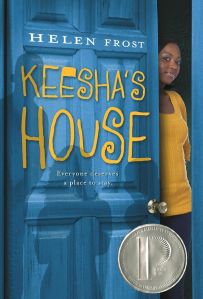
It definitely feels like a precious gift, just considering how precise Frost had to be while composing each line, stanza, and poem, with the strict rhythm and rhyming schemes of sestinas and sonnets. And how much she cared about these young characters’ stories to be that diligent in telling their tales.
Did you read it? How did you find it? Comment below and we can discuss!
Filed under Book Notes
I agree with Mac Barnett, 94.7%
Yes, I specifically used this number, 94.7%, from Barnett’s book, Make Believe, mostly “about children’s books for adults” who consume, share, make, and sell children’s books. And yes, I am well aware of how this particular line got him in deep water with the world of children’s book creators: “Maybe more like 94.7% of children’s books are crud.”
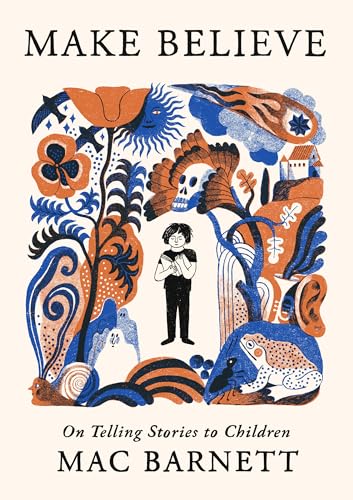
Do I think he seriously believes that almost 95% of children’s books are trash? I think he is attempting at humor, trying to shock his readers into paying more attention to the rest of the book to see if he could justify this claim. However, I do think that Barnett truly feels (instead of conducting thorough quantitative research) that there is almost a state of emergency that so many children’s books published in the past 5-10 years fall short of being brilliant, innovative, expansive, revelatory, and soul nourishing.
Since I already knew about this sentence, appearing on page 27 of the 143-page short book, and some people’s extremely hostile reaction to it online, I read it, and moved on. I wanted to see for myself what he has to say about the craft of telling stories to children.
What I discovered is that, I basically agree with almost every point made in this book – especially how bland literature for young readers have been for a while and I wish, as hard as he does, for a new wave of children’s books that, instead of trying to “do good for society” to just be really good books. I equally wish for books that defy convention, get deeper into the human condition, and truly move readers to revelations and epiphanies. What I also discovered is that Make Believe as a persuasive essay is not brilliant, innovative, expansive, revelatory, or soul nourishing. It’s just, fair. Definitely not on the top 5% of books or essays written on crafting literature for children such as those from Philip Pullman or Ursula le Guin, or the wise author-editor duo cited amply in this book: Margaret Wise Brown and Ursula Nordstrom. Does that make Make Believe a “crud” of a literary criticism? Nope. It’s just – mediocre and didactic. It’s kind of ironic that the publisher included the Kirkus Review blurb which calls it a “loving sermon” nodding at its preachy tone (which Barnett finds so undesirable.)
For people who are unfamiliar with children’s literature criticism, this book serves as a quick overview of what might make for good children’s books but I will definitely recommend other books and sources to truly enrich one’s understanding of this vast and beautiful field, such as Dear Genius: The Letters of Ursula Nordstrom, compiled and edited by Leonard Marcus (indeed all of Marcus’ titles on children’s literature); Daemon Voices: On Stories and Storytelling by Philip Pullman; and articles published in The Horn Book.
Filed under Book Notes
I’m reading 7 books at once
For a few years, I have not read many books in paper, due to problems with my eyesight. Listening to audiobooks and reading on devices with backlit text was easier. But now, after the recent cataract surgeries, reading books printed in paper is once again possible.
So I got a little carried away. These are the books that I am reading right now.

Mostly are nonfictions in short segments so it is easy to pick up and put down. Can’t wait to write about each one as I finish them.
Filed under Book Notes
Global Lit in Libraries – last week’s post on World Kid Lit Wednesday about a charming picture book translated from Dutch
Filed under Book Notes
I Got Lucky! New Scythe book ARC in the house!
YES! I won a raffle from Simon and Schuster and received this advance reader’s copy after attending a virtual preview where Shusterman gave an amazing talk about the writing of this prequel, which is the first of a new trilogy, First Blades! According to Shusterman, this story takes us back to the time before the creation of Thunderhead, featuring a group of intelligent and foreseeing teenagers who were concerned with the end of Mortality in the year 2042 and of course, how AI will shape the future of the human race. The release date is December 2026.
Filed under Book Notes
How could you, Ken Liu, the devastation of “The Literomancer” (contains spoiler)
I’ve been pacing myself, reading a story a day of Ken Liu’s speculative short stories collection, The Paper Manegerie. It feels like a treat every time, experiencing his storytelling power with inventive magical or scientific elements, and the masterful and economic character and world building.
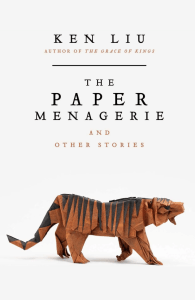
But oh, yesterday….yesterday, I encountered “The Literomancer,” a story set in mid 20th century Taiwan, weaving together American Intelligence work, the political tension between Communist China, KMT Taiwan government, and the sentiment of the “original province people” (benshengren/penshengjen) with the innocent, and innocuous, school girl outcast experience, uprooted from Texas to Taiwan.
How I wish I am able to UNread this story. UNremember what transpires 3/4 into the tale. The story of mild upsetting scenarios of a girl being bullied and then finding likable strangers who care for her, almost like family suddenly takes an extreme, nightmarish, and traumatizing turn when innocent people are suspected to be spies.
I had to quickly skimmed past the graphically described torture scenes and speed-read to the concluding paragraphs of the story, finding the whole experience nauseating and chilling. I was ANGRY! How poorly the story is contracted, pivoting without warning and throwing such brutality at my unsuspecting eyes. And I thought Liu knows how to pace and plot.
Then…I realized, that would have been exactly how the characters feel – brutally torn from the idyllic and caring circumstances to face the sudden and extreme tortures. That’s what is so scary when the guilt-less are smooshed senselessly and bloodily under the cruel tracks of the metaphorical tank operated by those who believe that it’s better to sacrifice a thousand innocents as long as they don’t miss the possibilities of eliminating one real enemy.
I know you are brilliant…Ken Liu, but now I don’t even know if I dare keep reading the other stories in the collection. (I will, because the book is SO good but now I read with caution and a nagging fear.)
Filed under Book Notes
A Miyazaki quote to ponder
I’ve been slowly reading the catalog put together by the Academy Museum of Motion Pictures in LA to accompany a retrospective exhibit of Hayao Miyazaki from 2021. The short essays capture and explain Miyazaki’s creative process and philosophies.
This morning, I felt specially moved by this quote from him, “Children are filled with…things so ancient that only their DNA remembers” when referring to the seemingly wise intuitions in children, and in his young characters. (Unfortunately the source isn’t clear.)
Children cannot name why or how they know what to do or how to connect to the world but they often seem to be more in tuned With the world while adults have mostly shed or hidden those connections in our DNA.
At this, what I think of as, my third stage of life, I would love to rediscover those intuitions and ancestral memories that maturation under societal directives might have concealed or stolen from me.
It could be a fun journey.
Filed under Book Notes
After 6 years, I guess I’m still around
The last post on this blog is from 2019. COVID 19 happened. Life took on a different hue. Reading became harder. Thinking and writing about books, which was an unshakable habit for a couple of decades, became almost a foreign concept. To be honest, I also lost interest in many of the newly published books for middle grade from 2020 on. What an unfortunate situation for me, a devoted Middle School Librarian who breathed and lived children’s and YA literature since 1989 when I started the Master’s in Children’s Literature program at Simmons.
For the last 3 years, I switched to serve as a High School Librarian at the same school and slowly rebuilt the habit to read (mostly to listen, since my eyesight deteriorated a lot) all kinds of books – thanks to the passionate reading community of colleagues and students. And now, I feel that I can finally come back to jot down thoughts about books and media again. Even if just as a record for myself.
Luckily, wordpress kept all my previous posts intact – unluckily, fairrosa.info is no longer mine. A new URL – fairrosa.press – seems a nice way to start anew for this stage in my life as a retiree.
So, after 6 years, hi and hello again. I’m still here.
Filed under Book Notes
Making “WAVE”s or Going with the Flow? – Pinay Thoughts on Marvel’s new Filipina superhero
I posted my first reaction a few days ago upon seeing the first look poster of the very first Filipina Superhero from Marvel. Since then, some discussion went down over on my Facebook Timeline. Somewhat heated debate between me and a white Facebook friend (not RL friend) trying to parse out our understanding of the data: that Tagalog is both a Language and a group of people; that people with Spanish heritages are less than 1% of the population; that the artist, although Filipino, displays largely western, marvel influenced comic book art styles, etc. I definitely outright challenged this white friend’s recollection and knowledge — and also pointed out that her 4-year living in the Philippines as a white person does not give her the same lived experiences as Filipina or Filipina Americans.
In the end, what matters here is not how this one white friend responded, but what my two Pinay educator friends had to say. In the spirit of being called in (since I’m not Pinay) and calling others in, I’m reposting their salient comments here. I’d really like to encourage Marvel and the creators of the new diverse superheroes to be courageous: this is uncharted water, but you have the resources to make large waves: do your due diligence and stay true to the cultures you’re representing even if they could be unfamiliar to western eyes. Create something fresh and unlike all the previous superhero stories! Don’t just do the same-old, same-old with merely changes of skin tones and costumes! (And please no resorting solely to “oriental mysticism”!)
Maria is an elementary school librarian who also produces and hosts a Theatre Review Show on YouTube to highlight work primarily by women and POC playwrights, actors, directors, etc. :
Maria Paz Alegre Hey all Pinay here. I’m Kampangan and Tagalog – though little known outside our country, Tagalog is indeed both a language and a people! Props to Roxanne for shining light on that little known fact. TBH my fam usually refer to ourselves as Manilenyos first, a nod to our capital city. I believe Tagalog can be compared to the word “English” – both a language and a people. The idea that we are strangers to our own land, coming from Spain and Polynesia to conquer is false. We’ve ALWAYS been there. Been there long before King Philip and long before Christ. Source: myself, and if experts are needed, my father Edilberto N.Alegre- an award winning scholar and PhD of Filipino Cultural Anthropology. His books are often required reading at the University of the Philippines where he taught for several decades, but feel free to google him if you like.
I’m also the one who made the spray tan comment. I stand by it and it appears I may need to explain.
I was ELATED AF to find out that Marvel made a Filipina superhero, only to feel a kick to my gut when I saw her. If you know my country, then you know all about the systemic bigotry derived directly from white colonialism. The bleaching cream, the rhinoplasty, the upper eyelid surgery, you name it… I cannot stress the havoc that this western standard of beauty has wrought on my people, especially on indigenous tribes like the Ati.
Are there mixed Filipinos with western features? Sure! But they often make up the “1%“ and are almost always the rich and elite. They do not look like the vast majority of my country people. My stepmother (Joycie Dorado Alegre) has been the Commissioner of the National Commission in Culture and the Arts to the Visayas and Mindanao and she personally worked on campaigns to encourage that “Black is Beautiful. Brown is Beautiful. You are Beautiful.” It’s been a very rewarding but very uphill battle.
So yes, to see the first representative of my race in Marvel with Eurocentric features? It sucks and it hurts.
Spain wins again. America wins again. The Filipinos must take a hit and live to fight another day, again. And while a Pinay character may be a step in the right direction to you, it greatly disappoints me and many others that she doesn’t look like like one. They could have done better.
Justine is a Health and Wellness educator whose Decolonizing Beauty Standards workshop at the People of Color Conference (for educators in Independent Schools) was the highlight for many attendees two years ago:
Justine AF Yo! Pinay here too and glad this convo is happening so thanks Roxanne Feldman for your allyship. I’m feeling like all I need to do though is clap and bow down because Maria Paz Alegre just crushed it with her eloquence. But since I rarely can keep quiet, I’ll add my 5 pesos here:
1. Yay that Marvel is naming a character an identity that matches one of mine.
2. Boo that she looks like the beauty ideal I’ve been told to emulate for most of my childhood. Unless Wave has that nose because her Tita was right about clothes-pinning it and she obeyed, she is the 1%
3. Interesting that the Cebuano artist drew a Pinay that had the more expensive body alterations done when they could’ve just drew the cheaper and more common one by applying Eskinol lotion to lighten herself up.
4. Decolonizing the beauty ideal is not dunking your face in Hawaiian Tropics oil. We’re more than a skin tone.
5. There better be some real Pilipinx words and cultural practices that aren’t all Spanish and American influenced in this screenplay to make up for this. Just saying.
P.S.
And a week later, our differences in opinions did not get reconciled. Instead of seeing what my Pinay friends expressed, that it would have been wonderful to see a more representational Pinay character, she posted this picture and claims that the woman on the right most “has basically the same shape face and brows of the comic character.”
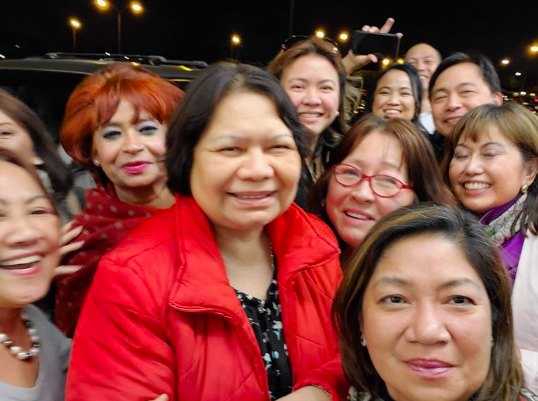
Perhaps this the case of seeing what you want to see and refuse to see what you don’t want.


I alwo wonder why instead of seeing how most of these women do not look like the artist’s imagining of Wave, this Facebook friend decides to hone in on the one that, to her, makes the point.
Filed under Field Reports, Views, WIWWAK
Potential Newbery Contenders? March Edition
Over at Heavy Medal, devoted readers have spoken and made their March Suggestions of 2020 Newbery contenders. Click on this link and see the March list. Excited about many of them. And super impressed with New Kid by Jerry Craft. Happy Reading!
Filed under Book Notes
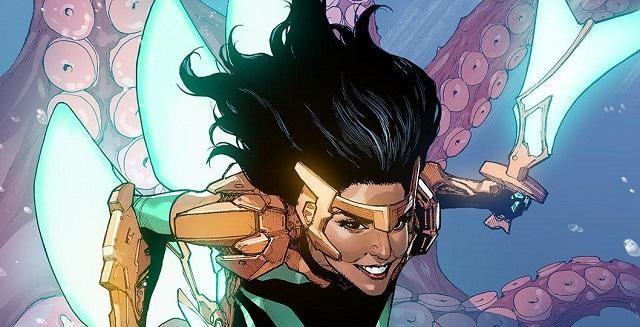
Marvel’s New Filipina Hero – WAVE (First Reaction)
(Reposting from my Facebook)
Good and Bad News at the same time?
YAY – Marvel is debuting a Filipina superhero — WAVE;
HUH? – Why does she look like a Euro-White lady with tan skin?
And the artist is Filipino…
Reported as having “identifiable Filipino “morena” skin” …. my Filipino friends — what are your thoughts?
Filed under Field Reports, Views
Critical Thinkers
Educator friends, what does it mean to cultivate critical thinkers?
A critical thinker is not a cynical thinker. Too often, we value or even praise young people for their ability to be “critical” about events or people around them, believing that being able to find faults, poke holes, or even make fun of matters are signs of their mental acuity. In fact, those are often mere manifestations of small mindedness and posturing, or even just parroting grown-ups and peers.
A critical thinker must have the patience and fortitude to gather multiple aspects of any single issue before making up their mind. A critical thinker is not quick to judge and does not belittle.
So, when we teach young people — please remember to give them plenty of opportunities and time to practice patience and broadmindedness.
Filed under Views
The Whiteness of My Profession
 Over at Heavy Medal: A Mock Newbery Blog – a commenter noticed that the nineteen Heavy Medal readers who volunteered to read and participate in discussing and choosing our 2019 Heavy Medal Award winners/honorees all identify as White. I wrote my longish response in a comment there and repeat the words here:
The predominately white Committee (with Steven, white, and myself, Asian/non-white, serving both as manager of the blog and occasional commenters starting January) simply reflects the librarian profession as a whole.
Here’s the finding from ALSC itself in 2016 via an Environmental Scan study of librarianship in the U.S. (Note, the Librarianship counts are almost 10 years old by now so hopefully the number has increased.)
“The overwhelming majority of librarians, including children’s librarians, are white women. Librarians are disproportionately white compared to the population of the United States as a
whole, as demonstrated by the “Librarians and US Population” graph that follows (Librarian data from Diversity Counts 2009-2010 Update; US population data from “Outreach Resources for Services to People of Color”). It is clear from this graph that people of color and Native/First Nations people are grossly underrepresented in the field of librarianship.” — The graph shows the following:88% of Librarians are white and 12% are non-White: 1.8% are Latino, 6% are African American, 3.8% are API, and 0.4% are multi-racial or Native American.
So, out of 21 people (including Steven, white, and Roxanne, Chinese,) we should have 2.5 persons who are “non-white” – we have 1, making it 4.7% diversity: if we only look at race. If we look at other factors, gender (5% of the profession is male, and we have 4 members identify as male, making 20% of the membership.) We also have some diversity in political views, abilities, ages, sexual orientation (openly identified or not,) professional focus, etc.
This brings me to explain an important process during the Committee formation to balance representation so Committee members look MORE like the nation and the children our professional serves than the profession itself. ALSC, through members and the Board, intentionally balances the representation of each Committee (Newbery, Caldecott, Bepre, Sibert, Notables, and many more,) through both the voting and appointment processes.
We here at Heavy Medal do not use any balancing mechanism. If no Heavy Medal Readers of Color volunteer to serve, then we have no HMAC Members of Color to participate. Do you think we should have pushed during the call for participation to encourage more readers of color to sign up for this process? I am curious to what outcome would have been then.
Last year’s Newbery Fifteen included three (counting me) Asian participants — we did not have any African, Latino, or Native American participants, either. Or could it just be very possible that we do not have many/any Readers of Color — and this is merely a parlor game for white (and Asian) children’s literature enthusiasts?
Much to think about.
Filed under Field Reports, Views
Thankful
I’m grateful these days that I work in a school where I am allowed to share my honest opinions, respectfully, with my co-workers and my students about what matters: that equity and inclusion are of supreme importance, that love and kindness are what we need to combat hatred and ignorance, and that there is hope in young people and the future.
Filed under Views
No More Laura! And the controversy begins…
Yesterday/Last Night, youth librarians, young readers authors and publishers gathered in the Hilton, New Orleans, Grand Ballroom to witness and live a historical moment. In the room that held a thousand, we united and cheered in the decision (long in coming, and long overdue) to update and change the name of the life-time achievement award administered by the Association for Library Services to Children (ALSC).
The Wilder (Laura Ingalls) Award has been given to an author or illustrator who has made, “over a period of years, a substantial and lasting contribution” to American children’s literature since 1954. In recent years, however, the name of the award has prompted the Association to examine its implication, especially when it comes to Wilder’s portrayal and sentiment about Native Americans (Indians) and Black Americans in her classic Little House series.
Read about the decision to update the name of the award to Children’s Literature Legacy Award and the divergent opinions (in comments) from the general public here:
http://www.alsc.ala.org/blog/2018/06/childrens-literature-legacy-award-alaac18/
I, for one, applaud the decision and am proud to be a part of an organization that continues to examine practices that should no longer be upheld as we honestly face the reality of this nation’s history.
Filed under Field Reports, Views
ALA Annual Conference – New Orleans
I’m volunteering to Live-Blog my ALA attending experience for ALSC. Check it out here:
Filed under Field Reports
What About White Boys? (All Children’s Lives Matter)
 I haven’t posted for a long time — but I have been thinking about both our society and the children’s books that reflect (and hopefully help shape) our society and its future.
E-V-E-R-Y S-I-N-G-L-E D-A-Y!
Here’s what I posted on Facebook this morning:
As we teach girls to say NO, we must also teach boys to RESPECT. As we teach girls to be STRONG, we must also teach boys to be KIND. As we teach black children to EXCEL, we must also teach white children to REFLECT. As we teach black children to have more self CONFIDENCE, we must also teach white children to have more INFORMED EMPATHY.
Instead of judging and blaming each other, we must teach POSITIVE INTERACTIONS AND ACTIONS between groups of people.
Heck, this is not just about children. This is about all of us.
And promptly a white male relative (in his 50s) who is informed, kind, and loving, posted that he agrees with my basic principles, but it seems so “one-sided” and that it sounds like I am blaming and judging white males.
Here’s what my response to him:
Actually, I think of it as helping white males to adjust better in a world where their past and complacent modes might no longer serve them well and let them be equal partners of a future, equal world.
If you truly examine our history and society and systems, you would see that pretty much all other groups: women, non straight, and non white people have been on the receiving end of systemic oppression: less paid for equal work, fewer rights for the same human beings, etc. I actually want Educators who have been advocating one sided to educate girls and people of color but having largely ignored giving the tools and skills to handle an increasingly demanding (and rightfully so) world.
So yes, it is one sided: for the benefit of our children and ourselves. Instead of just blaming people like Trump or Sessions or Weinstein, I want to figure out how we can successfully educate the white/male of the future to thrive and to not thrive by stepping on others’ heads. Does this make sense to you?
Indeed, I have been wondering and hoping for more books by White and Non-White authors that feature good, kind, fair, courageous, moral, wonderful WHITE male and female characters — who do not just show up as white saviors or antagonists but act like so many of my real life white friends do — stand up for what’s wrong, fight for justice, and are self-reflecting and always want to be better humans.
I often hear that children need mirrors to reflect themselves and their experiences — I say that they also need a crystal ball that can show them what they COULD become. I am worried when I started noticing that authors of children’s books seem to think that when they create wonderful children of color protagonists, they are then obligated to create white antagonists (bullies, uncaring teachers, etc.) I wonder about the image that a white young reader sees in such books — are these the only roles they can assume now? Are they being delegated to the dark side without redemption? How hopeless is that? And how dangerous!
I wish to caution writers and editors: in our zealous (much needed) pursuit to include positive characters from marginalized groups, please do not make the dangerous mistake in creating a host of negative characters from the majority group, or excluding them from positively interacting with characters from the marginalized groups.
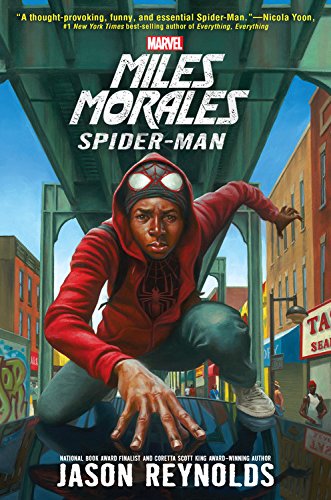
Case in point: Miles Morales features a black/hispanic hero with an Asian side-kick and a racist white teacher — is there no possibility for Miles to have close and allying white peers, friends, and mentors? Another case in point: Hello, Universe features wonderful, quirky, and ultimately lovable Filipino, Hispanic, and Asian main characters. And there is ONE white family/white child — and that ONE white family/child are bullies whose actions are most aptly described as despicable. Of course, these are but two books from thousands of children’s books published in 2017 — but they are highly touted, much recommended books, featured in Best Of the Year lists, for middle grade students. What is the telegraphed message here — and if there are more books like this frequently consumed by young readers — how would they view each other and each other’s group?
This is why I say, “Thank Goodness for Magnus Chase,” a white boy, created by a white male author, who encounters an assorted group of friends and foes — from different cultures, with different sexual orientations/gender identities, and religious beliefs. And they are judged not by the color of their skin or identity traits — but by their inner convictions. Because, let’s not forget that when Doctor Martin Luther King Jr. said, “I have a dream that my four little children will one day live in a nation where they will not be judged by the color of their skin, but by the content of their character,” he never meant that he wished his children to grow up “judgment free.” As citizens of the world and members of our own community, we must understand that the content of our character is to be examined, held accountable, and, yes, “judged” by our peers and our society. Being part of a particular culture, whether marginalized or main-stream, does not exempt anyone from having a moral conscience.
While I am completely opposing the sentiment behind the “All Lives Matter” slogan (which is a detraction and distraction from the urgent “Black Lives Matter” movement,) I must advocate that ALL CHILDREN’S LIVES MATTER.
Please look at the big picture.
Please look toward a long-term future.
Please mind the GOAL — which is to respect and treasure everyone equally, regardless of skin colors, religious beliefs, sexual orientations, genders, etc. etc. etc. In order to actually achieve this goal, we cannot trample on ANY child and their potential, positive future. We must make it possible that the children of today will become fair and compassionate adults – so we must hold up that crystal ball and motivate them with positive imageries of their potential selves.*
* Of course, I am not advocating of having no villains in books or no conflicts in stories! Just please be mindful of the trend…
Filed under Views
Kirkus Collections – Diversity in Children’s Books: A Searchable Database

Children’s book review editor at the Kirkus Review wrote an introduction to its ambitious, and hopefully highly functioning and useful database. Please read! The Collections will only grow as more books are published and added to the Database.
Public Librarians and Booksellers with Baker & Taylor accounts will be able to access the full Database. Alas, it is not available to me (school librarian using Follett, even though it owns Baker & Taylor.) *sigh*
They are also going to publish, one article a day, in October, a series of essays by authors, librarians, and scholars, expressing diverse viewpoints on the Diversity landscape of children’s literature. Can’t wait to read them all!
Filed under Field Reports
Dear White People: It Is Up to You to Undo Racism (with help and guidance from People of Color)
In early July, I attended a week-long educators workshop offered by the National Museum of African American History & Culture. (With daily access to the museum’s collections before it opened to the public!)
There were more than 30 attendees and five master teachers, with 2-3 guest speakers a day. We unpacked many topics, from the dehumanization of the African American slaves to self-reflection of what is Whiteness in the 21st century America and how as educators we must examine and incorporate true history and social justices into our curriculum.
After a particularly impactful day, with one of my New York City Independent School colleagues, Erica Corbin Rodriguez leading the workshop, I went back to the hotel and texted with a friend who was a former student and also a fellow-teacher at Dalton. He is a 24 year old white male and I have his permission to post our conversation here: I’m the white text with blue background and he’s black text with gray background.
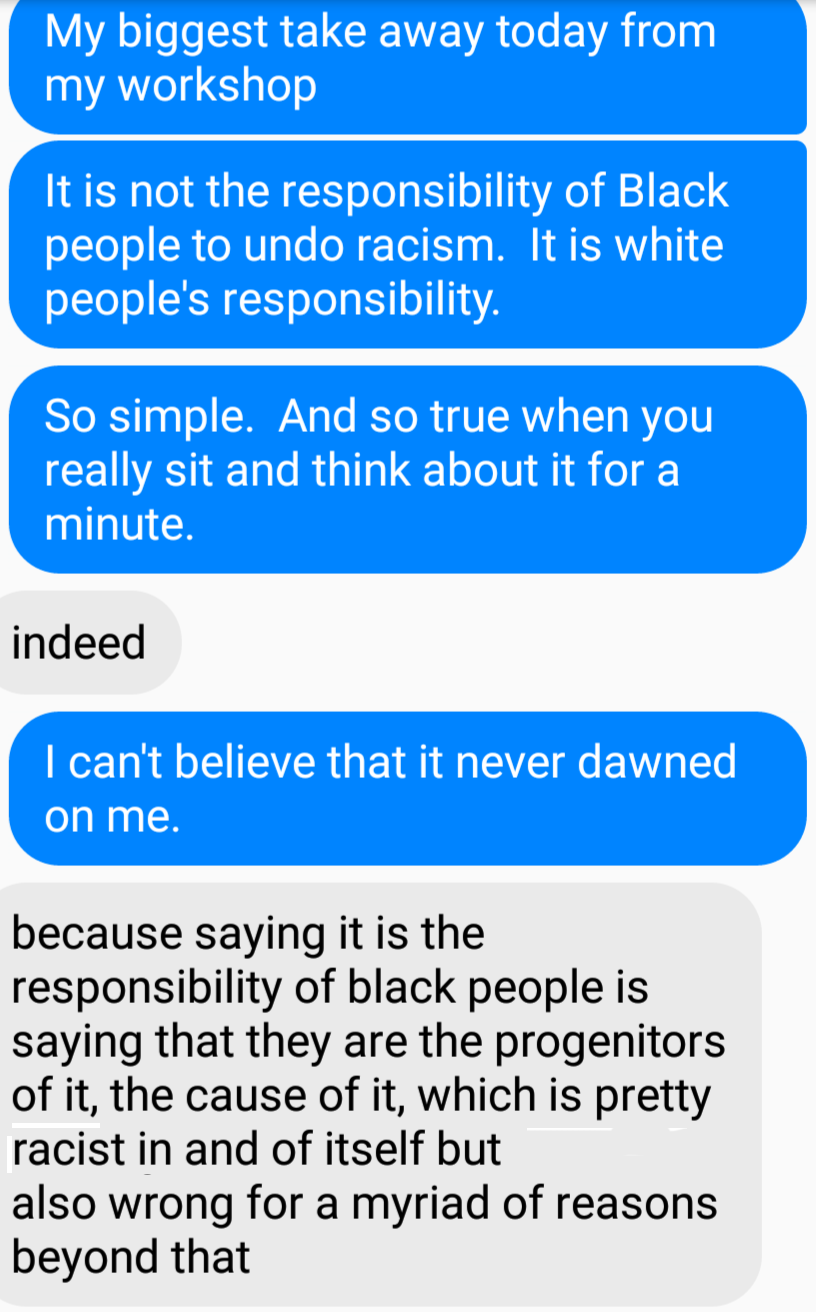
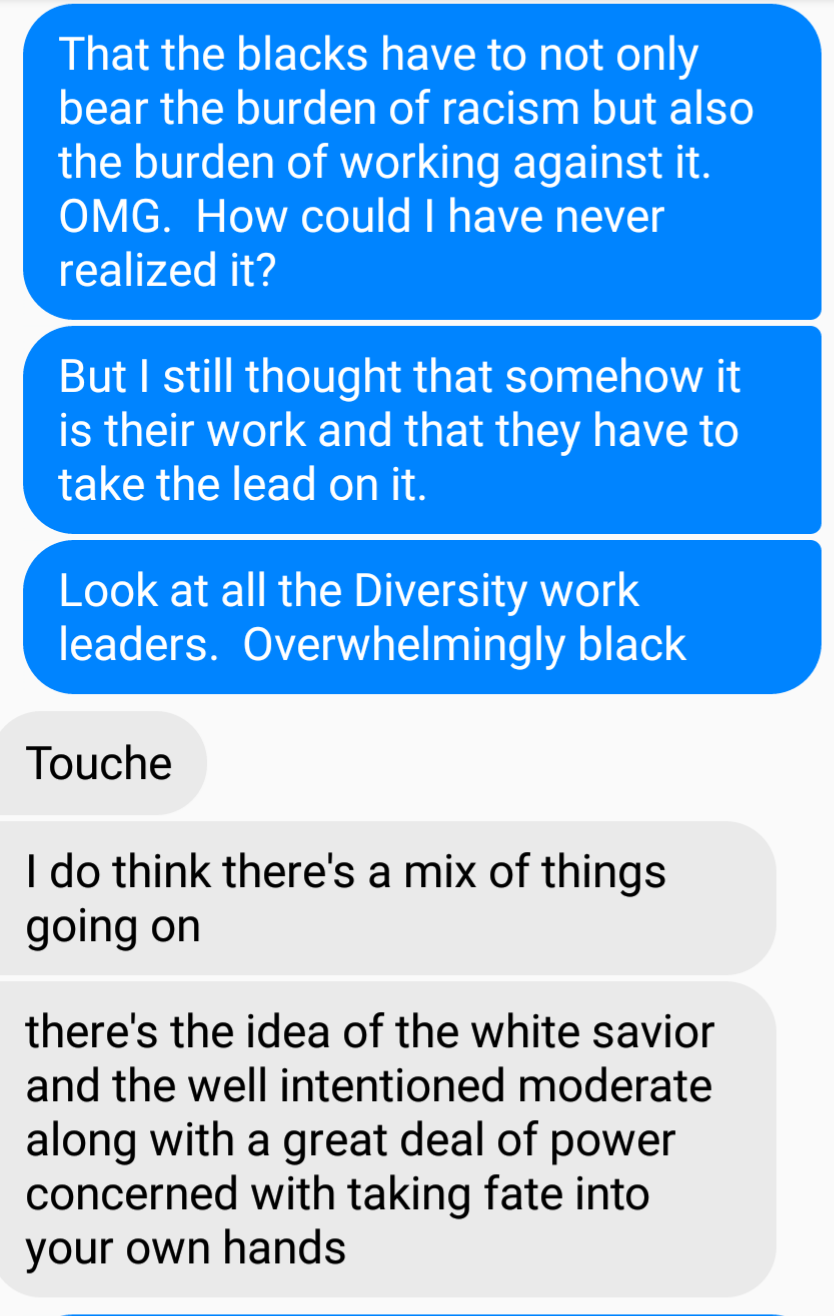
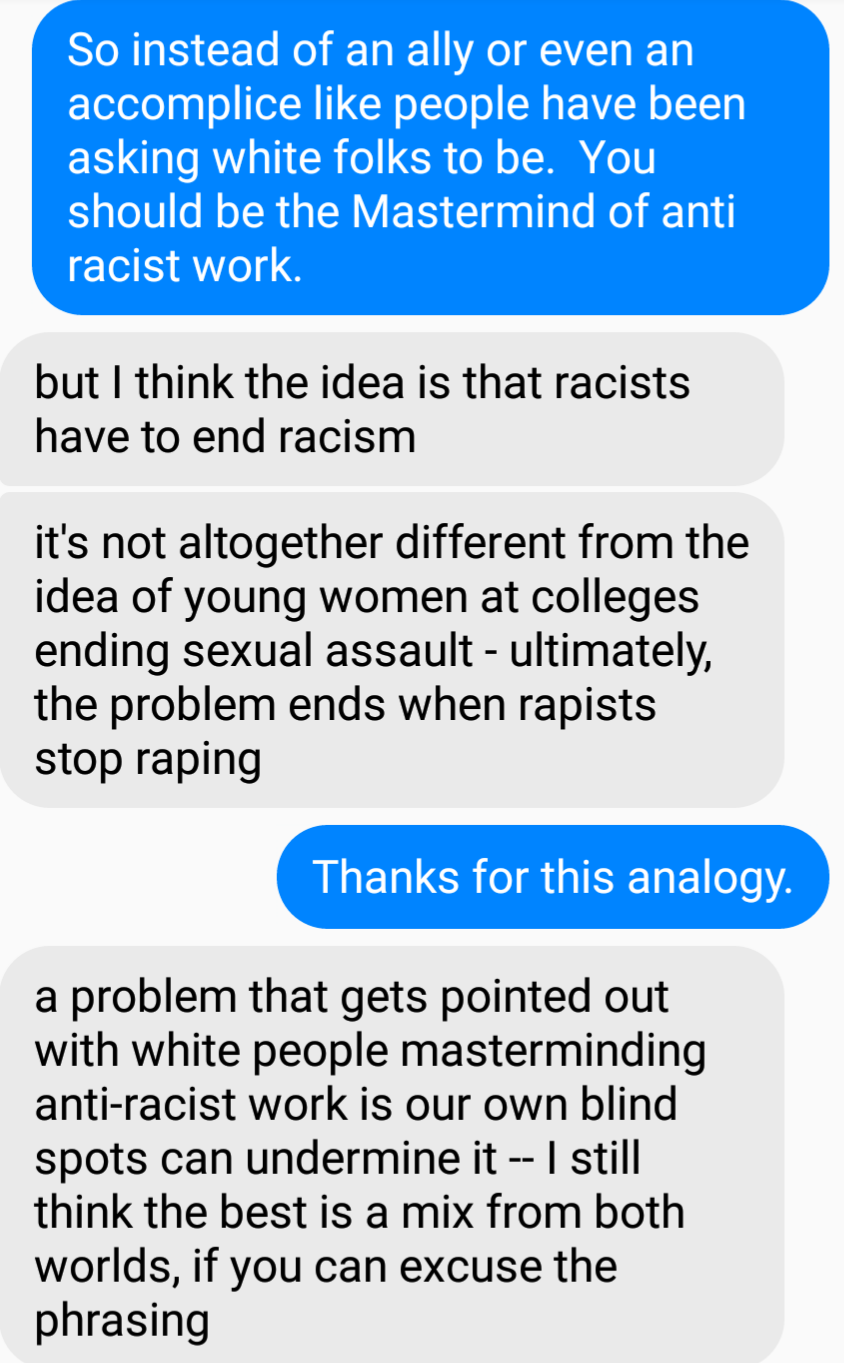
As the 2017-18 school year starts tomorrow for all our students, I am constantly reminding myself that it is my responsibility to keep social justices front and center in my curriculum and my interaction with students. This one former student is not a unique or singular case: he is one of many responsible, compassionate, and self-reflective white men and women that we hope to “unleash into the society” and make the world a more just and loving place. And just as he said, he is responsible to undo racism, more so than any person of color. He and many others will need constant dialogue and guidance — let’s work side by side to achieve our common goal: equality for all.
Filed under Field Reports, Views

