Category Archives: Book Notes

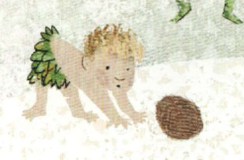
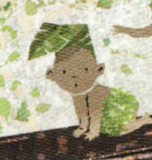
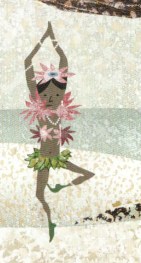
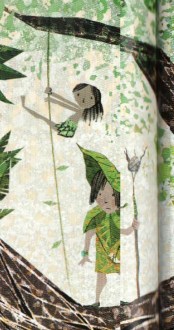
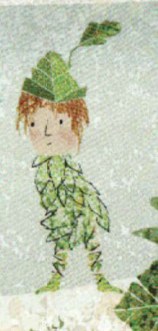
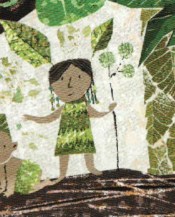
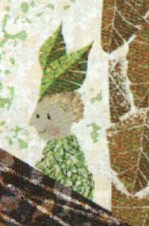
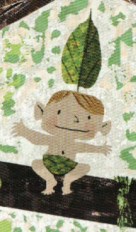
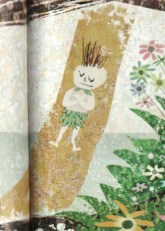
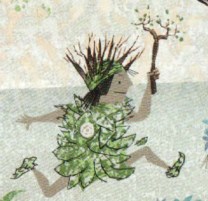
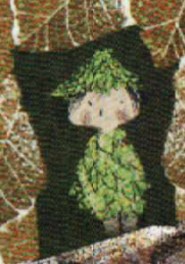
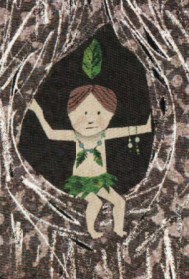
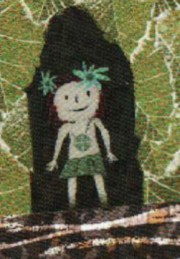
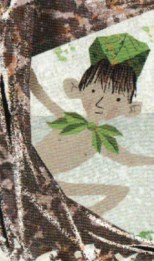
A Tribe of Kind Souls: a closer look at a double spread in Lane Smith’s There Is a TRIBE of KIDS

There Is a TRIBE of KIDS (capitalization as part of the title/design), written and illustrated by Lane Smith (Stinky Cheeseman, The Happy Hocky Family, It’s a Book, etc.), was published in May, 2016 (two months ago.)

This book has received four starred reviews from major review sources and positive reviews from others. However, the use of the word TRIBE and some of the images on a particular double-page spread toward the end of the book have sparked heated debate (in which I took part) in several online places.  A short description and link to each of these reviews (with comments) can be found at the end of this post.

I read and re-read this book many times and have considered all the reviews cited below and many additional comments sprinkled throughout the internet.  Finally, I feel that I am ready to share my own take on this book.  I must stress that this is but ONE of many potential interpretations of the book which features very few words and delivers most of its “messages” with pictures that can be differently interpreted.

By no means do I want to discount Debbie’s and others’ pain when they face certain images (that they see on the second to last double spread) which definitely trigger strong emotional reactions from past and personal experiences.  (My own triggers are seeing erroneously attributed so-called Chinese cultures or imageries and boy do those get me seeing red!)

So here it is,

Fairrosa’s Interpretation of the Double Spread in There Is a TRIBE of KIDS:

I must confess that my initial reaction to the word TRIBE in the title was a skeptical one: how would it be used in the book?  to indicate some relations to Native American cultures?  to indicate something primitive?  When I finally read through the book (many times over,) I realized that, as Debbie Reese and many reviewers pointed out, it is a play on word.  Tribe is a collective noun for a group of “young goats” (kids) and Tribe is also a collective noun for many human groups that share the same cultural, geographical, or historical experiences.  The word is still used widely.  It is used by American Indians as their official group names.  It is used by the Jewish people.  It is also used by groups who need to bond over their unique identities and experiences, such as the deaf community (as found in Tribes, a play by Nina Raine from 2015.)

In the case of this book, Lane Smith used it to indicate a very specific “kind” of human beings: children. The child protagonist, after mimicking all kinds of animals, finally found his own “tribe.”  The text is all in past tense — until the very last spread which is in present tense, proclaiming the currency and the universality of childhood.

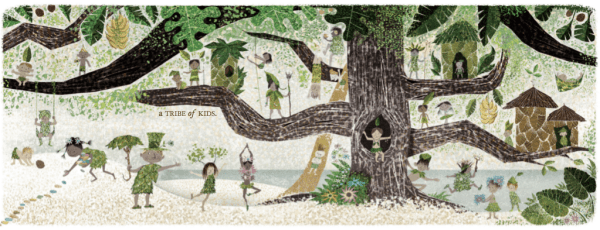
Here is my interpretation of the second to last spread accompanying the text, There was a TRIBE of KIDS (note the past tense!)
Screen Shot 2016-07-17 at 11.11.46 AM

(reproduced with permission from Roaring Brooks Press)

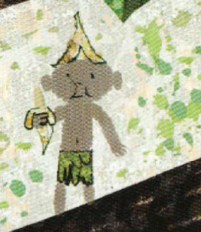
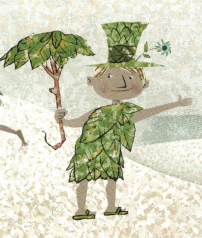
Since our child protagonist is not in this picture, so unlike the previous encounters, we don’t see him mimic or play act.  We see this child (looking a bit like Burt in Mary Poppins, doesn’t he?) welcoming the new child (our protagonist, off page, unseen) into a TRIBE.
 

tribe07

We, readers, along with the child protagonist, observe the scene with keen interest:

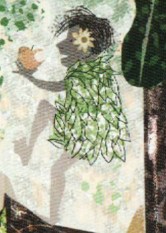
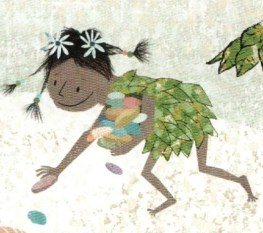
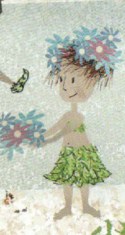
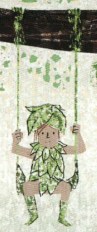
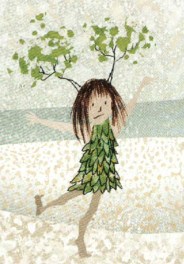
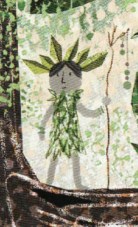
A TRIBE of kids from around the world and from both yesteryears and now, dressed much like our protagonist (in leaves, branches, and flowers,) being themselves and playing like all children might:

We watch, as they

swing, eat and play with their food,
tribe02 tribe15 tribe08

collect seashells and flowers,

tribe04 tribe25

play balls, crawl, balance, dance,
tribe03 tribe09

tribe11 tribe12

scout, explore,

tribe13 tribe26

take care of a younger sibling, 

tribe10

dress up like an adult (a princess, a king, a judge?)
tribe19  tribe20 tribe27

give a hug,

tribe01

dangle, slide,

tribe14 tribe17 tribe16

model, run (like an olympian with a torch,)
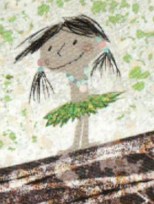
tribe23 tribe24

hide, and seek.

tribe28 tribe18

tribe22  tribe21

What I do not observe is the child protagonist attempting to mimic any of these KIDS, as if these are roaming animals. I also don’t see the “wildness” linked to a colonial sense of the word TRIBE (as stated by Minh C. Le and as troubling to others). I see children engaging in regular childlike and childhood activities.  And if I were to read this book with a young child, that’s how I would posit it — “Look, do you play hide and seek, just like these kids?  Do you pretend to be a king or a princess sometimes?  Do you play with your food?  Do you love going down the slides or sit on a swing?  This makes you part of the TRIBE of all children in the world.  You belong with each other and you accept and embrace one another.”

As I pointed out in the beginning of this post, my interpretation is different from some others’ views, including those of Minh C. Le’s, Sam Bloom’s, and Debbie Reese’s. All three wrote thought provoking reviews of this title — and I urge all to read them and take their concerns or potential hurt and mis-use of this book seriously.

Il Sung Na’s ‘The Opposite Zoo,’ and More by Minh C. Le (New York Times)
Le feels that the “juxtaposition of the word ‘tribe’ with the woodland utopia conjured uncomfortable associations,” and a particular image is problematic “in its echoes of the longstanding trope in children’s literature that uses Native imagery or ‘playing Indian’ to signify wildness.”

Reviewing While White: There Is a Tribe of Kids by Sam Bloom (Reading While White)Bloom finds himself in agreement with Le’s take on the book and ponders why all the reviewers for the major publications have given this book such favorable feedback when he sees even more images that are problematic.  He posits that perhaps it is due to Lane Smith’s long-time fame and status as a celebrated children’s book creator.  He also links to a page delineating the negative associations that the word TRIBE contains from the Teaching Tolerance site. Bloom concludes his essay by strongly indicating that he does not recommend this book. He writes, “If it wasn’t Lane Smith’s name on the front cover, could we more easily see the problems inherent in There Is a Tribe of Kids? I don’t know the answers to these questions, but I do know that this is a book that I personally won’t be sharing with (human) kids.”

Lane Smith’s new picture book: There Is a TRIBE of KIDS (plus a response to Rosanne Parry) by Debbie Reese (American Indians in Children’s Literature)
Reese details the picture book and focuses first on the word play and the repeated pattern of a child going through the natural world, mimicking behaviors of groups of animals, while garbed in leaves.  Reese then moves on to discuss the double spread that features a TRIBE of KIDS (children) and the specific images she finds objectionable.  She also delineates many counter-points to Rosanne Parry’s review of the book.  Reese uses words like “rolling your eyes” and “grinding your teeth” to express how irate she is with Parry’s proposed interpretation of the book’s images.

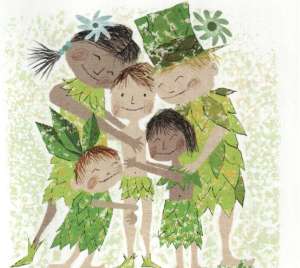
Rosanne Parry also wrote a blog post in response to Sam’s post: A Tribe of Book Reviewers (Writing in the Rain Blog). Parry writes to share her interpretation of this book and her disagreement with Sam’s take on the book as a reinforced negative portrayal of children “playing Indian.” Parry’s take on this book is in accordance with reviewers who see that there are multiple cultures represented in the book and that the book’s focus is on the importance of a sense of belonging and the warmth of acceptance in every child’s life, regardless of their origins or skin tones.  The final “snapshot” seems to encapsulate this sentiment — the kids of pale and dark skin tones locked in a friendly embrace to show their kinship and solidarity:tribehug
For those interested, here are links to all four starred reviews:
 

5 Comments

Filed under Book Notes, Views

Boston Globe-Horn Book Awards, 2016

The winners and honor titles are now public!!!  Watch the video announcement here!


Fiction/Poetry

Winner

The Lie Tree
by Frances Hardinge

Honor

The Hired Girl by Laura Amy Schlitz
Goodbye Stranger by Rebecca Stead

Picture Books

Winner

Jazz Day: The Making of a Famous Photograph by Roxane Orgill, illustrated by Francis Vallejo

Honor

One Day, The End.: Short, Very Short, Shorter-Than-Ever Stories by Kai Dotlich, illustrated by Fred Koehler
Thunder Boy Jr. by Sherman Alexie, illustrated by Yuyi Morales

Nonfiction

Winner

Most Dangerous: Daniel Ellsberg and the Secret History of the Vietnam War by Steve Sheinkin

Honor

Symphony for the City of the Dead: Dmitri Shostakovich and the Siege of Leningrad by M.T. Anderson

Voice of Freedom: Fannie Lou Hamer by Carole Boston Weatherford, illustrated by Ekua Holmes

Having read a host of titles this year, I can vouch for the excellence and brilliance of each and every one of our final selected titles. I couldn’t have been prouder or more grateful to having served on this committee. Hope more readers will discover/rediscover these books!

Below are many other titles that I would also highly recommend to readers, by categories:

Fiction/Poetry:

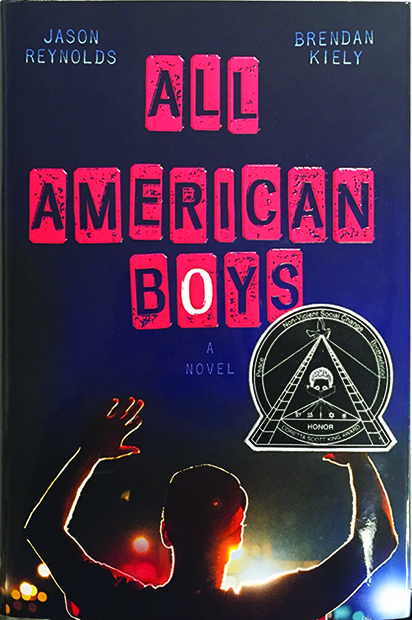
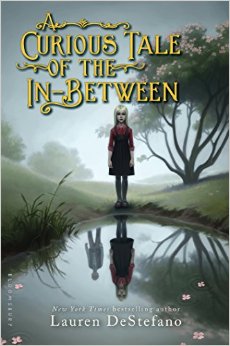
whengreenbecoomestomatoes allamericanboyscurioustaleoftheinbetween

Bardugo, Leigh: Six of Crows
Brown, Peter: The Wild Robot
DeStefano, Lauren: A Curious Tale of the In-Between
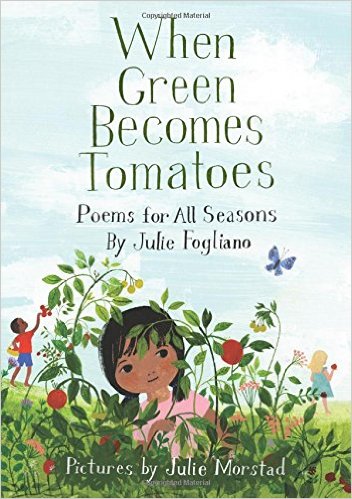
Fogliano, Julie: When Green Becomes Tomatoes
Lu, Marie: Rose Society
Nelson, Marilyn: My Seneca Village
Oppel, Kenneth: The Nest
Reynolds, Jason & Brendan Kiely: All American Boys
Riordan, Rick: Sword of Summer
Rundell, Katherine: Wolf Wilder
Savit, Gavriel: Anna and the Swallow Man
Selznick, Brian: Marvels
Sepetys, Ruta: Salt to the Sea

Picture Books:

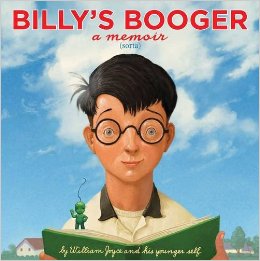
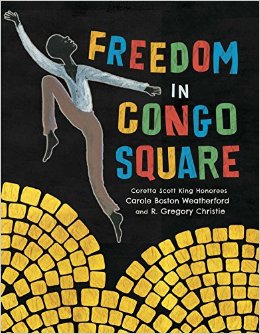
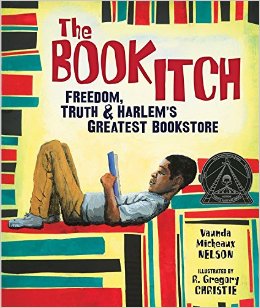
billysboogerfreedomincongosquare bookitch

Atinuke: Double Trouble for Anna Hibiscus!
Barnett, Mac: Leo: A Ghost Story
Buitrago, Jairo: Two White Rabbits
Daywalt, Drew: The Day the Crayons Came Home
Fan, Terry & Eric Fan: The Night Gardener
Goodrich, Carter: We Forgot Brock
Henkes, Kevin: Waiting
Hurley, Jorey: Hop
Jenkins, Emily: Toys Meet Snow
Joyce, William: Billy’s Booger
Light, Steve: Swap
Miyakoshi, Akiko: The Tea Party in the Woods
Miyares, Daniel: Float
Nelson, Vaunda: The Book Itch
Park, Linda Su: Yaks Yak
Smith, Lane: There Is a Tribe of Kids
Stead, Philip C: Ideas Are All Around
Tate, Don: Poet
Weatherford, Carole Boston: Freedom in Congo Square
Yoon, Salina: Be A Friend


Nonfiction:

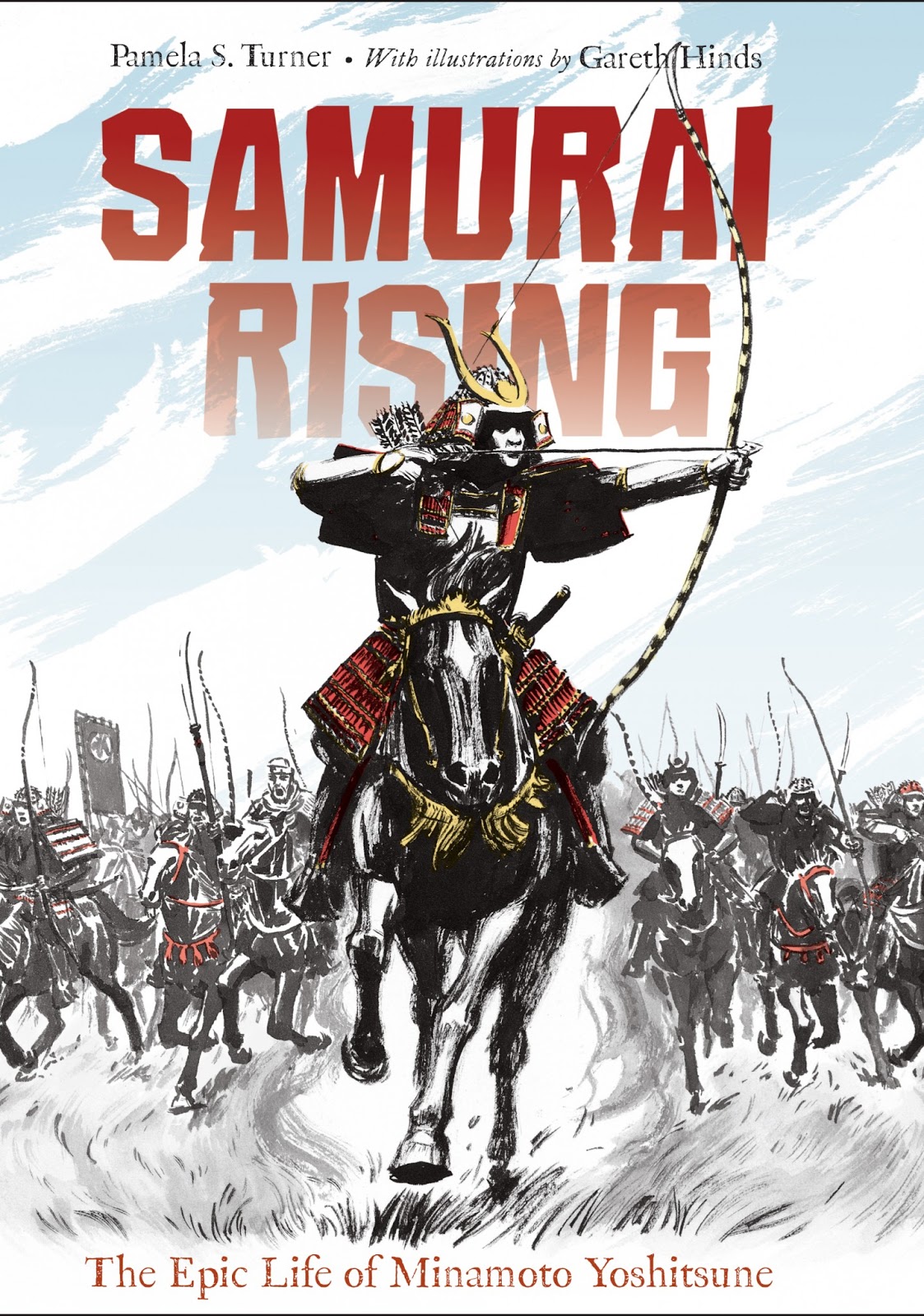
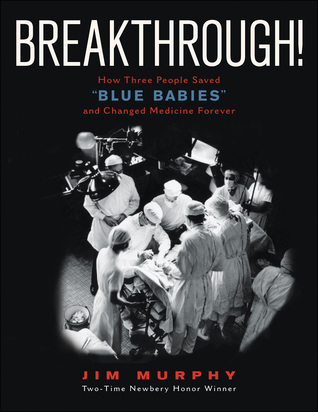
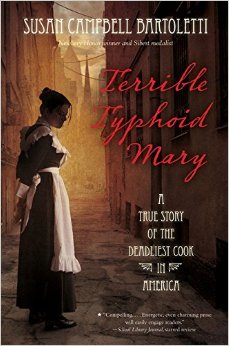
samurairising breakthrough terribletyphoidmary

Bartoletti, Susan Campbell: Terrible Typhoid Mary
Brown, Don: Drowned City
Engle, Margarita: Enchanted Air: Two Cultures, Two Wings: A Memoir
Freedman, Russell: We Will Not Be Silent
Hendrix, John: The Miracle Man
Murphy, Jim: Breakthrough
Pinkney, Andrea Davis: Rhythm Ride
Samanci, Ozge: Dare to Disappoint: Growing Up in Turkey
Silverberg, Cory: Sex is a Funny Word
Tonatiuh, Duncan: Funny Bones
Turner, Pamela S.: Samurai Rising: The Epic Life of Minamoto Yoshitsune


4 Comments

Filed under Book Notes, Field Reports

Last Day of Asian Pacific American Heritage Month

It is the last day of the 2016 APA Heritage Month — but it will not be the last time I write about media representation of Asian Americans or about the importance of respect, integrity, diligence, compassion, empathy, knowledge, open-mindedness, inclusion, and collaboration in regards to improving accurate and nuanced representations.

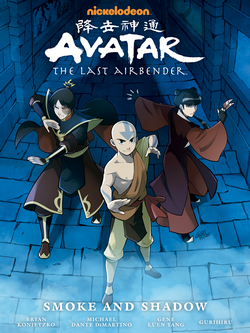
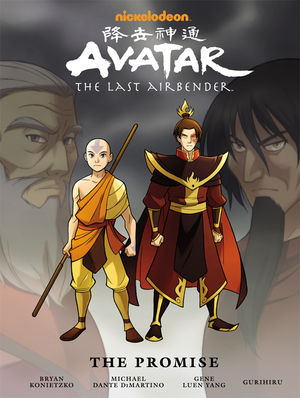
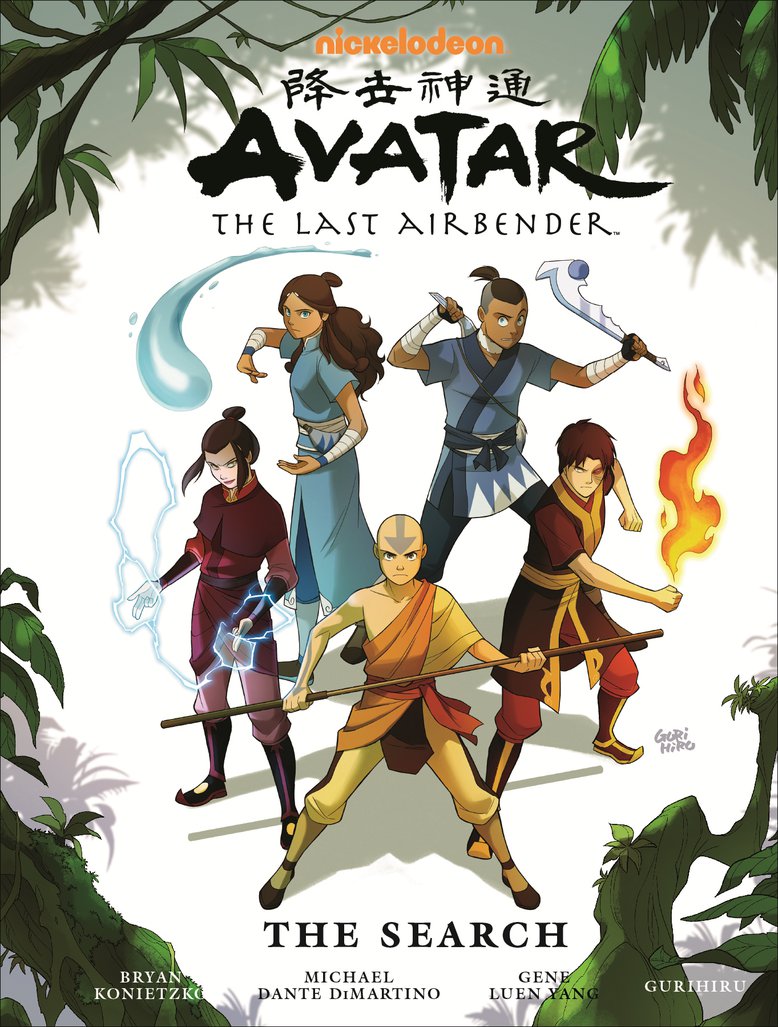
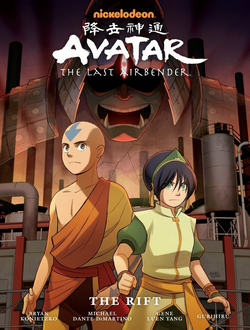
Smoke_and_Shadow_hardcoverToday, I want play an upbeat note and share my adoration to the wonderful Avatar: The Last Airbender series penned by Gene Luen Yang. Currently there are four completed stories, each told in three paperback volumes and also collected in a library binding oversize single volume.  They are: The Promise, The Search, The Rift, and Smoke and Shadow.  Of course, for fans of the Nickelodeon TV show like me, these stories are like lush oases in the parched void left by the ending of the original series.  We get to see Aang and his gang grow up a bit, deal with more complex issues, and find out answers to some questions left unresolved by the show!

avatarthepromiseHowever, I have also observed many young readers encounter these as stand alone series and thoroughly enjoy the adventures, character relationships, humor, and the conflicts.  This is a series that could easily err on the side of “appropriation” because it definitely mimicked the Japanese anime style and the several nations’ customs and philosophies or even “national traits” are loosely and (one might argue) stereotypically based on certain Asian cultures — another potentially incendiary aspect of the show.

avatar___the_search_hard_cover_by_antomori-d6pbo7vInstead, it is accepted and even embraced as appreciation and celebration by viewers from all racial backgrounds, including many Asian Americans — one of the super fans is Gene Luen Yang.

Many factors contributed to why the show worked in building and not destroying positive representations: characters are deftly portrayed as individuals, whether they’re from a specific culture or not, the show creators are always careful when cultural details are represented — all Chinese characters and sentences are correctly written out and composed, and the relationships between characters and nations are complex and nuanced.  Not to mention the artistic rendering of the images and the exciting plot progression through the 61 episodes!

The_Rift_hardcoverThe book series written (not illustrated) by Gene Yang, published by Dark Horse, are equally, if not more, complex, thrilling, and satisfying! Please read them, share them with people in your life, young or not so young, and celebrate everything that works well in these volumes!

For those interested, there are some great questions and answers about the creation of the TV show and the outcry against the casting of the 2009 life action movie based on the show at racebending.com.

Leave a comment

Filed under Book Notes, Views

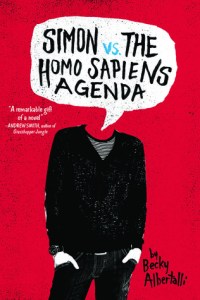
Simon vs The Homo Sapiens Agenda

Ssimonvshomosapiensimon vs. The Homo Sapiens Agenda
by Becky Albertalli

Listening to this book was a bit like watching a John Hughes movie… actually, it was a lot like watching a John Hughes movie. It is kind of sweet, there might be some heart-breaking moments, some misunderstandings, some bullying, but definitely a lot of friendship, quite a bit of sweet-loving, and totally easy to get hooked on and want to know more and want everything to work out at the end — and boy did EVERYTHING get worked out! Mostly believably so but definitely veering toward the hyper-optimistic end of possibilities: which, we all need from time to time!

I was a little sad that once Simon & “Blue” met up in real life, the author pretty much stopped giving us their exchanges of ideas: no more interesting emails to read of their views on the world around them or the quirky questions and answers. In the last part of the book, the readers are left with just observing their physical (sweet) contacts and first explorations: as if all those emails were just a precursor to what REALLY matters: kissing and other physical relationships…  It would have been more fulfilling an emotional journey for me as a reader if both physical and intellectual aspects of their relationship had been more equally represented during the last part of the story.

(And a potential quibble: I am still baffled why the characters refer to Tumblr as “the Tumblr” — was it that the author does not understand the teen-lingo these days or that it is THAT specific Tumblr page reserved for the kids in that particular town/high school — thus the article?)

Leave a comment

Filed under Book Notes

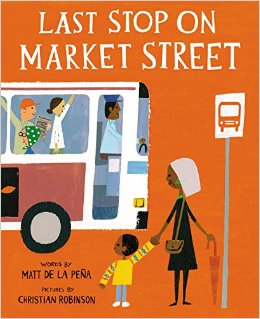
A Picture Book for Newbery! Last Stop on Market Street

laststoponmarketstreetLast Stop on Market Street by Matt De La Peña

Illustrated by Christian Robinson

I jumped up and down when this book was announced at the Youth Media Awards press conference — after the initial “WHAT? Really?  A picture book text?” Then, it was, “YAY!  Finally.  A real picture book has won the Newbery!”  Great job.  Committee!

However, it was not until today, when I finally re-read the text, blocking out all the illustrations, just paying attention to the rhythm, the word choices, the imagery, the heart and soul of this seemingly simple text for the very young that I realized how marvelous a choice this book is for the award.

By recognizing the text, which allows for so much imagination and chances of deep discussions, especially literary ones, the Newbery Committee has affirmed the significant value of finely crafted text for young children.  I can still recite many passages from Margaret Wise Brown’s The Important Book because I read that book to my daughter when she was still in her crib.  Every night, for months, and no matter how many times I read it aloud, I found myself admiring the genius writing page after page.  I am quite certain that the reason my daughter appreciates poetry and what she calls “good writing” in the adult books she reads now that she’s 16 is her wide exposure to excellent texts like The Important Book,  So Said the Little Monkeys, Chicka Chicka Boom Boom, Madeline, and many others.

I am ordering copies of Last Stop on Market Street for my Middle School Library and will encourage middle grade teachers to use the book to inspire students to interpret the text as they envision in their mind.  CJ could be anyone.  Nana could be anyone’s grandma.  The boys on the bus with something CJ envies do not have to share ear-buds on their iPod and the imagery of the large tree “drinking through a straw” was never depicted literally in the illustration anyway.  The students in a language arts class will simply bask in the glory of the text like “The outside air smelled like freedom,” and “rain, which freckled CJ’s shirt” and have a rigorous mental workout to understand the implied interactions and emotions.

And ample discussion opportunities for the ending, when Nana does not give her usual deep laugh… now what is that all about?

De La Peña sure wrote a distinguished book!

Leave a comment

Filed under Book Notes

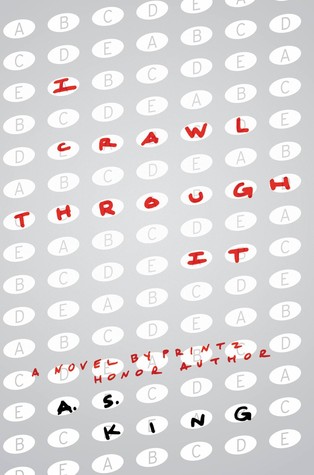
I Crawl Through It by A.S. King

icrawlthroughitI Crawl Through It by A.S. King

It was an intriguing and entertaining read — although using the word “entertaining” to describe my reading experience with a book dealing with mental illnesses, abuse, and traumatic events in teens feels a little crass. Nonetheless, I felt that King, as a writer, really revels in designing and playing “games” with her readers.  Mind games, for sure!

Do we really know what actually happened to each of the four main characters?  What’s with the man behind the bush?  What’s with the invisible (or real?) helicopter?  Nothing was really certain — not during and not after reading the book.  And I’m quite alright with that much ambiguity — I only wish that I had liked and/or could have felt more empathetic toward any of the characters.  Because of the stylistic choice and the hyper-reality setting, the main characters all seem to be more guinea pigs in a giant game of maze on stage, masterminded and controlled by the author for the amusement and perhaps even edification of the audience.  Even the cover design with the standardized test answering sheet reminds me of some sort of “whack a mole” holes in an arcade…

Anyway — to sum up — I admired the workmanship and enjoyed the weirdness but never quite got caught up enough to care about any of the characters or how “the story” was going to end.

Leave a comment

Filed under Book Notes

Here by Richard McGuire

hereHere by Richard McGuire

I really love the premise: taking one fixed spot on earth, examining the many years of lives (from prehistoric to contemporary) and living by visually presenting the slices in time: one might see a Native American couple making love and a modern American, white family squabbling on the same or adjacent or consecutive pages, all “cut up” and scrambled, seemingly not following rhyme or reason.  But, of course, there are certain patterns and events clustered by the nature of the happening (holiday celebrations, fighting, loss, new births, etc.)  However, aside from admiring the beautiful and pristine, almost too clinical, artwork and having some moments of revelation (finding out on what ground the current house was built, for example,) I was left not all that impressed or emotionally affected which I definitely was hoping for!


Leave a comment

Filed under Book Notes

The Nest by Kenneth Oppel

The Nest by Kenneth Oppelthenest

If any book should be called Unsettling and Disturbing, this one is a prime candidate.  The last third of the tale got not only extremely dark and dangerous, it is also filled with vividly described, horror film worthy scenes and imageries.  Expertly done.  I probably would have truly loved the entire book if I wasn’t taken out of the narrative flow a number of times when Steve uses highly literary words and phrases that I thought uncharacteristically older than the character’s age and not quite in keeping with the rest of the tone of the very straightforward and effective telling.  I was hoping and fearing a truly dark ending and was slightly disappointed (because of the very twisted-minded adult reader in me) and very relieved and pleased that there’s some hope and a lot of growth for both the hero and the reader. And what a complex and admirable hero we have in Steve!

Leave a comment

Filed under Book Notes

Sunday Select, December 13, 2015

FCLSSQuote of the Week

But in our digital conversion of media (perhaps buttressed by application of the popular KonMari method of decluttering), physical objects have been expunged at a cost. Aside from the disappearance of record crates and CD towers, the loss of print books and periodicals can have significant repercussions on children’s intellectual development.

Perhaps the strongest case for a household full of print books came from a 2014 study published in the sociology journal Social Forces. Researchers measured the impact of the size of home libraries on the reading level of 15-year-old students across 42 nations, controlling for wealth, parents’ education and occupations, gender and the country’s gross national product.

After G.N.P., the quantity of books in one’s home was the most important predictor of reading performance. The greatest effect was seen in libraries of about 100 books, which resulted in approximately 1.5 extra years of grade-level reading performance. (Diminishing returns kick in at about 500 books, which is the equivalent of about 2.2 extra years of education.)


— by Teddy Wayne
from Our (Bare) Shelves, Our Selves
The New York Times

We Need Books

Our (Bare) Shelves, Our Selves by Teddy Wayne – from The New York Times

NATIVE VOICES ROUNDTABLE PART 1: SHARING STORIES & TALKING BACK (PART 1 OF 2)  — from We Need Diverse Books

NATIVE VOICES ROUNDTABLE: SHARING STORIES & TALKING BACK (PART 2 OF 2)  — from We Need Diverse Books

Children’s Authors Share Their Favorite Childhood Books Compiled by Diane Roback — from Publishers Weekly

Horn Book Fanfare 2015  — from The Horn Book Magazine

How Kwame Alexander Gets Teens Reading and Writing Poetry — from School Library Journal

WSJ’s Best Books of 2015  — from Wall Street Journal

In the Works: SLJ’s Battle of the Kids’ Books 2016 Edition by Monida Edinger — from Educating Alice

We Need Ideas and Opinions

An American Refrain by Libba Bray – from Libba Bray’s Blog

Novelists team up for teen book on race and police by James Sullivan — from The Boston Globe

THE N-WORD AND MY DAUGHTER by Martha Haakmat — from Raising Race Conscious Children

I gathered these entries from various sources such as Facebook, Twitter, Goodreads, and specific sites that I follow such as Educating Alice, Pub Peeps, Book Riot, School Library Journal, The Horn Book, We Need Diverse Books, etc.

Leave a comment

Filed under Book Notes, Views

Sunday Select, December 6, 2015

FCLSS

End-of-Year Best/Award Lists Round Up

Some lists were already announced and included in other issues of FCL Sunday Select.  They are not repeated here.  It is always of interest to note the varied opinions from different venues: booksellers vs professional review publications vs popular review platforms.

SLJ’s Best of 2015: Books, Apps, and More — from The School Library Journal

Notable Children’s Books of 2015 — from The New York Times (Sunday Book Review)

2016 Morris Award Finalists — from The Amercian Library Association

The Best Books of 2015 — from The Boston Globe

Editors’ Picks: Books for Children and Teens — from Amazon.com

Goodreads Choice Award 2015 — from Goodreads.com

The Best Children’s Books of the Year, 2015 Edition — from The Children’s Book Committee at Bank Street College of Education

Best Children’s Books of 2015 — from The Washington Post

Best Children’s Books of 2015 — from The Guardian

Best Children’s and Teen Books of 2015 — from BookPage.com


Leave a comment

Filed under Book Notes, Field Reports

Sunday Select, November 29, 2015

FCLSS

Quote of the Week

I can’t change the color of my skin or where I come from or what the teacher workforce looks like at this moment, but I can change the way I teach. So I am going to soapbox about something after all. Be the teacher your children of color deserve. In fact, even if you don’t teach children of color, be the teacher America’s children of color deserve, because we, the teachers, are responsible for instilling empathy and understanding in the hearts of all kids. We are responsible for the future of this country.

So teach the texts that paint all the beautiful faces of our children and tell the stories of struggle and victory our nation has faced. Speak openly and freely about the challenges that are taking place in our country at this very moment. Talk about the racial and class stereotypes plaguing our streets, our states, our society. You may agree that black and brown lives matter, but how often do you explore what matters to those lives in your classroom?

— words from a speech by Emily E. Smith
as reported by Valerie Strauss
 “Teacher: A student told me I ‘couldn’t understand because I was a white lady.’ Here’s what I did then.’”
 for The Washington Post

Thanksgiving Weekend — A Single Highlighted Selection

Teacher: A student told me I ‘couldn’t understand because I was a white lady.’ Here’s what I did then by Valerie Strauss — from The Washington Post

Leave a comment

Filed under Book Notes, Field Reports, Views, WIWWAK

Sunday Select, November 1, 2015

FCLSS

Quote of the Week

It was interesting to hear my White students say that they think that books do a good job of representing diverse characters. My students of color at this time did not say anything. I did not add to the conversation and I ended the conversation at this point.

…….

It was eye opening to my students. My White students seemed surprised by what my students of color were sharing. I then wrapped up our conversation saying that history and books often overlook certain groups of people and that this year we will be learning about many points of view.

— by Sarah Halter Hahesy
 “Transparency About the Lack of Racial Diversity in Children’s Books”
 from Raising Race Conscious Children

Viewpoints & Practical Suggestions

Transparency About the Lack of Racial Diversity in Children’s Books by Sarah Halter Hahesy — from Raising Race Conscious Children

Supplement Materials to Top Ten Things You Need to Know About Children’s/YA Publishing in 2015 by Harold Underdown — from The Purple Crayon

YA Authors Talk Social Media, Research Process…and Spill Secrets by Mahnaz Dar — from School Library Journal

‘Tis The Season (to contemplate on best books for young readers)

Calling Caldecott (for potential Caldecott Contenders) moderated by the Horn Book staff  — from The Horn Book Magazine

Heavy Medal moderated by Jonathan Hunt & Nina Lindsay (for potential Newbery Contenders) — from The School Library Journal

Someday My Printz Will Come (for potential Printz Contenders) moderated by Karyn Silverman, Sarah Couri, and Joy Piedmont — from The School Library Journal

The National Book Award Winners 2015  — from The National Book Foundation

CYBILS Awards — from CYBILS

I gathered these entries from various sources such as Facebook, Twitter, Goodreads, and specific sites that I follow such as Educating Alice, Pub Peeps, Book Riot, School Library Journal, The Horn Book, We Need Diverse Books, American Indians in Children’s literature, etc.

Leave a comment

Filed under Book Notes, Field Reports, Views, WIWWAK

Sunday Select, November 15, 2015

FCLSS

Quote of the Week

While the burden of mistakes can be placed on the author and illustrator, in truth publishers share an equal part of the responsibility in making sure that the books they produce are accurate and do not reinforce harmful stereotypes.

— by Jason Low, publisher of Lee & Low Books
 “Is Staff Training Worth It?‘”
 from The Open Book

The Most Important Industry News of the Week

This week, I am featuring only ONE industry news link here, because I don’t want to dilute its significance.  Hopefully, we’ll start hearing from other publishers, large and small, that take their staff on this worthwhile journey.  As an educator who partook in similar trainings in recent years, I have to say that I believe everyone in the United States should have the experience of going through such tough journeys: self-examining, questioning, and re-affirming ideologies that will help create a more equitable society for our own future.

Is Staff Training Worth It? by Jason Low — from The Open Book (Lee & Low Books Blog)

Authors, Books, & Book Lists

A Conversation With Philip Pullman by Katy Waldman — from The Slate: Book Review

APALA Author Interview – Gene Luen Yang by by Jaena Rae Cabrera — from APALA (Asian Pacific American Library Association)

Pep Talk from Neil Gaiman by Neil Gaiman– from National Novel Writing Month

The Little Black Fish and other stories: Iranian illustrated children’s books – in pictures by David Almond and Saeed Kamali Dehghan — from The Guardian

Thinking About Thanksgiving by Nina Lindsay  — from Reading While White

Family Ties  by Elissa Gershowitz — from The Horn Book Magazine

OPL 2015 Holiday Gift Guide–Children’s Books by Amy Martin — from Oakland Public Library

I gathered these entries from various sources such as Facebook, Twitter, Goodreads, and specific sites that I follow such as Educating Alice, Pub Peeps, Book Riot, School Library Journal, The Horn Book, We Need Diverse Books, American Indians in Children’s literature, etc.

Leave a comment

Filed under Book Notes, Field Reports, Views, WIWWAK

Sunday Select, November 8, 2015

FCLSS

Quote of the Week

Updated — I have now included also the entire Panel discussion — which Sean Qualls & Sophie Blackall also shared their views.  They all do not agree with each other.

Around 26:00 — Sophie Blackall talked in details about her own reactions toward the controversy over her book A Fine Dessert; 35:00 – Sean Qualls starts talking; 38:00-ish, he touches briefly on A Fine Dessert; keep watching and you’ll hear Susannah’s views as well.

— Daniel Jose Older
 “Daniel José Older on A Fine Dessert”

A Fine Dessert – Multiple Conversations

Collected below are various online articles, conversations, and comments about the picture book A Fine Dessert written by Emily Jenkins, illustrated by Sophie Blackall, published by Schwartz & Wade, an imprint at Random House.  The book has been under careful scrutiny by many – when it was highlighted as one of the Caldecott hopefuls, when it was among the 10 illustrated books of 2015 chosen by The New York Times, and when it received objections by readers who found certain text and images hurtful.  I did not read or look at the book until this past Monday, after many others already grappled with the book for a while.  The conversations are important to note and should continue, not only about one book, but about the entire Children’s Publishing industry.  More on that from my own viewpoint is forthcoming.  Since Debbie Reese has been diligently documenting and collecting all the pertinent links.  I’m providing only ONE link here in this section.  Do read as much as you can and consider and re-consider!

Not recommended: A FINE DESSERT by Emily Jenkins and Sophie Blackall by Debbie Reese — from American Indian in Children’s Literature

Books & Awards

The Scholastic Picture Book Award 2015 Winners  — from Scholastic Book Award/Asia

SIMMONS COLLEGE AND LEE & LOW BOOKS ESTABLISH NEW SCHOLARSHIP   — from Lee & Low Books

An Interview with Kate DiCamillo — from The Horn Book Magazine

Please don’t air brush African teen fiction by Ellen Banda-Aaku — from The Guardian

‘Monstress’: Inside The Fantasy Comic About Race, Feminism And The Monster Within by Graeme McMillan — from The Hollywood Reporter

I gathered these entries from various sources such as Facebook, Twitter, Goodreads, and specific sites that I follow such as Educating Alice, Pub Peeps, Book Riot, School Library Journal, The Horn Book, We Need Diverse Books, American Indians in Children’s literature, etc.

Leave a comment

Filed under Book Notes, Field Reports, Views, WIWWAK

Sunday Select, November 1, 2015

FCLSS

Quote of the Week

Africa is not rich or poor, educated or illiterate, progressive or archaic.

What Africa is depends on which part of it you are referring to.

No single story can adequately reflect that, but a multiplicity of stories can and should broaden our received wisdom about the continent.

With more platforms and opportunities than ever before, there has never been a better time to challenge that confusing and costly concept of a single African story.

— by Nancy Kacungira
 “Why I cannot tell ‘the African story’”
 from BBC News

Viewpoints

Why I Cannot Tell ‘The African Story’ by Nancy Kacungira — from BBC News

Science Has Great News for People Who Read Actual Books by Rachel Grate — from Arts.Mic

You Have to Read the Book by Elizabeth Bird and the Comments section by many — from Fuse8 Production

We Are Not Rainbow Sprinkles by Roger Sutton and the Comments — from The Horn Book

Book Lists & Awards

WE NEED DIVERSE BOOKS™ ANNOUNCES INAUGURAL WALTER DEAN MYERS GRANT RECIPIENTS  — from weneeddiversebooks.org

PW’s Best Books 2015  — from Publishers Weekly

The New York Times Best Illustrated Children’s Books of 2015 — from The New York Times

I gathered these entries from various sources such as Facebook, Twitter, Goodreads, and specific sites that I follow such as Educating Alice, Pub Peeps, Book Riot, School Library Journal, The Horn Book, We Need Diverse Books, American Indians in Children’s literature, etc.

Leave a comment

Filed under Book Notes, Field Reports, Views, WIWWAK

Sunday Select, October 25, 2015

FCLSS

Quote of the Week

Those words nearly broke my heart. I could have sobbed in the convention hall. Instead, I swallowed them as a reminder that I need to do a better job, too. That I’ll always need to do a better job. That there is no arrival point. I’ll never arrive at some point where I’m outside the system of systemic racism—I’ll always be in it, and because I am, I have to do the best job possible calling people into the conversation that recognizes it, in order to do the work to try to deconstruct it. I’ll always need to do a better job “calling people in” rather than “calling people out.”

— by Brendan Kiely
 “The White Boy in the Third Row”
 from Reading While White

Opposing Viewpoints (Do They Have to Be?)

These past couple of weeks we saw sparks flying with opposing views over specific children’s books and general thoughts on children’s book publishing – mostly centered on the “writing the other” notion.  It seems to me that many practitioners (authors, librarians, critics, etc.) have been thinking hard and deeply and some have tried to sort out strongly held convictions when they clash against others’ beliefs.  Selected here are a few strands that I found especially powerful and am currently struggling with.  I lead the list with one article by Brendan Kiely, whose proposal for “calling people in” to the conversation and discussion on diversity issues in children’s and YA literature seems most sage and hopefully can serve as a reminder that we are ALL in this together and our final goals are to provide the best literary work for the young people in our world.

The White Boy in the Third Row by Brendan Kiely — from Reading While White

This Book Is Creating A Space For Queer Black Boys In Children’s Literature by JamesMichael Nichols — from Huffpost Gay Voices

About Meg Rosoff’s next book… a collection of links to various responses to a following facebook blow-up while discussing Large Fears, the book under discussion in “This Book is Creating a Space for Queer Black Boys in Children’s Literature”  — from American Indians in Children Literature

The Privilege of Colour, the Prejudice of White by Shelley Sousa — from Shelley Sousa: real writer made up worlds

The Hired Girl by Jonathan Hunt and especially the Comments section by many enthusiastic readers — from Heavy Medal

Good Intentions, Bad Outcome by Michael Grant as a response to On Writing PoC When You Are White by Justine Larbalestier

Books, Authors, the Publishing Industry

Wordcraft Circle Honors and Awards, 2015  — from worldcraftcircle.org

What it feels like to write a picture book by Viviane Schwarz — from The Kraken Studio

A Defence of Rubbish by Peter Dickinson

International Literature Shines at the USBBY Conference Science  by Lyn Miller-Lachmann — from http://www.lynmillerlachmann.com

The PW Publishing Industry Salary Survey 2015: A Younger Workforce, Still Predominantly White by Jim Milliot — from Publishers Weekly

I gathered these entries from various sources such as Facebook, Twitter, Goodreads, and specific sites that I follow such as Educating Alice, Pub Peeps, Book Riot, School Library Journal, The Horn Book, We Need Diverse Books, American Indians in Children’s literature, etc.

Leave a comment

Filed under Book Notes, Field Reports, Views, WIWWAK

Sunday Select, October 11, 2015

FCLSS

Quote of the Week

Diversity Matters: …digital media today reflect the real world as children perceive it. Cultural diversity must, therefore, be built into digital media, not added later as an afterthought. Cultures should be represented richly and with integrity and dignity. This is another potential opportunity for children to learn about the world through screen media.

— from “Growing Up Digital:
Media Research Symposium”
prepared by American Academy of Pediatrics

Views & Reports

Can children’s books help build a better world? by SF Said — from The Guardian

Yes, Audiobooks & Graphic Novels Count: Accepting Students’ Diverse Reading Choices by Cindy L. Rodriguez  — from Latin@s in Kid Lit

When you’re invisible, every representation matters: Political edition by Adrienne K — from Native American Appropriations

We Are a Family…Not an “Alternative” Family by Janet Alperstein — from Raising Race Conscious Children

Growing Up Digital: Media Research Symposium — from American Academy of Pediatrics

Authors & Books

ALSC Around the World: Ich liebe Bibliotheken! by Andrew Medlar — from ALSC

The Hidden Depths of Sandra Boynton’s Board Books by Ian Bogost — from The New Yorker

Top 10 Science-Project Series  by Miriam Aronin — from Booklist Online

Reading Rainbow IS BACK!

I gathered these entries from various sources such as Facebook, Twitter, Goodreads, and specific sites that I follow such as Educating Alice, Pub Peeps, Book Riot, School Library Journal, The Horn Book, We Need Diverse Books, American Indians in Children’s literature, etc.

Leave a comment

Filed under Book Notes, Views, WIWWAK

Sunday Select, October 4, 2015

FCLSS
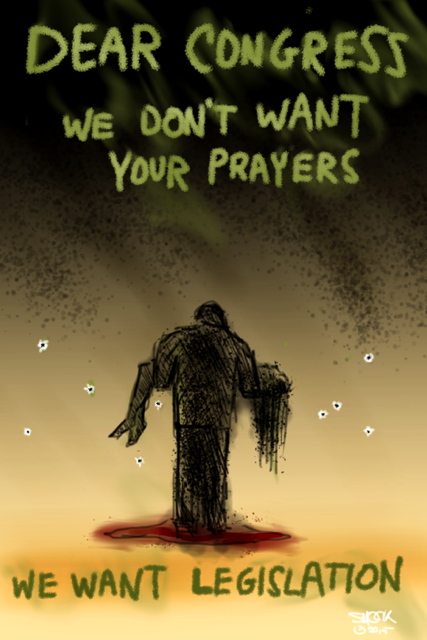
This week’s selection is not a lengthy one but the image quote pins a moment in history that I hope to be a turning point in the United States’ public psyche: and I truly believe that children’s and young adult literature can play a big part in our communal effort to raise conscientious and compassionate next generations.

Quote of the Weekdear-congress-1b

— by Jonathan Schmock
from “Dear Congress” on http://jonathanschmock.com/dear-congress/

Considering Cultural and Emotional Competency

It’s Banned Books Week again. Can we stop yelling at each other about it?: Jacqueline Woodson interviewed by Ron Charles — from The Washington Post

Big News about Hoffman’s AMAZING GRACE by Debbie Reese — from American Indians in Children’s Literature

Patterns of Immigration Excerpt by Roni Dean-Burren  — from Dean-Burren’s Facebook Post

Authors & Books

It’s a Coder! It’s a Teacher! It’s a Kick-Ass Graphic Novelist!: Is Gene Luen Yang from Krypton? by Michael Mechanicook — from Mother Jones

Alice in Wonderland: A Very Important Date by Monica Edinger — from School Library Journal

Alice: 150 Years of Wonderland — Online Exhibit at The Morgan Library

2015 Finalists: Young Readers  — from Kirkus

I gathered these entries from various sources such as Facebook, Twitter, Goodreads, and specific sites that I follow such as Educating Alice, Pub Peeps, Book Riot, School Library Journal, The Horn Book, We Need Diverse Books, American Indians in Children’s literature, etc.

Leave a comment

Filed under Book Notes, Views, WIWWAK

So You Want to Be A Jedi: Star Wars, The Empire Strikes Back by Adam Gidwitz

soyouwantobeajediSo You Want to Be A Jedi: Star Wars, The Empire Strikes Back by Adam Gidwitz, with original concept arts
Really enjoyed much of the book — many of the Jedi lessons are great fun and with the trade-mark Gidwitz caring for a young person’s mind and character. The second person narrative device worked for me and the added extended training segments made me happy. The third person narrative parts about Han & Leia are faithful to the movie but to someone like me who saw the original movie and re-watched it a few times in the past few decades, they can seem a bit bland. I could tell that the imagined audience is actually those who’re young and not exactly familiar with Episode V. Waiting to hear from my 4th & 5th graders of their view.

Leave a comment

Filed under Book Notes

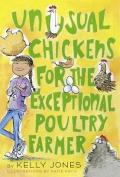
Unusual Chickens for the Exceptional Poultry Farmer by Kelly Jones

unusualchickensUnusual Chickens for the Exceptional Poultry Farmer by Kelly Jones

Definitely a breezy read with some fun bits and pieces. I really like Kelly Jones’ portrayal of Sophie, level-headed, with plenty of normal kid concerns and normal kid courage. Jones included some not-too-heavy-handed tidbits about how others perceive Sophie, being half Mexican American, being viewed as poor, being “presumed” in not-so-flattering ways.

Since my taste runs more toward more saturated kind of fantasy, I wanted the chickens’ powers (and they are amazing powers) to manifest more, stronger, and add more tension to the story.  However, I can also see how this can be quite attractive to those who just want their magic to be more like everyday happenings — not too many world-altering encounters.

My narrative device-detector antenna was definitely alert for this one and wish that the letter-writing device had worked all the way through.  The really really long, as-it-happens, climatic sections did not work all that well for me: not sure when/where Sophie would have been writing to Agnes in the middle of rescuing the chickens and participating in the Poultry Show (and it is apparent that those letters weren’t written after all the excitement as a report, since Agnes would have known all that had happened and wouldn’t have needed such narration of events.)

Leave a comment

Filed under Book Notes