Category Archives: Views

Children’s Book Publishing, Hot Men, and Sexism

After reading and posting comments on Roger Sutton’s blog post from yesterday presenting questions and a snapshot regarding gender representations in YA and children’s books, I recalled another similar post from a while back (8 years ago) The other g-word and all the impassioned, albeit a lot less heated, and eye opening comments following that post. 

Many of the comments, including my own, allude to the Hot Men phenomenon of children’s publishing: both behind the scene in the publishing process and in the front line at promotional and other events.

I was definitely trying to stir up the pot a bit but I still wonder if so many of the comments, especially from female children’s book creators, don’t tell quite a bit of the truth! 

Such as this one: When I got my first book illustration job at a major publisher, I noticed something that made me feel instantly uneasy. It was a male illustrator’s headshot taped to the wall with hearts around it. I asked about it, and got giggles and swoons about his cuteness from the all female dept. My first thoughts when I saw this photo were: is this just a little office joke or is he actually be more likely to get offered a ms. then a similarly talented female or male? and: does he feel weird when he comes into the office and sees that?

Or this one: When I was studying illustration, a teacher took me and some of the other female students aside for a talk at the end of the year. He said he had no idea what was going on, but he wanted to warn us of something. He said that in his experience, year after year, he not only had more female illustration majors then males numbers wise, but that in his opinion they were overall better illustrators, and that after graduation most of the women faded from the scene while more men made it. He was utterly perplexed, had no answers, but urged us to be aware of this and to please not quit and to press on despite the odds. He literally begged us not to get discouraged and quit the field.

Leave a comment

Filed under Views, WIWWAK

Over at Read Roger Horn Book a small…

Over at Read Roger (Horn Book,) a small word/ideology battle over female representation in children’s and young adult books. Gender by The Numbers. Take a look!

I posted a couple of responses — here’s the most recent one, in response to two other commenters:

Maia said, “Wouldn’t it be nice if having female authors or protags guaranteed that what was being written reflected a feminist worldview?”

Yes, wouldn’t it? From earlier March to now, one of my thoughts was: how many women writers who write stories with female protagonists have pretty much “subjected” their main characters to fit the negatively stereotypical young women mold? Vapid, romance-crazed, hyper-appearance-conscious (toward themselves, their peers, or their love-interests), etc.? I’d rather take Avi’s Charlotte Doyle or M.T. Anderson’s Violet (from Feed) over Stephanie Meyer’s Bella (Twilight Saga) or Cecily von Ziegesar’s Blair or Serena (Gossip Girl) any day.

So, the bottom line: numbers definitely do not always tell the whole story. If any of us wishes to engage in truly fruitful discussions on these issues, we all have to first do our homework and read A LOT of the books under examination and THINK carefully about our initial, intuitive responses and then THINK again and again about whether these responses have solid basis in reality — and then LISTEN to each other and CONSIDER the many other sides of the same issue.

And, by the way, as a middle aged woman who has lived in the States for the last 25 years, I must agree with Maia that, to me, rage, pent-up or otherwise, is never a good starting point to initiate a conversation and is definitely not a valid excuse to ignore facts or to lash out at random strangers. I am almost offended by Mike Jung’s sentiment that these women are somewhat excused for their bad behaviors because of their rage — would you excuse men the same way? Can they lash out at women? If not, then perhaps you are still thinking that women are not sensible creatures who should have the ability to engage in logical and reasoned discourses even when they feel wronged? Are we so unreasonably emotional that we cannot be held accountable for our actions?

Leave a comment

April 1, 2015 · 1:56 pm

But I NEVER imagined him as being like me. In my head, he’s white.

With the #WeNeedDiverseBooks movement, many gatekeepers and practitioners of children’s literature have been publishing thoughtful articles and having deep conversations on the urgent need to publish and promote books featuring diverse characters.  To highlight how important this movement is and how decades of mostly “white” books have “trained” our young readers what to expect from books, I’d like to swing the spotlight directly on some young readers themselves:

The Setting

Time: A sunny Monday morning in winter.  3rd period.  Individual choice time.

Place: A comfortable School Library Reading Room, Upper East Side of Manhattan.  This is an independent school where 60% of students are white and the rest are made up of darker skinned students (if we also consider East Asian as “darker” skinned.)

Character List

F – The Librarian, Female, Asian American, 50-something

A – Student, 7th Grade.  Male. Half Black, Half Jewish
R – Student, 7th Grade.  Male. Twin of A.
W – Student, 7th Grade.  Male. African American.
J – Student, 7th Grade.  Male. Caribbean Black.
N – Student, 7th Grade.  Female. Jewish/White.

A, R, W, J, N are all devourers of books, especially action packed Science Fiction or Fantasy novels.

The Scene

The students sprawled on the comfy chairs and benches with their laptops, half participating in a discussion on books featuring African American characters and history as they had just finished a unit on African American Authors and Stories (Day of Tears, Carver, We Are the Ship, The Other Wes Moore, Brown Girl Dreaming, among others.)

Suddenly, A exclaimed, “Oh my god.  The main guy in the book I just finished is black! He’s super cool! But I NEVER imagined him as being like me.  In my head, he’s white.”

R, J, and W immediately jumped into the conversation and were all in agreement how they also never imagined a superhero with their own faces.  N, usually talkative, remained silent.  The kids and the librarian then started talking about how there are also so few black action heroes in movies except for perhaps Will Smith and Samuel L. Jackson.

The period ended.  Everyone picked up their new reads and left the Reading Room.

End Scene

The previous was based on a recent informal conversation I had with those five kids.  I didn’t detect any sense of outrage or dismay.  The boys simply accepted the lack of dark skinned heroes as the norm.  I, on the other hand, could not stop wondering about that one statement, “I NEVER imagined him as being like me.  In my head, he’s white.”

Is this a shared sentiment across the country by non-white young readers who seldom see themselves on book covers or between the covers?  When they do encounter people of color in books, most of these characters seem to always need some form of “saving” — from poverty, from political or racial injustice, or from other dire situations (human trafficking, child soldier, etc.)

Isn’t it high time for us all to change that default and reshape the landscape of American children’s books?

Let’s have non-white heroes and let their faces show on the covers.

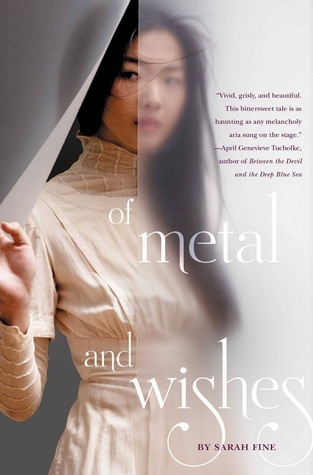
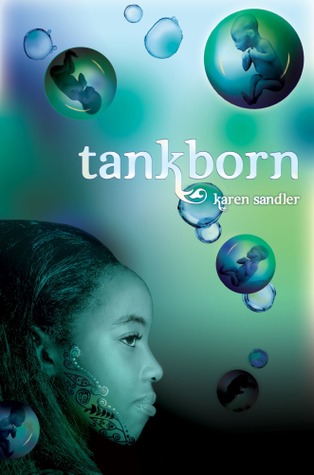
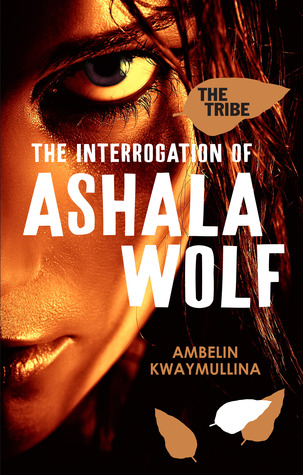
interrogation ofmetalandwishes tankborn
2014, Candlewick Press
Australian Import
Vol. 1 in Tseries
2014,
Margaret K. McElderry
Vol. 1 in series
2011, Tu Books
Vol. 1 in trilogy


1 Comment

Filed under Field Reports, Views, WIWWAK

Haven’t had a chance to read all the…

Haven’t had a chance to read all the abusive words thrown at Andrew Smith that caused him to shut down both his twitter and facebook accounts. I did have the chance to read the VICE interview and saw what he had said (as published by VICE) and simply couldn’t fathom how an honest, although tongue-in-cheek, and quite humble remark such as, “I consider myself completely ignorant to all things woman and female. I’m trying to be better though” would have been the cause of so much personal attack and pain. I read couple of responses that more or less match what I think: Andrew Smith is a brilliant author who deals with issues in his books mostly through male perspectives: raw, honest, frequently biased or myopic (because it IS raw and honest) — and is obviously aware of the criticism that he’s not fleshing out his female characters as much as his readers would have liked. I’m trying to make sense of all this… I have not read Alex Crow — but I did read 100 Sideway Miles and found Julia to be independent, mature, and an incredibly strong and positive influence over Finn — an entirely different female character from Shann in Grasshopper Jungle. I need to do a lot more digging to figure out why the outcry and also whether I find it justifiable to condemn a human being and his character simply by the characters they put in books and also by some sentences in an interview that, to me, seem to be interpreted to carry very different meanings than intended.

Here are links to the original interview and some responses:

The original interview:
http://www.vice.com/read/failure-of-male-societies-869

An interpretation that states Andrew Smith, by saying (tongue-in-cheekly) that he’s ignorant of how women function, Andrew Smith is admitting that he considers women “LESS THAN HUMAN.” I can easily, by the same ignoring-all-logic-or-facts method used by Tessa Gratton here, claim that he is considering women “MORE THAN HUMAN” and thus harder to grasp and he’s trying to do a better job at learning how to WRITE THEM as characters. Sorry. Grrr…. :

A well-argued essay in response to the twitter witch hunt and Gratton’s attack

Slice of Life #11- Criticism is Key

A long list of thoughts that present many ideas that I think about what Andrew Smith had said:

What I Think About Andrew Smith And What He Said

8 Comments

March 13, 2015 · 10:43 am

I am not happy with the WIWIK tag…

I am not happy with the WIWIK tag — I don’t think it expresses the correct sentiment. So bear with me as I change it to What I Wish We All Know. Either something that I know that I wish others do, too; or something that I have questions and wish to be informed: all of them should be something that is under each practitioner’s belt. So, perhaps, it should be WIWWAK: What I Wish We All Know! And it is still pronounceable.

Leave a comment

March 13, 2015 · 9:46 am

WIWIK – What I Wish I Knew

I have been thinking how I may contribute to the #weneeddiversebooks movement. One strong belief of mine is that we not only need diverse books but amazing and accurate diverse books. Two more blog posts in the Doing The Diversity Thing Diversely are forthcoming. More thoughts have been brewing. In the meantime, is there something I can do on an ongoing basis? And how do I gather all of these under one thread?

Last night, reading Wendy Mass’s The Candymaker and encountering this declaration: “alphabet is the foundation of every language” gave me an idea. This is an incredibly fun book, extremely popular with my students. I am thoroughly in love with the intriguing plot line and mesmerized by the candy factory! But reading that sentence, my instinctual reaction was, “um, no, the Chinese language is not built on a system of the alphabet. And there are more than a billion people who use this language daily!” I know that this is from Miles’ mind, a 12-year-old boy in a book. The author must have known that there are languages in the world that were not built on alphabets! She just made her character think this way. And yet, I wonder. Miles is a highly intelligent, book-loving, code-making, language-creating child. So it is also highly likely that he does know that “not every” language in the world is founded on a set of alphabets. A simple “almost” before “every” in this sentence would have been more accurate without sacrificing the authenticity of the character.

But, could it be possible that the author and the editor really did not know that there are non-alphabet based languages? If so, then perhaps I can contribute by questioning and discussing such matters for practitioners — authors, editors, librarians, teachers, etc.!

Thus a new TAG on Fairrosa Cyber Library was born. wiwik — What I Wish I Knew. With this tag, I can collect questions I have regarding cultural references in children’s books and give myself homework to research and find out accurate information. Others can join in to discuss and enlighten me, too! (I’m also adding this tag to some older posts and the link to the sidebar.

Leave a comment

Filed under Views, WIWWAK

Doing the Diversity Thing Diversely, Part 3: How Can We Know When We Don't Know What We Don't Know?

One form or another “matrix of knowledge” is often presented at educators workshops, especially when the discussion is about diversity.  These are the four quadrants of such matrix: 

KNOW
KNOW
DON’T KNOW
KNOW
KNOW
DON’T KNOW
DON’T KNOW
DON’T KNOW

When I read Malinda Lo’s blog post on YA novel reviewing, I realized that many of the problems cited in her article come from the lower-right quadrant.

We can look at these quadrants in light of book reviewing:

  • KK: One has a firm grasp of a particular knowledge and can readily access and utilize such knowledge.  Most reviews are done by reviewers familiar with the content or genre in order to accurately assess the quality of the book.
  • DKK: One sometimes is not consciously aware of possessing particular knowledge since such knowledge has become second nature.  Most reviewers will not have to put in extra effort to notice typos in a finished book.
     
  • KDK: One is consciously aware that one lacks particular knowledge or set of knowledge. In this case, research and inquiries are made and new knowledge is gained. Faced with a book where the main character has an unfamiliar medical condition will prompt any reviewer to do some research in order to assess the accuracy of the tale.
  • DKDK: One is unaware of one’s lack of knowledge in a particular area. More often than not, one also believes that he/she actually has solid knowledge about the matters at hand. This often makes it difficult for anyone to obtain actual knowledge.  In Lo’s “Perceptions of Diversity in Book Reviews,” most if not all of the examples cited in part 1 “Scarcely Plausible” and part 4 “Readers May Be Surprised” fit squarely into this  DKDK box.

I have no doubt that the reviewers in Lo’s examples believe that they KNOW about peer cultures or that they really KNOW how potential readers will react, and thus evaluate the books accordingly: all based on the self-trust in one’s knowledge and also on an urgent sense of mission to be the gatekeeper, warding off culturally insensitive materials.  But, as explained clearly by Malinda Lo, such heroic protection could result in damning certain books for committing crimes against cultural accuracy while in truth that the book might be indeed culturally accurate.  Such as the demand of having a glossary, since it has been standard practices and requirements on books with “exotic” and “unfamiliar” (read: non-white) words or expressions and that lack of such glossary signifies inferior quality. 

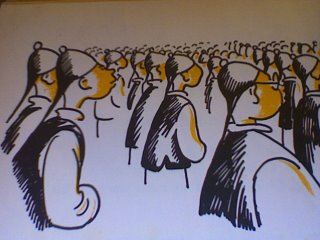
I myself have engaged in several discussions over the years on the portrayal of Chinese culture and characters in children’s and YA books.  I always do this with much trepidation: since there is no way that I can truly be the spokesperson for an entire (and extremely complex) culture, even if it is considered MINE.  (I am now even more aware of the differences between Chinese and Chinese American Cultures.) Take my post on Five Chinese Brothers for example.  This old picture book is often criticized as racially insensitive (or downright racist.) I addressed this controversy back in 2008, in Examining The Five Chinese Brothers, mostly defending the illustrations by Kurt Wiese. I pointed out that if one examines the pictures carefully and accurately, without being influenced by an overblown sense of social justice, one can easily see how many of these cartoon faces have different features: nose shapes, eyebrow angles, even ear shapes and sizes.  The well-intentioned critics usually claim that Wiese was being racially insensitive because he perpetuated the “oh, they all look the same; I can’t tell them apart” concept. These critics didn’t seem to realize that perhaps they themselves Don’t Know how to read cartoon/stylized lines of Chinese features.  To me, all five viewable faces in the two pictures below are distinctly different — are they?

 Photo-38-751016

Photo-43-785330

However, since posting about it 7 years ago, I have also come to realize how much I also DKDKed!  My insistence to support the use of yellow for the faces is based on my personal experiences: as a Chinese girl growing up in a homogeneous environment, proud to be a member of the “yellow race,” and never having to contend with my ethnic identity.  It is a highly biased stance (and I wanted to break the connection of Yellow=Undesirable, what an naive idea!)  I disregarded the real experiences of Chinese and Asian American child readers.  Just because I don’t find being labeled “yellow skinned” hurtful does not mean that there are not many who are indeed hurt.  In this case, I believe that their views are more valid than mine.

Yes, I have to update my own mindset, bringing myself from the DKDK quadrant to at least the KDK quadrant and striving to listen and learn from others. 

Since my pervious post in this series was about Africa Is My Home, I decided to look at reviews from 2 years ago when the book was first published.  I found this review from Kirkus and decided that a discussion about parts of the review fits nicely here.  

I have some disagreements with the review, but most can be chalked up to personal tastes and subjective views.  I would not have classified this book as a “text-heavy picture book” but a “heavily illustrated historical fiction.”  I don’t feel that Robert Byrd’s illustrations are “frequently cramped,” although there are definitely a few busy scenes: at the market place, in the court house, and on the Amistad.  I (and my students) also don’t find the text befuddling in any way.  

What made me wonder the most is this claim of one of the book’s several “flaws:”

“Its illustrations…offer minimal variety in the characters’ skin tones and facial features.”

The reviewer seems to say that it is quite problematic in depicting the people (adults and children) from Mende Land (Sierra Leone) with very similar skin tones: perhaps to the point that implies Robert Byrd’s lack of respect for the people depicted.  Most racially sensitive folks believe that “not all Africans have the same skin tones” and that “no one should lump all all Africans as being the same.”   We should treat them as individuals and as humans equal to everyone else.  This is all I hold true as well. However, the reason we see distinctly different shades of skin tones in the States (or other non-African continents) is the result of the long and vast history of African diaspora and racial mingling.  And in Africa Is My Home, the illustrator Robert Byrd shows his awareness of this in his illustration of  the market place scene set in Cuba:

IMG_20150227_092333

IMG_20150227_092315

(note the two women shopping for vegetables/fruits)

Byrd, using water color and non-realism style,) depicted Mende Land children and adults with very similar skin tones.  The variation, if any, is extremely subtle.

africaismyhomepageimage

There are also some very similar facial features, for sure: The shape of the nose, the large round eyes with the whites showing, etc.

Curious, I searched for recent photographs of Sierra Leone children and came across many group photos such like this one from the BBC News Magazine.

_69801704_children

And cannot quite bring myself to label Byrd’s choices as a flaw in the book.

If Byrd had made the skin tones and facial features a lot more varied for the Mende Land people, just like what he did for the Cuban market place scene, would the Kirkus reviewer then praise him for his cultural sensitivity, even if that might have been an even more inaccurate depiction?  From where I stand, this well-intended criticism, aimed to point out “cultural insensitivity,” seems to lack cultural understanding itself.

Like I said earlier, I’m always really fearful when I hold different opinions about books regarding cultural references: since perhaps I am so off base.  So, I’d love to hear from others who have better understanding of the topics addressed here and would love to be enlightened about anything that I Don’t Know that I Don’t Know!

8 Comments

Filed under Views, WIWWAK

Doing the Diversity Thing Diversely, Part 2: The Importance of Fretting

africaismyhomecoverYesterday marked the paperback release of Africa Is My Home, by Monica Edinger, a dear friend and colleague.  I always think of Monica as a fellow journeyer in the fantastic and sometimes treacherous, but always rewarding, territory that is Children’s Literature.  Monica and I met online 20 years ago over the Child_lit listserv.  Our mutual admiration for Lewis Carroll and his creations (Wonderland, puzzles, games…) made us fast virtual friends.  Since 1997, I have worked with Monica on numerous projects both at Dalton where she teaches 4th grade and I am the middle school librarian and out of Dalton, co-teaching a Fairy Tales course online for Rutgers’ Youth Literature Certificate program and co-planning SLJ’s Battle of the Kids’ Books for the past 7 years (with Jonathan Hunt and the good folks at SLJ,) among others.

I did not write a blog post for the book’s hardcover release two years ago, feeling self-conscious about how I probably could not really be objective in “reviewing” this book, being the first person who read Monica’s very first draft more than a decade ago.  However, to celebrate the release of the paperback edition and to contemplate how this book fits within the recent discussion on the various ways Diversity in children’s books can be achieved, I am compelled to write about it even more — even if I cannot extract my knowledge of the creative process of the book from how I view the final product.

I know intimately what Monica went through in writing and re-writing this book: switching narrative voices, changing from nonfiction to fiction to nonfiction to fiction several times, “shopping” it around to various publishers and working with various potential editors.  I also knew first hand how much she invested in making this (slim in size and yet hefty in subject matter) book: remembering what Sierra Leone was like when she spent two youthful years there, connecting and reconnecting with people from Sierra Leone to check and re-check facts, traveling to Connecticut (Amistad Museum) and Ohio (Oberlin) to immerse herself in primary materials about Sarah Margru, not to mention all the online researches she conducted through a decade.  I also listened to her fret, and fret, and fret.

Ah, the fretting.

Monica Edinger is a German Jew.  She is not of African descent.  She is white.  She lives in the 20th and 21st century.  Sierra Leone is not exactly the same as Mendeland those many years ago.  And this is NOT her own conjured-up story but the tale of a real person who lived and felt. It is also a story that has to work for a child reader when it’s told.  So many details to consider…and to fret over.

How would the world receive this book when it finally got published?  Would the book receive positive or negative reviews?  Would the people whose story she chose to tell understand how much respect and care she had in the making of the book?  Would the book and the story be dismissed?  So many questions and potential pitfalls to imagine…and to fret over.

All that fretting is what I think needs to go into writing any book, but perhaps especially into writing “diverse” books where cultural authenticity and respect are extremely important.

I believe that Monica’s relentless drive of writing this book as authentic as she could manage came from several places: her sincere passion to tell this less-known story, her perfectionist’s need to be meticulous and accurate, her true fondness of researching and verifying facts, her strong dose of a healthy fear of not getting it right, and her tremendous respect and caring of the welfare of the people and culture of Sierra Leone.  She did not write a book in the vein of what I have started thinking as a “third world tragedy story” told by a well-intentioned white person from a completely outsider viewpoint, often tinged with a sense of superiority and savior mentality.  She wrote a story (with assistance from historical documents, her editor Sarah Ketchersid, and the talented illustrator Robert Byrd) that brings a historical tale to life with a high degree of authenticity and no outsider judgment.  It enriches and will continue to enrich the reading and cultural experiences of young readers.

I’m so glad that Africa is My Home has received much praise and accolades: the result of the incessant fretting from all parties involved.

In the next post, I will discuss a particular review of Africa is My Home and when it first hit the market and ponder over similar questions of what Malinda Lo wrote on her blog post about reviewers’ perceptions when it comes to diversity topics in children’s and YA books.

1 Comment

Filed under Views

Doing the Diversity Thing Diversely, Part 1

The many discussions face to face and online about We Need Diverse Books in children’s and YA literature have informed me that there simply isn’t a cure-all solution when it comes to creating and promoting diverse books for young readers.

So, I plan to share some thoughts on this Diversity Thing from my vantage point, which is many folds and diverse and also in flux as I learn more from others.  Before putting up these blog entries, I’d like to first describe who I am in relation to children’s literature and where that background fits into the Diversity conversation, so readers may have a firm grip on where I come from when expressing my ideas, which, I guess, is something we all need to start doing — sharing of where we come from and why we feel certain ways and understanding where others have come from and why they feel certain ways.

I am a Taiwanese/Chinese American.  I was born in the 60s, attended a public elementary school, then went on to attend the Catholic Sacred Heart Girls’ middle and high school (boarding), and finally National Taiwan Normal University (teacher’s college.) My double degrees were BAs in Education and English Lit.  After graduating, I taught English (as required foreign language) in a public middle school from 1987 to 1989.

My parents were from Mainland China, part of Chiang Kai Shek’s (Jiang Zhong Zheng) army retreat to Taiwan after the Chinese Civil War in the 1940s that resulted in the divide between the Communist China and the (more) Democratic Taiwan (Republic of China) regimes.  We still have a whole clan of the Xu family in Yunnan Province in China that I am attempting to re-establish relationship with.

  • Growing up in a largely homogeneous environment, being a member of the dominant class (my father was a member of the inner circle of both Chiang Kai Shek and his son, President Jiang Jing Guo,) and doing well in school in a climate that revered the intellect made it impossible for me to truly understand the feelings of being an underdog.  (Fortunately my near-sightedness, my short stature, and the fact I was not considered a beauty and was reminded of such fact by family and friends alike all through my youth balanced out that cockiness and allowed for some humility.) I also never had an ethnic identity crisis as many Asian Americans might have to struggle through since I was never a Minority!

As a young person, I was addicted to books and reading: my favorite stories came from Taiwan, China, Germany, France, Japan, Sweden, India, Italy, the US, Colombia, Russia, Greece, and many other countries. Most were classics but also plenty of contemporary (60s to 80s) writings.  All of my closest friends loved books.  However, reading novels was not considered the best way to spend one’s time.  Philosophical and personal essays were all the rage when I was growing up — all about how to better oneself, morally and worldly.

I came to the United States to study children’s literature in 1989 and received my MA from Simmons College in 1991.  In 1996, I received an MLS degree with a concentration on services to children.

  • One of my youthful aspirations was to win a Nobel Prize in literature.  I was a good writer, in those popular short essay forms.  I couldn’t and still can’t create fiction.  I revere the art form that is literature and since I’m so invested in literature for children, it is almost a sacred form to me.  This is why I am a very critical reader and get easily frustrated when I see something not done right that can be easily fixed.

I have been working since 1991 in New York City alone and have not lived elsewhere but NYC since 1991.  My string of jobs were all related to children’s book:

sales clerk for Eeyore’s bookstore for children (1991-1992)

subsidiary rights assistant to the department head at Macmillan Children’s Publishing (1992-1994)

children’s librarian at the New York Public Library (1994-1997)

middle school librarian at The Dalton School (1997-)

  • There are, in my head, inherent biases about racial compositions of peer groups by living only in New York City for 20+ years and working in a school where at least 40% of the students are not white. Immersed in such a diverse environment, it is hard for me to visualize, although I am cognizant to the fact, that in many States/Cities/Towns, young people do not meet “others” on a regular basis.
  • My continuous interaction with high achieving students who read regularly, have a passion for books, and can dissect literature aptly for the past 18 years greatly colors my view of what books are best for which age range and the kinds of books I promote at my workplace and on my blog.

I have been a member of the Association of Library Services to Children (ALSC) at ALA for almost 20 years and have served on two Newbery Committees, Notable Children’s Books Committee, and also recently Best Fiction for Young Adults for the Young Adult Library Services Association (YALSA) — among other non-book related committees.  I have also been involved in co-planning and co-maintaining SLJ’s Battle of the Kids’ Books site for the past 7 years.

  • This resulted in reading, thinking, and writing about children’s and YA literature on a regular basis and discussing books with thoughtful and experienced colleagues and practitioners such as Nina Lindsay, Monica Edinger, Vicky Smith, Kathy Odean, Phoebe Yeh, Junko Yokota, Jonathan Hunt, Adam Gidwitz, and many others.
  • Fairrosa Cyber Library (since 1994) is my site/blog devoted to children’s books that was one of the oldest online resources for children’s literature (and needs to be re-vamped, I know!)

A note on my reading habit: I still read English painfully slowly — having to sound out pretty much every word.  This is both a curse (I cannot read as many books as I’d like to) and a blessing (I am told often that I am a “careful” reader and that my slow-reading habit allows me to cite specific examples about style, tone, authenticity, etc.) 

A note on my reading preferences: I like unconventional and challenging literary forms and gravitate to fantasy and science fiction readily but can easily enjoy any genre, as long as I deem it “well written.”  Now, that’s another can of worms that I won’t open here.

A note on my attitude about this whole Diversity thing: The cliche is true: It is a long, hard, and never ending journey, and one cannot get anywhere without throwing something out there that might upset some folks, stir up the pot, generate passionate dissents, etc.  I am always willing to be made to see a different side of each matter and understand where others have come from, even if I might still disagree with them.  It is also of utter importance to me that during the discourse, others understand my efforts in upholding a professional mindset and stance, even when I appear to be extremely passionate and emotional (which I can be, often) about the matters at hand.  

5 Comments

Filed under Views

We Need Diverse, AND Amazing, AND Well Informed, AND Creative, AND Mind Stretching, Books

Last night, I rushed home to watch the Oscars live broadcast.

I was not following the news or discussion over the “All White Nominees” situation. So, it was a surprise to me that not a single person of color (brown, yellow, black, what have you) walked onto the stage to receive the golden statuette.

This morning, I woke up still pondering: hmm… what happened?  Was there not a single worthwhile movie featuring or made by people of color during the year 2014 that warranted some recognition?  If not, what happened?  Were there no creative or talented POC in the entertainment industry or were they not given the opportunities by the studios and the gatekeepers to showcase their talents?  If they never got to be SEEN, how could they have been nominated, or have won?   Then there’s the question of what happened with Selma and its actors, director, and writer?

The Youth Media awards press conference each year (where Newbery, Caldecott, Coretta Scott King, Printz, etc. awards are announced) has been dubbed, “The Academy Awards of Children’s Literature,” as if that’s high praise and what we children’s lit folks should strive to be.   At this point, I don’t want my beloved children’s literature field to be linked with the Academy Awards, especially after a strong showing of diverse topics, characters, and creators this year: a proud moment for many practitioners and champions of children’s lit.

And yet, the heated debate sparked by Malinda Lo’s and Roger Sutton’s recent blog posts (Lo’s Perceptions of Diversity in Book Reviews and Sutton’s Are We Doing It White?) reveals that even in the wake of a year of diverse winners, the children’s literature industry still has a long way to go in diversifying on all fronts, especially the gatekeepers (editors, publishers, reviewers, librarians, etc.) and their views.

I have been taking notes on others’ and my own thoughts and will post my reactions and observations in a few installments. Lots of soul searching and perspectives changing on-going in my head!


1 Comment

Filed under Views

Another almond post but the blogger failed to…

Another almond post… but the blogger failed to mention that ALMOND EYES originated from traditional Chinese texts where women were frequently described as having “almond eyes“ meaning larger than usual eyes shaped like an almond — so, kind of what the generic “western eyes” might look like! Since it is rarer, it is more desirable (like the double eye-lids and really pale complexion.)

http://www.npr.org/blogs/codeswitch/2013/09/16/219402847/-almond-shaped-eyes-remarkably-exotic-yet-too-foreign

Leave a comment

January 18, 2015 · 1:45 pm

I'm Not Sure I'm So Fond of Almonds

I like many different kinds of nuts. I actually am QUITE fond of almonds and many things made from almonds, even Toasted Almonds.  However, in the past few days, reading different books, written both by non-Asian and Asian authors, I have found myself puzzled by the insistence of the shade of my kind of skin as “toasted almond.”  It feels like a lazy throw-away descriptor, much like that of “olive skin tone” (as referenced in my other post.)

Here, depending on the lighting and different parts of my body being highlighted, are some sampling of my skin color from photos taken in 2014:

Screen Shot 2015-01-18 at 11.57.56 AMScreen Shot 2015-01-18 at 11.57.07 AMScreen Shot 2015-01-18 at 11.56.41 AMScreen Shot 2015-01-18 at 11.55.55 AM

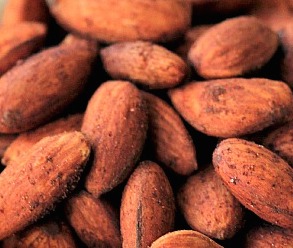
Here are pictures I took off the internet, showing what toasted almonds might look like in different settings, I guess, under different degrees of “toasting”?

almond1almond2almond3


I can definitely see Some resemblance between some of my photos and those of the almonds, after the toasting process. But for some reason, I feel heavily reduced since that seems to be the only way to describe my skin tones and those of millions of others who share my skin tones.

A plea: can we possibly build up some newer vocabulary, phrases, and ways in describing physical attributes, especially varying skin tones?  Perhaps more precise, and not always resorting to food comparisons?  (Another recent weird encounter — some Chinese girl’s complexion is described as “white rice noodles,” as a way of non-offensive, or even complimentary description — I can’t imagine any Chinese girl being too excited being told that their skin reminds people of white rice noodles. Just imagine, if you are reading a book where a white girl’s complexion is described as reminding the boy next door of a plate of “steaming ziti.”)

This site might not offer the ultimate answer to all questions about describing complexions and other physical attributes, but it serves as a starting point and a reminder of how not to resort to stock phrases and cliches. http://writingwithcolor.tumblr.com/FAQ

7 Comments

Filed under Views, WIWWAK

When a reader completely missed the author’s intent or craft

First morning of 2015. 

Just finished a very powerful book with a strong, convincing, well constructed multiple view points narrative structure and challenging ideas that demand the readers to live with the discomfort of not-knowing the whole truth, to understand that life is complex depending on the the angles of the viewers, and to mull over the potential futures of the varied characters.

Headed over to goodreads and see other readers’ reactions.  Many positive ones and especially from those who have lived through similar circumstances as the characters did in the book.  But then, I found a review complaining that because “the reader” finds it confusing how the story is told with so many different POVs and that “the reader” cannot see the point of some side characters’ remarks even though they give a fuller picture of how complex such matters can be and “the reader” cannot accept a book with no clearcut facts presented even though that is the whole entire point of the narrative.

I wanted to leave a comment and requested that “the reader” to admit her own shortcomings in her inability to appreciate challenging literary constructs and demanding ethical quandaries.  But then, I wonder: can we ever fault a reader for her inabilities to meet the author at the author’s level?  Is it the reader’s responsibility to challenge herself that way? 

This comes down to how we view books:

Is a book a sacred or demi-sacred object and deserves reverence and hard work to decipher by every reader?  Or is a book just another consumer product and the reader can register complaints and give poor ratings purely based on personal preferences without considering the crafts and intents of the author?

I have been thinking about subjective and objective analyses of arts in all forms for a while and this goodreads review just brought it home for me that I cannot treat books as mere goods to be liked or disliked but artistic expressions that need critical examinations even if a reader’s emotional reaction can be a major component in evaluating a narrative’s success. 

Leave a comment

Filed under Views

On a wet wintry night last week 12…


On a wet wintry night last week (12/10/2014,) I participated in a panel discussion where the question of how to bring more international YA literature into the American market was raised and pondered. Hosted by Words without Borders and NYPL and moderated by Marc Aronson. Other panelists are Arthur Levine, publisher of Arthur Levine Books/Scholastic, Padma Venkatraman, author of A Time to Dance, and Briony Everroad, guest editor for the Words without Borders December issue on International YA literature. This is a summary of the evening.

Leave a comment

Filed under Field Reports, Views

Kirkus Prize Finalists — Very different from National Book Award Long List

Kirkus Book Reviews announced the finalists for the Kirkus Prize for several categories today. The finalists for the young readers are:

EL DEAFO
by Cece Bell, illustrated by Cece Bell

THE RIGHT WORD: ROGET AND HIS THESAURUS
by Jen Bryant, illustrated by Melissa Sweet

THE KEY THAT SWALLOWED JOEY PIGZA
by Jack Gantos

THE STORY OF OWEN: DRAGON SLAYER OF TRONDHEIM
by E.K. Johnston

THE FREEDOM SUMMER MURDERS
by Don Mitchell

AVIARY WONDERS INC.: SPRING CATALOG AND INSTRUCTION MANUAL
by Kate Samworth, illustrated by Kate Samworth

Some observations:

  • Kirkus: 6 titles – NBA: 10 titles
  • Kirkus: 3 out of the 6 titles (50%) are NOT fiction and 1 more that is a mixture (lots of scientific information in an imagined environment) – NBA 2 out of 10 (20%) is NOT fiction with quite a few titles set against very realistic or historical backdrops.
  • Kirkus: All 6 titles are suitable for a sixth grader or younger – NBA, at least 3 titles pure YA and most are of interest to older readers.
  • Kirkus: 1 Graphic Novel – NBA no Graphic Novel

The two lists definitely complement each other!

Leave a comment

Filed under Book Notes, Views

Maze Runner – Observing the Races (as in skin colors and not contests)

Went to see The Maze Runner with a group of high school students. We all agreed that the movie was quite satisfactory and more intense than we had anticipated. When watching big action films these days, we often discuss the racial components of what we saw, so here’s a collection of the immediate comments:

  • The first person who died was not black.
  • Two black people died — both are portrayed as heroic deaths.
  • The Asian dude (Korean) is portrayed as a cool guy. His name is Minho — like the pop singer in South Korea Choi Minho. Minho outran Thomas (the white hero) the whole time in the maze.
  • The main hero and heroine are white.
  • (and this is not about race, but gender) — Teresa kind of lost her intelligence in the movie while in the book she was a lot more involved in planning the escape and solving the problems along the way.

No conclusions or judgments — just observations.

Leave a comment

Filed under Field Reports, Views

Because of the books I’ve been reading I…

Because of the books I’ve been reading, I have been learning about Nigerian history and contemporary politics, the 60s America, especially in Mississippi but also overseas in Vietnam and the important people during that time, including LBJ, and about more fantastic creatures in Russian folklore.

Leave a comment

September 21, 2014 · 5:18 pm

New trend?

Some of my high school students who witnessed the unpacking of publisher’s submissions this summer were slightly scandalized upon seeing this group of book covers.  Many of them are from the same imprint, but not all.  Is this a new trend in in YA cover design (gone with the partial faces and showing of only body parts?) Take a look through the Goodreads Popular 2014 YA list: https://www.goodreads.com/shelf/show/ya-2014 and see what unfolds.

IMG_20140903_101543

Leave a comment

Filed under Field Reports, Views

Do I have the right to be angry…

… at the really badly penned lyrics of a potentially interesting and weird Rock Musical? I sat through this off-Broadway production in painful silence, averting my eyes to the stage and the actors because I felt so sorry for them, having to deliver those lyrics! And anger simmered in my gut the whole time: how dare someone put on stage this production: in public, sell tickets, and demand all the production crew’s time and energy without at least putting SOME effort in coming up with more than 1 verse per song? Or at times, more than 10 words per song? The inane repetitive lyrics do not drive the points into the mind of this audience member but away from her thoughts – I tuned most of the words and ideas out when they were repeated 20 times over. I guess I just really dislike when I know that something could have been made better if only a little more effort was put into the process or perhaps the creators had bothered to seek some honest opinions to improve the results!

Then some doubts set in. Do I have the right to be angry at something that is quite subjective. Apparently someone must have liked it enough, or is not bothered by the lack of writing talent to appreciate the production as a whole: weird but interesting world, most actors are capable or even quite talented, and a storyline that is simplistic and juvenile but at least has a convincing enough arc.

All of these thoughts brought me back to the discussion of books and their flaws. I sometimes get really mad (or disappointed) when I find certain aspects or elements or devices in a book sub-par, and believe that these flaws could have been easily fixed. Sometimes, they become quite “fatal” and ruin my enjoyment of the whole. Over at Educating Alice, Monica Edinger wrote about her reaction to the Heavy Medal discussion on Fatal Flaws that might ruin the chances of a children’s book winning the Newbery. Fascinating discussion and valuable thoughts to digest. One person’s fatal flaw can be merely a blemish to another viewer or reader.

Leave a comment

Filed under Views

Sipping Rose Infused Tea

Drinking Pu-Er Tea infused with rose bought in a small tea shop on the northern path by the Greek Lake in Kunming, I sit in my living room and continue to remember and digest all this past summer contained — a summer unlike any other. I tried to summarize the experience of my 15-day trip and here’s the result (as posted on the Yak Yak board at WhereThereBeDragons.)

More thoughts will come along and I decided to start using this blog to include more than just children’s and YA lit. book notes.

Posted: August 20, 2014

Practical, Cultural, Personal

It has been almost 3 weeks since leaving Kunming and all the other cities/towns (Shaxi, Weishan, Weibaoshan, Shuanlang, Baoshan, Pupiao, etc.) I visited during the 15-day program with Dragons. On July 30th, I flew from Kunming to Shanghai and then to Vancouver to join my husband for a 2-week Alaskan cruise and did not get back to New York City until last Saturday. Much to sort through both in practical matters (laundry, pet care, grocery shopping) and internal matters — Dragons propelled me go through a most existentially challenging summer the intensity of which I cannot recall experiencing since in my 20s.

Living a mere couple of blocks away from The 9/11 Memorial Ground which is now open to the public, I am used to threading my way through hundreds of tourists every time I need to get somewhere in the city (a ten-minute walk takes me to subway lines to the rest of the five boroughs.) This morning marked the first time I took that familiar walk since leaving for the China Educators program five weeks ago. And I was keenly aware of the reversal of roles – I, THE “local” and THEY, THE “tourists.” In my mind, I repeated the Dragons’ mantra: Tourist vs Traveler. Some of THEM surely are immersed travelers and aware of the culture and history of this place, but a whole lot of THEM surely are just tourists. By looking at me, a 4-foot-11, 51-year old Chinese woman, wearing sandals and a bamboo basket, who would know that I’m not a tourist/traveler? And how can I tell for sure that some of them are not 9/11 victims families coming from Brooklyn or New Jersey to pay tribute and respect to their loved ones?

Thinking further: I’m not even sure that I can truly label myself as a “local” — being here for 23 years after growing up and educated in Taiwan kind of makes me only a semi-local, doesn’t it? Where could I truly call home? Taipei where I was raised? New York City where I reside now? Baoshan which was printed as my “origin city” on my Taiwan national ID?

These kinds of multi-stepped thoughts manifested on an hourly-basis while I was with Dragons.

They cropped up while the leaders, Max and Yingzhao, walked the five of us in the group through practical exercises for educators who might be leading a student group to a foreign country following Dragons’ experiential model. I took quite a bit of notes and asked a lot of questions about the stages of Group Dynamics, about the basics of Non Violent Communication (which I thought perhaps could be termed Non Aggressive Communication,) meditation techniques, and different icebreakers and check-in techniques. The hows, the whys, and the why-nots. The could it be…. and couldn’t it be… s as well. Whatever was given to us, I wanted to dig up more!

Then there were the more complex issues of cultural adaptations, interpretations, mis-interpretations, encounters, understandings and misunderstandings. My life-long knowledge of Chinese history, geography, literature, and traditions both enriched my experiences during those 15 days and challenged my status as a “knowing” but “foreign” outsider. I don’t even know what an average monthly salary for a middle school teacher is and how is that compared to the living standard: what is the monthly rent for a 3-bedroom apartment and how much it will cost to buy such a unit? I don’t know who the most popular local singers are and where might I buy a reasonably priced rice cooker. I observed, I photographed, and I talked and talked and talked to any locals that would talk back to me. Making friends with Mr. Ma who had a sweet-soup stand in the courtyard shopping ground within the Green Lake Park gave me just a little window into the life of a local shop owner. He and his family are believers of the Islamic faith. They just finished observing Ramadan. The ingredients of their food come from rural Yunnan. His daughter is studying to go to college, and along with his wife and his nephew, who is 24, helps him with running the shop. Business is decent. We talked about my family root in Yunnan and the political relationships between Taiwan and China. His nephew firmly believes that Taiwan should just be absorbed as an official Province (or special political unit) of China. And I found out that the attitude toward Chiang Kai Shek and his military strategies during WWII, fighting against the Japanese invasion, has completely changed in China in the past few years. Now they recognize his and Kuomintang’s achievements. This altered view was confirmed time and time again by others whom I met during the time in Kunming. Much to my joy and relief, since being an army brat of the Kuomintang armed forces, I had always feared the animosity that could be hurled my way if my affiliation had been revealed.

Meeting Lao Zhang, an artist and writer, who survived and thrived after The Cultural Revolution added even more cultural perspectives. I learned yet more from too many others to detail here…. Mr. Yu, a total stranger who gave me a ride and helped me find my ancestral home, my cousins, Ms. Ji, who runs a cafe in Shaxi, Shitou (Rock – a 25-year-old woman from Shandong province) who served as my impromptu tour guide in Shaxi, the Taoist priest who showed me the scripture he was reciting in the morning “lesson,” the girls who mind the shops in Baoshan, etc.

Holding all of the information in my mind, feeling the powerful emotion of “going back to the motherland” for the first time in my heart, and trying to learn new techniques of group management while being part of a group that’s being managed, was truly too overwhelming for me to absorb at once in such a short time. (Not to mention miraculously finding my relatives separated since the end of the Chinese Civil War in 1949, 65 years ago.)

This finally led to the toughest, most complex, and mind-shattering aspect of the whole trip: my personal identity struggles. My many years of complacency of self-worth, self-awareness, and self-understanding were jolted by the thunder and lightning of an internal flash storm which questioned whether I actually knew myself — what was my own identity? Stripped off of the coziness constructed with long time friends, a loving family, fairly established professional standing, and the most satisfying dream-job, and many other aspects of my daily existence such as the art and music I love, I had an opportunity to examine me as ME, raw. It was a frightening experience, one that I am still trying to recover from, and yet it was also a truly incredible experience, leaving me hopeful that I might have learned a couple of new things, even though I did not go on this trip to re-establish my self-awareness or re-construct my ways of relating to others.
It has been almost 3 weeks since leaving China… and I am still re-considering priorities, trying to decipher reasons behind my fears and reluctances, and figuring out how I can improve fluency in empathy.

Leave a comment

Filed under Views