Category Archives: Views

An 8th grade boy said…

“When I’m reading, I’m neither a boy, nor a girl.  I’m only a reader.”  This was said because a fifth grade girl, upon seeing the book with a girl faerie depicted on the cover I was giving to this boy,  remarked, “But he is a BOY!” (meaning, he would not read a Girl Book!)

His reply, my friends, made my day :)

Leave a comment

Filed under Field Reports, Views

Feminist or Anti-such?

I, along with my students and thousands of fans, have fallen in love with recent books by Tamora Pierce and Kristin Cashore. (Terrier, Bloodhound, Graceling, and Fire.) These fantasy books all feature incredibly attractive and strong teen females. They fight crimes, they battle monsters, they fall in love but seem to be totally in control of their relationships! They, not the male partners, are the ones who are empowered to choose and make their destinies.

So, when you have these young women, each (Beka, Katsa, and Fire) is taking one or multiple partners to bed, some details have to be attached. Beka got a charm, Katsa and Fire both used an herb — these supposedly will prevent pregnancy — the messy aftermath of their amorous acts.

On the one hand, I am happy that they are “getting it” and having a great time with it. On the other hand, my 21st century, teacher of teens and mother of a pre-teen daughter, mind keeps wondering: What are the BOYS/MEN doing to prevent the communication of the “other” kind of mess? The mess that hangs over millions of modern men, women, and children. Yes, these are Fantasy stories — but since the idea of birth-control are included, what’s to prevent our wonderful writers to also come up with some clever ways so that at least the young people in the stories (and the young people reading the stories) are careful about diseases. (In both Beka Cooper and Fire’s cases, they are sleeping with men who have multitudes of partners before and after themselves.)

Just wondering… Why in these quite feminist slanted stories, men and boys are still not held “accountable” for their actions?

2 Comments

Filed under Views, WIWWAK

Examining The Five Chinese Brothers

On Child_lit (a listserv devoted to the discussion of children’s literature), we’ve been having a heated debate (again) over Bishop’s The Five Chinese Brothers. (Claire Hutchet Bishop/Kurt Wiese, 1938) I have been a supporter for this book for the longest time, sharing it with my daughter who is half-Chinese and half-Jewish. (I am 100% Chinese: half Han, half Manchurian, born and raised in Taiwan.) I’m only posting here to let my readers decide whether the common complaints about this book match the facts. The complaints have been mostly based on the illustrations, so that’s all we’re going to look at today.

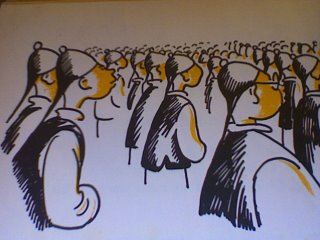
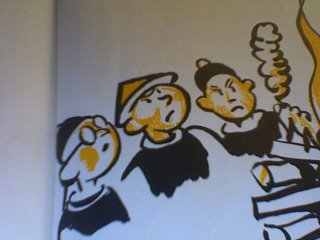
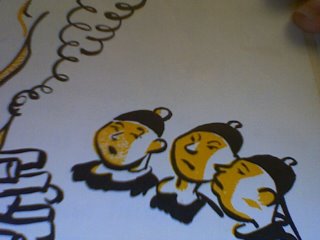
1st complaint: everyone in the crowd looks exactly alike in a stereotypical way.
There are only two spreads in this 32-page picture book that contain a crowd scene. Most of the faces are just outlines of the cheeks. These few faces in the front show completely different features: ear and face shapes, noses, mouths, and neck thickness, and one even wears glasses. Their outfits are all alike and every man has a queue (the braided hair) which was the required/prescribed hairstyle for all men in the Qing Dynasty (1644 – 1912.) Cutting off the queue or wearing hair in a different style could cause someone’s life since that was against the law. So, if the illustrator decided to set the story during those 250+ years, it is entirely normal for a crowd of men to wear queues.

Photo-38-751016

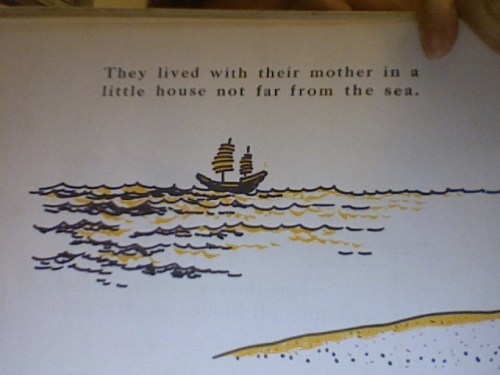
Complaint 2: Chinese people are not yellow like that.
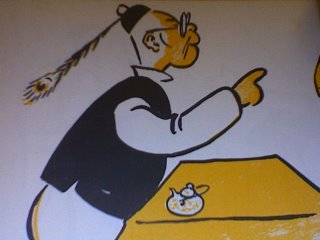
This book was published in 1938, at a time where 4-color separation and multicolor printing was not common and was not done in most children’s books. This book has 3 colors which means it has but ONE color. Black and white were a given and one more color was added to brighten the illustrations. Everything is YELLOW in the book — from the waves of the sea, to the sails of the boat, the treasures on the seabed, and the flames of the fire. As a Taiwanese Chinese, we were taught that we were the “yellow race” and proud of the hue of our skin. Yes, we are not truly “yellow” (like many blacks are not really “black”) but we were never ashamed of our skin color.

Photo-37-751044

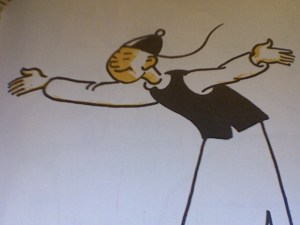
Complaint 3: Not only the people in the crowd, the other characters all look the same, too. (It’s a given that the five brothers have to look exactly alike — which Weiss managed to do extremely well.)

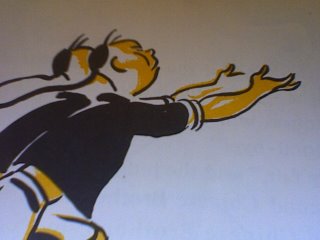
This is one brother. Examine the pictures following this one: do these faces look “the same” and “the same as the brother” to anyone? Indeed, each face depicted differs from the rest. If the readers/viewers cannot make out the differences, it is not the artist’s fault.

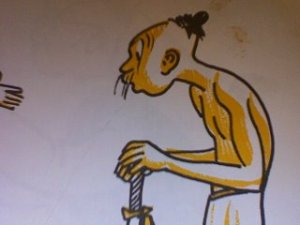
Complaint 4: these people all have the stereotypical slanted eyes.
It is true that most of the faces illustrated feature slanted/small/single line eyes. Could it be that – a. many Chinese people’s eyes are smaller, without the hanging folds over the eyes, than the Western people? b. The slant of the eyes is prevalent in the Chinese? and c. This is a particular style of the artist?

Photo-40-720526

Photo-39-720506 Photo-41-756385 Photo-42-756407 Photo-44-785347 Photo-45-718906Complaint 5: Bishop didn’t cite a source of this “Chinese” tale.

In 1938, most retellings of fairy and folktales were not sourced.


13 Comments

Filed under Book Notes, Child_lit Archive, Views, WIWWAK

Kung Fu Panda and Wuxia

Let me just come straight out and state that I really loved Kung Fu Panda, one of the summer’s animated family movies set in a non-specific Chinese village, featuring all animal characters, ranging from Rhinos and leopards to pigs and praying mantis. Oh, and, a Giant Panda whose father, unfathomably, is a duck who is a chef and owns a noodle shop. I know that upon close examination, many people might find the story a bit superficial, and superficially mystical: about finding oneself and having faith in one’s abilities and the whole “mystical” notion of fulfilling one’s fate. It might be an outsiders’ view of what Chinese martial arts world is all about but the creators of the movie did their homework and pay a lot of homage to the wuxia tradition.

Wuxia can be loosely translated to “martial arts knights” but the notion of WU is larger than just the practice of martial arts; it’s a mind set and a way of life. So is the notion of XIA — it often is not simply a person who has demonstrated talents in the arts of WU but also someone with great integrity and compassion, one who will help the less fortunate, and fulfill one’s duty to the fullest. Wuxia Xiaoshuo (Wuxia Novels) has been a uniquely Chinese popular literary genre for the 20th and 21st centuries. A little more detailed explanation of general themes can be found on the wikipedia article on this topic.

One of the most fascinating elements, for me as a reader of wuxia xiaoshuo (I read wuxia most ardently during high school and college years) is the training processes of the protagonists. These tend to be unrealistically super-human — one might learn to “walk on the top of grass” or to “defeat a dozen enemies barehanded and blind-folded,” etc. That’s why in my mind wuxia is closely resembling the western Fantasy novels. The creators of KFP definitely captured this aspect when Shifu (literally: Teacher/Master) figures out how to train Po and the audience is treated to a fantastic sequence of training sessions.

The movie is accompanied by a wonderful soundtrack and gorgeous background artwork. The calligraphy is not only beautiful but accurate. However, in most wuxia stories, you will find people using many different kinds of weapons: from swords to spears, with “hidden weapons” such as small needles (sometimes dipped in poison) and poisonous powders. Weaponry and the inventiveness of such are also what the readers/audience tend to appreciate in a work of wuxia. Maybe the sequel will feature more than just body-combat and using random objects (bricks and firecrackers, for example) to fight.

Leave a comment

Filed under Views, WIWWAK

2008 Anaheim ALA Highlights in Pictures

I’m back home in warm and breezy New York City. It’s beautiful here by the Hudson. The sun just set. And we saw many beautiful white sails on the river in the dimming sunlight…. Now it’s time to upload some pictures from the ALA Annual Conference. I never remembered to bring a camera but this time, I did and boy did I go a bit crazy! I should have taken some pictures of the Notable Children’s Books Committee but I got too nervous and too focused on “work” and never thought of capturing those moments which were super important. These pictures here preserved the moments that I relaxed and had fun with friends — old and new.

But before the people pictures… see the carpet in the Ballroom of the Disneyland Hotel…. can you “Spy Mickey”?

Yes. Monica and I (and Nina) went to Disnleyland!

Peter Sis

Orson Scott Card

Nina Lindsay, Me, Candace Fleming, Eric Rohmann, Richie Partington at the Lucky Strike Bowling Lane (Orange Block)

Andrew Clements

Reunion with the 2002 Newbery Committee
(Kathy Odean, Ken Setterington, Louise Sherman, Jeri Kladder,
Patty Carleton, Me, Vaunda Nelson, Vicky Smith)

Lisa Falk, Vicky Smith, Elizabeth Overmeyer, and Kathy Odean

I also saw Joanne dinner and “glanced” and said hi to Deb. Junko is in Germany and Gail and Shron were not at the Conference.

THE CALDECOTT/NEWBERY BANQUET, JUNE 29th, 2008.

Yup, it’s me with the 2008 Caldecott Medal winner Brian Selznick. Our footwear matched!

2008 Newbery Winner Laura Amy Schlitz with Nina Linday, Newbery Chair.

2002 Newbery winner Linda Sue Park with me.

Me, Kathy, and Louise pre-banquet

Jonathan Hunt, friend, librarian, reviewer, and 2008 Printz Committee member Monica Edinger, friend, teacher, author, blogger of children’s literature, and 2008 Newbery Committee member. At the banquet.

Me with Hope Anita Smith, poet, author of The Way A Door Closes and Keeping the Night Watch.

Leave a comment

Filed under Field Reports, Views

Full Circle and Then Some

I found an entry on my pre-blog reading notes, on the day of finishing reading The Golden Compass for the first time, eleven years ago. The date was 9/11/96…

I wrote,

“I was Devastated.

How could the book end such way? I was all hoping for a completion, a happy reunion, a resolutioin.. and was thrown the cliff-hanger for BOOK II — which is NOT available yet. Oh.. what agony.

/complaint mode off!

What a treat. What a complicated and yet simple, deep and yet playful, violent and yet gentle, and moving and yet chilling book!

One thing that is so charming and yet so unsettling about Lyra is that, even though she has a truth-reader, and she is a truth-teller — she also masters the art of lying. She knows the truth about the people (or creatures) that she confronts, and then uses that knowledge to manipulate them and gain upperhand. Even though, since she is pure at heart and means only well, she does not apply that skill to harm people (just to kill the bad ones!) She is indeed the same as her mother, who is also a master in the art of deceit.

Pullman’s portrayal of a parrallel world to 19th century earth (Oxford, London, The Arctic, etc.) is almost hypnotic. The fascinating description of Daemons (substantial representations of humans’ souls that live and die with their humans and share all pain and joy with them) and the strong BOND between them and the humans is what draws me to the book in the first place and still is what works for me all the way til the end.

This is the 1996 Andersen award winner and rightly so.”

I couldn’t find an even earlier note about how by that time, I was losing heart at the state of Fantasy fiction for children and how I seemed to have lost my appreciation of this genre but The Golden Compass saved me and rekindled my love and faith in this genre.

Then… 11 years and 1 month and 20 days later — I sat in a friend’s apartment, at a small gathering of children’s lit. lovers, eating pizza and sharing stories and toasting the upcoming movies, the online community of child_lit listserv, and the friendship we forged through discussing children’s books — with Philip Pullman! I told him in person how I felt when the first book ended. He asked my opinions over which Harry Potter to read (The Third, of course) and also whether I liked Jonathan Stroud’s work and Megan Whalen Turner’s books and genuinely valued what I had to say about them. We talked about the bench and he related the tender story of discovering a wooden heart left on THE BENCH, with the carving dedicating it to Lyra and Will.

I still couldn’t quite believe that this night had happened, but I do have this to prove to myself:


Leave a comment

Filed under Book Notes, Child_lit Archive, Field Reports, Views

A Thin Line

According to some scholars, there had, for a long time, a gender bias in children’s books. Traditionally, boys were portrayed as “strong, adventurous, independent, and capable,” while girls tended to be “sweet, naive, conforming, and dependent.” Girls in books tended to be more passive and “acted upon” rather than the active seeker of solution and adventures. However, I could recall many female protagonists who possess all the positive and active characteristics: Charlotte (Charlotte’s Web,) Claudia (From the Mixed-up of Mrs. Basil E. Frankweiler,) Meg (A Wrinkle in Time,) Cimorene (Dealing with Dragons,) Leslie (Bridge to Terabithia,), India Opal (Because of Winn-Dixie,) and Lyra (The Golden Compass.) This is just a start of a long list of names. I doubt not that young readers “need” these strong girls in their readings to form part of their world view without the traditional gender bias. Many newly published books for children continue this trend. (Lucky in The Higher Power of Lucky comes to mind.)

For a long time now, there has also been a group of girl protagonists that I might term “misunderstood.” The famous ones are Ramona (Ramona the Pest and other titles,) Gilly Hopkins (The Great Gilly Hopkins,) Harriet (Harriet the Spy). These girls are head-strong, actively seeking adventures, and (on the surface) do not care how others perceive them. (But as readers soon find out, they are all insecure and desire to be noticed, admired, and loved.) Out of this vine, there grew the current bunch of girls who are not only strong and adventuresome, but also couldn’t care less what others perceive them and how others might feel and react to their words and actions.

More and more female protagonists act rudely and selfishly and have been praised for their “pluckiness” and nonconformity. We see a mild case of witty snippishness in Mia (Princess Diaries,) and then there are the younger cast such as Junie B. Jones whose antics, unlike those of Ramona’s, are a lot more intentional and whose sarcastic descriptions of the others (children and adults alike) are beyond just a show of pluckiness or humor. Last year we saw a group of amazingly talented outcast girls in Kiki Strike: Inside the Shadow City. They sure are adventuresome and resourceful. No guys ever helped them with their mission. They are bonded over life-and-death situations, saving each other from great perils, and sharing secrets no one else could know. And yet, when they are with each other, sarcastic put-downs are uttered and thrown at each other relentlessly. These are not merely nonconforming, plucky girls: they are downright rude and nasty.

And, yet, it seems, the world celebrates them. “Kiki Strike celebrates the courage and daring of seemingly ordinary girls, and it will thrill those who long for adventure and excitement.” —School Library Journal and “This is a rallying cry for the ‘curious’ and an effective anthem of geek-girl power . . . All in all, an absurdly satisfying romp for disaffected smart girls.” —Kirkus Reviews

When did so many girl protagonists cross the line and went from being admirably courageous and confident to being mean-spirited and self-congratulatory in their total disregard of others? I always believe that literature does not exist to cultivate readers’ manners or to provide role models. A good storyteller should always aim at achieving a good story. It is true that these girls exist in real life (flinging insults at each other as a way to show intimacy and quick wit, much like their male counterparts) and that the world of stories should be wide-open and encompass all kinds. However, it is crucial that children’s book creators and their teams do not simply make up these characters to follow a trend since these are what children see and hear on a daily basis, both in their real life and on TV/in movies and seem to fit the market place.

I wish that more critics and readers are aware of this somewhat subtle but insidious shift in children’s literature heroines and continue to appreciate the “traditional” “strong, adventurous, independent, and capable” literary girls whom we admire and would love to be friends with after reading the last sentence of a tale.

More on this later.
4 Comments

Filed under Views, WIWWAK

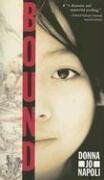
Bound

boundby Donna Jo Napoli

Reading this retelling of the “Chinese Cinderella” story was a painful experience for me. I could not even tell if it is well told, as stories go, because I was so distracted by all the inaccuracies in Napoli’s portrayal of Chinese cultures, customs, characters, and philosophies.

Here are some examples of my understanding that does not coincide with Napoli’s text. Granted, I need to do more research and see if maybe my understanding is not universally correct..

A second wife of a man is not the “Stepmother” of his children by the other wife. She is the “auntie-mom” or “second mother.” A stepmother is the wife of a second, separate marriage after the first wife is no longer around.

Napoli’s misunderstanding of Chinese words is glaringly annoying: A Carp (li 3rd tone) and the word Advantage (li the 4th tone) look and sound completely differently — yes, in English, you see them both sound as “Li” — but their tones are different, and thus a Chinese speaker will not confuse these two at all. There is no way that Xing Xing (the main character) can paint/carve one of these two words to set up a “pun” in the ceramics she made.  And would a Chinese native speaker say something like this, “‘Ming means ‘bright’ with a second tone. The word for ‘destiny’ sounds the same but with another tone.”????? If they are speaking Chinese (which they are supposed to be doing in the story,) there will be no need to point out the tonal differences because by SPEAKING them, the different tones are already apparent.

Also — homophones are the most common in Chinese language. All the following are of the same pronunciation (and it’s only 5 out of a possible 20 or so homophones): Ming = bright, Ming = name, Ming = bird call, Ming = remembrance, Ming = hell/world of the spirits. Yes, the Chinese do have word plays, and much of such plays relies on the confusion of homophones… but, the way Napoli wrote it, you can just tell that she does not really GET this language. This is the same throughout the book: reading it feels like reading a Chinese History 101 text, with pieces of a tale stuck uncomfortably on the margins.  A most painful experience…

Leave a comment

Filed under Book Notes, Views, WIWWAK