How to Heal a Broken Wing

Author: Bob Graham (illus.)
Rating:
Reading Level: toddler to 3rd grade

Publisher: Candlewick
Edition:Hardcover, 2008


How to Heal a Broken Wing Since I am not one who usually loves books with strong and obvious messages, I surprised myself for really liking this one. Why? First and foremost, I think it is because that there is a real plot and emotional arc in the telling of this gentle and simple story of hope. Hope in healing the wounds of the world (a page with the TV screen showing the current War in contrast with the family’s loving care of the bird); hope in having our next generations to have compassion for the world around them; and hope for the inter-generational “collaboration” in finding ways to heal.

Graham’s cartoon illustrations do not reduce the emotional impact of the story — the varied composition, perspectives, page layouts, all contribute beautifully to accentuate the events and the interior motions of the characters. That one spread where you only see Will and the bird with broken wing (as an extreme close-up from the spot on the cover) is superb! The more and more closely I examine this work, the more I appreciate it. (So, just changed from 4 to 5 stars!)

View all my reviews on Goodreads.

Leave a comment

Filed under Book Notes

Wanda Gag: The Girl Who Lived to Draw

Author: Deboarh Kogan Ray (illus.)
Rating:
Reading Level: K to 3rd Grade

Publisher: Viking
Edition: Hardcover, 2008

Wanda Gag: The Girl Who Lived to Draw I am profoundly moved by this picture book biography of an amazing artist. It’s partially because of my own belief in the power and importance of art in our world, but mostly, it’s because Deborah Kogan Ray’s candid text, capturing Wanda Gag’s spirit, and her oil paintings capturing Gag’s world and time. My eyes and heart were drawn to those little lighter/brighter outlines around some of the objects and figures in each painting. I don’t really know why, but they seem to be metaphorically significant: flashes of light (hope? human spirit?) peeking through even the darkest times. This is an outstanding biography, even for slightly older readers.

View all my reviews on Goodreads.

Leave a comment

Filed under Book Notes

The Recent Newbery Debate

In the world of Children’s Literature, a recent (and seemingly perennial) debate has the field experts and practitioners jumping in and all over each other on the Nets (an Ender’s Game term!) Anyway. Here are some links and a couple of my own responses to those articles and comments.

The original article is called Has the Newbery Lost Its Way by Anita Silvey and SLJ published the article and many comments in its Talkback section. One of the very active talkback follows Nina Lindsay’s thread in SLJ’s own blog “Heavy Medal” entitled The Newbery Remembers its Way, or “Gee, thanks, Mr. Sachar”. Over here on Roger Sutton’s blog Read Roger, his post Going for the Gold also generated further discussions. Another thoughtful blog post is The best book no kid wants to read at Librarily Blonde.

I posted two rather long-winded responses on the SLJ and the Librariry Blonde sites but want reposts them here as well:

Response on Librariry Blonde:

I agree with almost everything here and I already posted a long response to Silvey’s article in two places. However, I still think it is important that we/the committee members take into consideration of the author’s ability to “speak to children” successfully through his/her work. And I DO think that the criterium of potentially appealing to many children should be considered as an important component when we define the “work of art” aspect in a “book for children.”

This is a separate genre and it should have its own distinct set of criteria. If we are looking at a work of fiction, we must of course examine its plot, its character development, its theme presentation, its pacing, its use of language, etc. But, then, where in this list of criteria do we consider the “children’s literature” part? What makes a book “stand apart” and become a great “book for children” and not just a “book for general readers or adults” IS its ability to reach out and grab child readers. Some of them will appeal to adults (Golden Compass, Charlotte’s Web, Tuck Everlasting, Out of the Dust, The Giver, and yes, Holes) as well — but, if they are only appealing to a very small group of children and a large group of adults, then they, in my mind, fail to BE “children’s books.”

I think there has to be a balance and a serious appreciation of those writers who really know how to tuck the heart strings of many children without giving up the high demand of literary qualities. That, my friends, should be the real charge of the Newbery Committee (and actually it IS the current charge if the committee chooses to interpret the criteria to its fullest extend and give EVERY clause equal weight.)

Response on SLJ:

I don’t quite feel outraged by Anita’s article as some of my Newbery Committee colleagues (not necessarily serving simultaneously as I did but those who went through the “same” process as I did.) Maybe because in some way, I feel similarly to many of those quoted by her — that the recent few years did not QUITE yield the most long-lasting and child-appealing titles.

But even in the 90s, not all of them are being sought after by today’s children — even HOLES has lost some of its luster with my 4th and 5th graders because they have moved on to the newest things! Out of the Dust is not picked up by children themselves. It is being “used” by teachers. The View from Saturday is read but only by a small group of children. The Midwife’s Apprentice does not get takers no matter how much I try to push it. Walk Two Moons is just one of the many Sharon Creech titles now. The Giver remains strong going both within the classroom setting and words of mouth. Missing May has become almost obscure. Shiloh definitely does not elicit the same excitement as many new titles. Maniac Magee is still being taught and regarded highly in classrooms. It, however, is also not a book that children recommend to each other any more. Number the Stars remains strong. So… out of the 10 titles, only 3 really has its OWN lasting power without the help from teachers or librarians.

And in the 9 years of winners from 2000 to 2008, we have Bud, Not Buddy, a book my students constantly read and exclaim to their peers how good it is! We have The Tale of Despereaux, a new “classic” amongst grade school kids. And this year’s Good Masters! Sweet Ladies!, a book that teachers will keep promoting and will bring fresh air into the classrooms. Plus the title cited by Anita A Single Shard which teachers definitely enjoy teaching. And the reports from the students remain positive, although it is not an easy “sale” all the time. That’s 4 titles worthy of mentioning. Not that much different from that of the 90s and actually if one examines carefully each decade, the scenarios are quite similar (3 or 4 that really speak to a larger number of children and 3 or 4 that are somewhat obscure and than about 2 in the middle ground.)

So, I do question the whole “surveying” method that is the basis of this article and wonder about those other who were “interviewed” but not quoted. Did some of them speak positively about the choices and their faith in the process but were not quoted because their opinions did not fit cozily with the intent of the report? However, even as I somewhat question the method of the article, I do agree, quite strongly, that CHILD-APPEAL is essential in selecting the “most distinguished” literary work for children in the United States.

I have made this same argument for years now — that we as participants in a legitimate field of intellectual inquiries (the children’s literature study,) must acknowledge and award those who have the uncanny abilities to speak directly to children everywhere — those who know HOW to write “for children,” and those who are beloved by their targeted audience. Writing for children will always be regarded as “simpler and easier” than writing for adults if we cannot figure out ourselves how to critique, evaluate, and award the true talents and keep the Newbery Medal truly meaningful to the readers.

4 Comments

Filed under Book Notes

More on Gaiman’s Graveyard Book Reading

(I was asked to report on the event at Child_lit so I wrote a bit more about it and decided to post the report here!)

It was a lovely free event (I got there at 4:30 for the 7:00
event so I did get very good seating!) at the Teacher’s College Horace
Mann Auditorium. It seats about 500 and the room (orchestra and
balcony) was filled to capacity. Most of the people in the audience
are Neil’s adult fans — many college/late 20s who obviously are great
fans of Sandman since when he made references to Sandman characters,
the entire room responded. There were, however, a dozen or so
children and when he read (he read the entire first chapter — 33
pages,) those children responded very favorably — laughing at the
right moments (also thanks to Neil’s skillful and dramatic reading).
I sensed that the audience got slightly restless toward the end of the
chapter since there were a couple of places that we felt would have
made a natural break. but the story kept going, after shifting gears.
However, I imagine that if it is broken down to two readings, no one
would have felt the reading was just a tad “long.”

Oh, and we were treated to a very cool, not-before-seen, Coraline
trailer. It IS going to be 3D Stop Motion Animation for the whole
entire deal. Let’s hope for the BEST!

His Q&A section was great, talking about his China trip (one month,
researching myths and legends, and breaking a finger,) his haircut,
his characters in books, whether he’ll write sequels to Neverwhere,
American Gods, etc. (yes, he WOULD if he had the time — and yes,
there are stories set in all these worlds.) He was asked if there is
any difference in writing a “more intricate and complex” book for
adults than a “less so” (grumble) book for young adults/children. He
said No. It’s all putting one word after another. And then he said
that the only difference was the length it took him to write the books
— one (American Gods) took longer than the other (Graveyard Book.)

He talked about how he sometimes worries about his characters coming
out of his books to knock on his door and demand to know WHY he
created him and made them live such miserable and dark lives. He
talked about how he indeed is “their maker.” He imagines of his own
“meeting the maker” moment after his unavoidable demise: “When I ask
WHY ME, Why NOW? I’m afraid of hearing a booming voice from the Sky
that says, ‘Because that makes a BETTER STORY.'” The audience
laughed, of course. (He did the God-Booming voice very well… and my
paraphrasing is nowhere near funny as he was in person.)

I posted a link to the audio file from HarperCollins on my blog. No
pictures or video from me, unfortunately. I believe that the reading
will be (is planned to be) put online soonish — since he is doing ONE
CHAPTER per city on this tour until the whole book is read through.
(And he also talked about audio book recording and how much he LOVES
doing it even though it is really hard work.)

– AND INDEED the VIDEO of his reading can be found HERE.

Leave a comment

Filed under Field Reports

More on Gaiman’s Graveyard Book Reading

(I was asked to report on the event at Child_lit so I wrote a bit more about it and decided to post the report here!)

It was a lovely free event (I got there at 4:30 for the 7:00 event so I did get very good seating!) at the Teacher’s College Horace Mann Auditorium. It seats about 500 and the room (orchestra and balcony) was filled to capacity. Most of the people in the audience are Neil’s adult fans — many college/late 20s who obviously are great fans of Sandman since when he made references to Sandman characters, the entire room responded. There were, however, a dozen or so children and when he read (he read the entire first chapter — 33 pages,) those children responded very favorably — laughing at the right moments (also thanks to Neil’s skillful and dramatic reading).

I sensed that the audience got slightly restless toward the end of the chapter since there were a couple of places that we felt would have made a natural break. but the story kept going, after shifting gears. However, I imagine that if it is broken down to two readings, no one would have felt the reading was just a tad “long.”

Oh, and we were treated to a very cool, not-before-seen, Coraline trailer. It IS going to be 3D Stop Motion Animation for the whole entire deal. Let’s hope for the BEST! His Q&A section was great, talking about his China trip (one month, researching myths and legends, and breaking a finger,) his haircut,
his characters in books, whether he’ll write sequels to Neverwhere, American Gods, etc. (yes, he WOULD if he had the time — and yes, there are stories set in all these worlds.) He was asked if there is any difference in writing a “more intricate and complex” book for adults than a “less so” (grumble) book for young adults/children. He
said No. It’s all putting one word after another. And then he said that the only difference was the length it took him to write the books — one (American Gods) took longer than the other (Graveyard Book.)

He talked about how he sometimes worries about his characters coming out of his books to knock on his door and demand to know WHY he created him and made them live such miserable and dark lives. He talked about how he indeed is “their maker.” He imagines of his own “meeting the maker” moment after his unavoidable demise: “When I ask WHY ME, Why NOW? I’m afraid of hearing a booming voice from the Sky that says, ‘Because that makes a BETTER STORY.'” The audience laughed, of course. (He did the God-Booming voice very well… and my
paraphrasing is nowhere near funny as he was in person.)

I posted a link to the audio file from HarperCollins on my blog. No pictures or video from me, unfortunately. I  believe that the reading will be (is planned to be) put online soonish — since he is doing ONE
CHAPTER per city on this tour until the whole book is read through. (And he also talked about audio book recording and how much he LOVES doing it even though it is really hard work.)

* Here’s the link to the Graveyard Book Reading Tour on Video.

Leave a comment

Filed under Book Notes

Neil Gaiman in NYC

I feel strangely obligated and slightly compelled to at least mention that I was one of the audience members (around 500) who went to hear/see Neil Gaiman read the first chapter of The Graveyard Book. He was as always, charming and witty, and the Q&A section where he answered many questions written on index cards went beautifully humorous. And I, as always, did not bring a camera. Oh, well. I am sure that if you google Neil Gaiman Graveyard Book New York City — you’ll see some more enthusiastic and better prepared fans’ pictures, videos, and audio clips. Here’s an audio file for the entire first chapter as pre-recorded by HarperCollins.

Leave a comment

Filed under Field Reports

Hate That Cat

Hate That Cat: A NovelAuthor: Sharon Creech
Rating:
Reading Level: 2nd to 5th grade

Pages: 153
Publisher: HarperCollins
Edition: Hardcover, 2008

I was really delightfully surprised at how I enjoyed reading this one. I remember loving Love That Dog and did not think that I was emotionally manipulated — although most of the time I feel Creech’s books highly “manipulative.” And again, I cried over this little story and did not hate the fact that I cried. I have been wondering about Verse Novels and this book does not only present itself as a verse novel, it discusses the notion of poetry — light ones vs. “serious” ones; children’s self-reflective writing vs. classic, grand poetry. It’s definitely a very teacher-y book. I can see 4th-6th grade teachers all over thinking to themselves, “I can use this in my poetry unit! It even teaches techniques such as similes, metaphors, and alliteration!” The introduction of a deaf mother is an interesting touch. Maybe a little forced but it does offer the opportunity for the young readers to think and discuss the notion of beat/rhythm as “sounds” and actual physical vibrations. (Oh, my, god, can this book even be used by Science Teachers about sound waves?!!)

Anyway. I am pleased with the book.

View all my reviews.

Leave a comment

Filed under Book Notes

Examining The Five Chinese Brothers

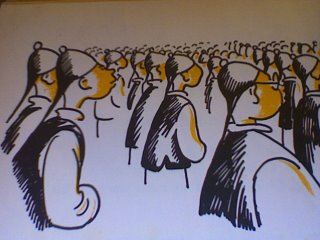
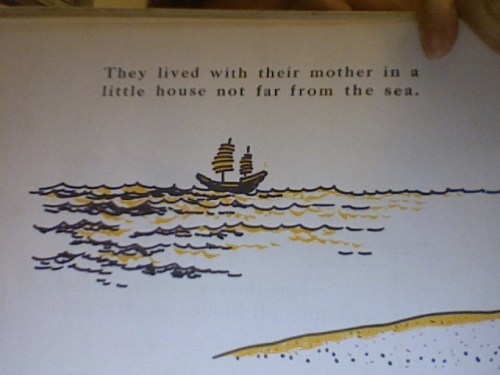
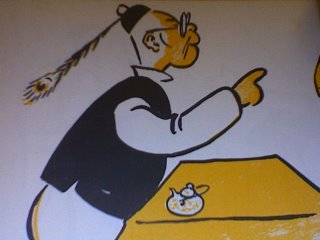
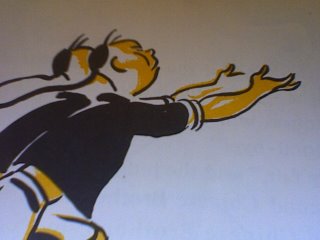
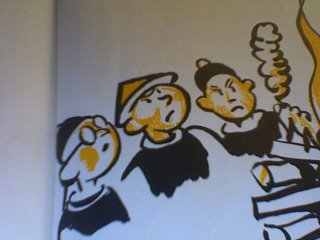
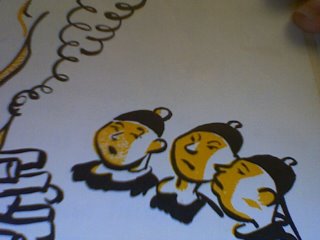
On Child_lit (a listserv devoted to the discussion of children’s literature), we’ve been having a heated debate (again) over Bishop’s The Five Chinese Brothers. (Claire Hutchet Bishop/Kurt Wiese, 1938) I have been a supporter for this book for the longest time, sharing it with my daughter who is half-Chinese and half-Jewish. (I am 100% Chinese: half Han, half Manchurian, born and raised in Taiwan.) I’m only posting here to let my readers decide whether the common complaints about this book match the facts. The complaints have been mostly based on the illustrations, so that’s all we’re going to look at today.

1st complaint: everyone in the crowd looks exactly alike in a stereotypical way.
There are only two spreads in this 32-page picture book that contain a crowd scene. Most of the faces are just outlines of the cheeks. These few faces in the front show completely different features: ear and face shapes, noses, mouths, and neck thickness, and one even wears glasses. Their outfits are all alike and every man has a queue (the braided hair) which was the required/prescribed hairstyle for all men in the Qing Dynasty (1644 – 1912.) Cutting off the queue or wearing hair in a different style could cause someone’s life since that was against the law. So, if the illustrator decided to set the story during those 250+ years, it is entirely normal for a crowd of men to wear queues.

Photo-38-751016

Complaint 2: Chinese people are not yellow like that.
This book was published in 1938, at a time where 4-color separation and multicolor printing was not common and was not done in most children’s books. This book has 3 colors which means it has but ONE color. Black and white were a given and one more color was added to brighten the illustrations. Everything is YELLOW in the book — from the waves of the sea, to the sails of the boat, the treasures on the seabed, and the flames of the fire. As a Taiwanese Chinese, we were taught that we were the “yellow race” and proud of the hue of our skin. Yes, we are not truly “yellow” (like many blacks are not really “black”) but we were never ashamed of our skin color.

Photo-37-751044

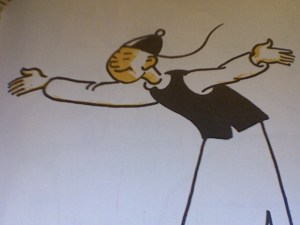
Complaint 3: Not only the people in the crowd, the other characters all look the same, too. (It’s a given that the five brothers have to look exactly alike — which Weiss managed to do extremely well.)

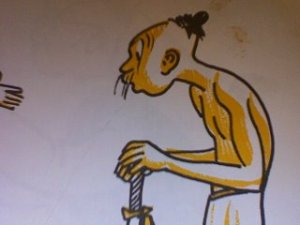
This is one brother. Examine the pictures following this one: do these faces look “the same” and “the same as the brother” to anyone? Indeed, each face depicted differs from the rest. If the readers/viewers cannot make out the differences, it is not the artist’s fault.

Complaint 4: these people all have the stereotypical slanted eyes.
It is true that most of the faces illustrated feature slanted/small/single line eyes. Could it be that – a. many Chinese people’s eyes are smaller, without the hanging folds over the eyes, than the Western people? b. The slant of the eyes is prevalent in the Chinese? and c. This is a particular style of the artist?

Photo-40-720526

Photo-39-720506 Photo-41-756385 Photo-42-756407 Photo-44-785347 Photo-45-718906Complaint 5: Bishop didn’t cite a source of this “Chinese” tale.

In 1938, most retellings of fairy and folktales were not sourced.


13 Comments

Filed under Book Notes, Child_lit Archive, Views, WIWWAK

Schooled

Author: Anisha Lakhani
Reading Level: HS/Adults

SchooledI read this after hearing lots and reading quite a few reviews about the book, so I am not entirely sure about my reactions – how much was my enjoyment and annoyance colored by these preset expectations? And how much of my secret pleasure and overt disgust came from my having known the author and has been working in the school that this fiction is supposed to be based on? So read on, those of you who are curious to know my opinions about the book, with caution and many grains of salt!

First, I was surprised how the book does not really feature many recognizable students and faculty from the school, nor does it develop the school as a setting fully. In fact, most teachers do not even enter the story. It’s as if this fictional K-12 school has but 50 students and they all go to the 7th grade and there are only half a dozen teachers who come into contact with the protagonist and the children. In short, the setting of the school is not quite fleshed out or rich, and the supporting characters are not 3-dimensional, either. A few incidents or coincidences are probably not identifiable by those who are not intimately connected to the school, either. So much, so much of the story is extremely exaggerated: the characters complete caricatures, and the whole world distorted with the kind of hyper-reality one can only find in Gossip Girls and Sex in the City. (Of course also in the highly manipulated Real Housewives “reality” shows…)

This brings me to say to those who seem to think that this is a truthful portrayal of the Manhattan Private Schools/Ivy League Feeders world, “You are absolutely wrong.” This is fluffy fiction and no more than that.

I don’t think there is even a need to defend my school since there is so little resemblance in SCHOOLED to the actual school — including the physical descriptions and the ways teaching and learning are accomplished throughout the years. Suffice to say that I have encountered scores of most brilliant human beings: readers, writers, thinkers, activists, artists, mathematicians, scientists, all kinds of people — both from its faculty pool and the student body, to feel privileged and proud to be part of this incredible institution.

The biggest weakness of the book, to my eyes, is how bland the writing is… with few exceptions where the lines are actually funny or effective, such as, “The world could be coming to an end and my mother would still find a way to offer a cookie with the gas mask.” and “It was an all-purpose word, something of a Swiss Army knife capable of replacing all sorts of words, such as do, write, create, and especially finish.” The rest of the book is filled with lines with little crafting or “polishing”. Just a few examples here:

page 124: Anna wonders “if Shakespeare would be … delighted that his work was the cause of such delight to a group of… seventh-graders.”
page 126: “The last comment was like a wound in my heart.”
page 131: “And I was an air traffic controller trying to control fifteen little planes all trying to land at one time.”

To compound the problem of such thin prose is the poor editing. Missing punctuation marks, continuity errors, and misused words, such as “My ears were ringing. And when did faux mitzvah enter everyone’s vocabulary accept mine?” ACCEPT? And this is supposedly written/narrated by an Ivy-Leaguer who studied English in college and teaches English to 7th graders.

The one saving grace is that the readers do not admire Anna (oh, maybe a little bit toward the end of the story when she suddenly has a courageous enlightment moment), and that adds some flavor to the tale of a small fry lost in the world of greasy glitz.

And chatting online with a High School student might shed more light on our views over this book:

Edited for clarity:

fairrosa: Yup… I guess… closer to truth. Nothing is TRUE in this book, though. And it’s so hyper-reality that anyone thinks this has anything to do with reality is delusional themselves, I think.
student: You overestimate that, I think
fairrosa: overestimate how?
student: I think you overestimate how attuned the average reader is to Dalton
fairrosa: Definitely — that’s why I definitely need to write about how this is NOT the reality. But I did like the book enough… it’s better than some other trashy novels, for sure.
student: Wha? O.o
fairrosa: All the flaws aside, Anna Taggert is a main character that does not put on a holier-than-thou air, nor is she pretending to be anything but a corrupted small fry lost in a glitzy world, even though in reality, I have yet to encounter any such real-life teacher.
fairrosa: That’s my last paragraph…now.. do you think my analysis fair?? any other issues with the review?
student: Doesn’t put on a holier-than-thou air? I really don’t think you read this book XD
fairrosa: please let me know if I can post it as is?
student: It’s an okay-written review, it’s just wrong. It didn’t bother you that characters spent the whole time hitting on her? That, somehow, nothing was ever actually her fault?
fairrosa: Hey.. .Anna Taggert is portrayed as a silly, money grabbing, totally lost person. There is nothing there to show that she is better than anyone else…
Everything is her choice — she decided that she needed MONEY … she failed to plan lessons — she is stupid…The character is NOT portrayed as a GOOD person. Did you read the book?
fairrosa: One does not read the book and says to oneself that Anna Tagger is SUCH A GOOD person. Does one?
stuent: No, but she thinks she is!
fairrosa: But the READER knows that she is stupid, spoiled, greedy…etc. and the AUTHOR writes in that way…
fairrosa: she curses. she envies. she receives bribes. she cheats
student: Mmm, yes. But do you really think the point of the book is that she’s bad, or that she was a good person placed in a bad system?
fairrosa: I think she was WEAK… maybe Bad/Good is not a great way to describe her or anyone else.
fairrosa: I think she did not really have moral fibers… of course, the world around her doesn’t seem to have morals either…
student: She’s portrayed as a nice girl corrupted by an evil world. Yes?
fairrosa: Nah… I don’t think she’s portrayed as a “nice girl” ever — her motive of being a teacher is so that she would be LOVED by her students…So, I never got the sense that the protagonist is supposed to be a GOOD person.
student: Not that she would really teach or change students’ lives.
student: That’s absolutely false.
fairrosa: Did you find any of the book funny?
student: no.
fairrosa: Or are you just completely incensed?
fairrosa: Do you think it’s because you’re too close to it? Too protective of our school?
student: I think I might have been okay with it – or at least, not hated it – had it been marketed differently, had it not billed itself as that “look at what a 5-figure tuition really gets you”
fairrosa: Fair.

View all my reviews.
1 Comment

Filed under Uncategorized

The Black Book of Colors

Author: Menena Cotton, illus. by Rosana Faria
Rating:
Reading Level:pre-k – 2nd (and all ages)

Publisher: Groundwood
Edition: 2008, Hardcover

The Black Book of ColorsWhat a unique and amazing book!!!! I am speechless and wish everyone could read/touch/experience it!

View all my reviews.

Leave a comment

Filed under Book Notes

Take the CLAT Quiz!

The “Back to School” Horn Book Magazine is out. Monica Edinger and I have a piece in it. Maybe you’ll enjoy trying your hand in answering questions we prepared?

Leave a comment

Filed under Uncategorized

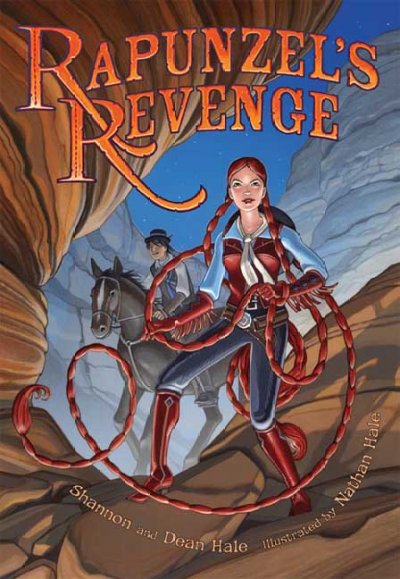
LRBC02-Rapunzel’s Revenge

Written by Shannon and Dean Hale
Illustrated by Nathan Hale
Published by Bloomsbury USA, 2008
144 Pages
Graphic Novel
Middle Grades (3-6)

Lily just got back from summer camp and picked up this book in the living room. I read it last week and fell in love with the story, the characters, the illustrations, and the graphic novel design of the entire package. I was pleased to find that Lily couldn’t put the book down. After she finished it, we had a little chat. The one thing that surprised me was that in Lily’s mind, the setting isn’t all that unconventional for a Rapunzel tale while to me, the setting is one of the most intriguing features since I always placed Rapunzel as a European story set in the deep woods.

Here’s our chat:

Leave a comment

Filed under Uncategorized

The Diamond of Drury Lane

The Diamond of Drury Lane (A Cat Royal Adventure)Author: Julia Golding
Rating:
Reading Level: 4th to 7th grade

Pages: 424
Publisher: Roaring Brook
Edition: Hardcover, 2008

This is a winner! (Literally, too, since it did win the Smarties prize.)

Cat (Catherine) Royal is a charming, vivid, endearing, and plucky heroine. Readers really care about what happens to her and her friends. The host of friends are also drawn with details and depth. One can practically hear them speak and see them act and react to Cat’s adventures. The clever device of having Cat being immersed and specially educated in the backstage of a theater gives credit to Cat’s deft hand at recounting events and using words above her station in life. For example, on p. 89: (I cast around for some suitably Shakespearean language to impress them, not having in truth a clue what I was talking about) “the wickedness of treason, the sting of revenge, and the noble disinterestedness of love, all set behind the scenes.”

The fast pace, the string of new obstacles, the many friendships between the characters, the gradual and satisfying unraveling of the truth about the Diamond, the breezy and energetic prose — all contribute to make a completely enjoyable reading experience. I especially appreciate how Cat got into bigger and bigger trouble and deeper and deeper danger as the story moves along so that toward the end of the tale, you are really anxious to see how she gets out of this last huge scrape.

View all my reviews.

Leave a comment

Filed under Book Notes

Rapunzel’s Revenge

Rapunzel's RevengeAuthor: Shannon and Dean Hale; illus. by Nathan Hale

Rating:
Reading Level: 4th – 7th

Pages: 144
Publisher: Bloomsbury
Edition: Paperback/Graphic Novel, 2008

It did not disappoint! Yeah! I had so much fun reading and looking at this book and its illustrations. Shannon Hale’s telling, even with reduced amount of text due to the graphic novel nature of the book, is crisp and humorous, and with certain subtlety that amuses me, the adult reader, and yet not difficult to appreciate for young readers. (I had a 10-year-old girl today reading it and she absolutely loved the book — then she found out that this is by the same author who gave her the pleasure of GOOSE GIRL and PRINCESS ACADEMY. She was thrilled!) The wild wild west setting is cleverly executed. I wonder how others react to the the references to the Native American cultures and characters — personally I thought it’s done very sensitively and much of it is conveyed visually — so I also wonder how all that was communicated between the authors and the artist. What a fun tall tale we’ve got us here. I am so pleased!

View all my reviews.

Leave a comment

Filed under Book Notes

What’s up with Normal?

In the past few years, I’ve noticed quite a few fiction titles for middle grade and middle school readers have the word NORMAL in their titles. Here’s a list to help everyone keep them straight!

Back to Normal by Kate Klise (2008 – Scholastic)
Chasing Normal by Lisa Papademetrious (2008 – Hyperion)
Deliver Us From Normal by Kate Klise (2005 – Scholastic)
Far From Normal by Kate Klise (2006 – Scholastic)
The Last Exit to Normal by Michael Harmon (2008 – Knopf)
Looking for Normal by Betty Monthei (2005 – HarperCollins)
Not Exactly Normal by Devin Brown (2005 – Eerdmans)
Waiting for Normal by Leslie Connor (2008 – HarperCollins/Katherine Tegen)

And, of course there is the wonderful nonfiction, It’s Perfectly Normal, and the YA Define Normal by Julie Anne Peters (2000 – Little Brown.)

I wonder if we collectively feel unsettled and abnormal and thus must find some way to either explain our abnormality or to rein

Leave a comment

Filed under Uncategorized

Someone Save the Authors from Sloppy or Non-existent Copy-editing!!!

Although I am only talking about one book today, by way of an example, I am really ranting about a fairly wide-spread phenomenon in Children’s Publishing of late — that of a lack of careful copy-editing. Copy-editing is defined briefly as: to mark errors of spelling, grammar, punctuation and word usage to prepare the manuscript for final printing so each finished book is as error-free as possible. I am unsure whether there are still full-time copy-editing staff in most children’s publishing houses these days (maybe someone can speak to this in a comment?) but from the number of errors one encounters in children’s books these days, it seems that human copy-editing has become an obsolete art. If you have read a lot of recent children’s books as I have done, you’ll know what I’m talking about.

I just finished reading a very well-written and exciting story by Polly M. Robertus, entitled The Richest Doll in the World. It’s a Holiday House 2008 publication. Judging from the font size and the length (129 pages,) I have no problem thinking of this book as for fairly beginning readers. Say, 2nd to 4th graders. It is even more inexcusable that the copy-editing is so sloppy! Here are a few page scans to illuminate my concerns. Before you read on and see for yourself whether this is a serious issue, I just want to say how sorry I feel for the author of this book. I can only imagine how much time, effort, hope, and heart went into writing, revising, and perfecting the telling of this entertaining and heartwarming story and yet, as a librarian, I cannot feel comfortable recommending this book to my young readers due to its poor copy-editing. I wonder if I am alone in feeling this way?

p. 18

You lust haven’t tried hard enough…LUST?
I can just imagine how a 2nd grader reading this book asks her mom, “Mommy, what is LUST? I don’t understand this sentence. What does ‘lust haven’t tried’ mean?” Try explaining that one!

p. 26
Last time I checked (2 seconds ago,) the word “sidesh” has not made its way into the Merriam Webster Dictionary yet. (One would imagine that even a computer spell checking program would have picked up completely non-existing words and corrected the error. Did the production team not even bother with a once-over using a free program?)

These two are both from p. 34 — and I was simply baffled by the abundance of commas…

19 Comments

Filed under Uncategorized

Today’s quote

“Things have to end to give them meaning and shape. Without an end, something is a soap opera.” — Neil Gaiman on giving an end to the Sandman series, segment of interview on Globo News.

Leave a comment

Filed under Uncategorized

Two Quotes

A quick and easy definition: Science Fiction has rivets; Fantasy has trees. – Orson Scott Card (from the audio commentary of Ender’s Game, audiobook edition, 2002)

“They are not just coloring out of the lines. Their pens are not even on the paper any more!” — paraphrased from Thom Filicia, designer and host of Dress My Nest, the Style Network

Leave a comment

Filed under Uncategorized

Quote of the day

I’m listening to Toole’s A Confederacy of Duncies and have many occasions to chuckle or even laugh out loud — although the many comical situations are also profoundly sad. Here’s a quote for the day to show Toole’s genius in characterization without getting into tedious details:

Miss Trixie was never perfectly vertical; she and the floor always met at an angle of less than ninety degrees.

Leave a comment

Filed under Uncategorized

Kung Fu Panda and Wuxia

Let me just come straight out and state that I really loved Kung Fu Panda, one of the summer’s animated family movies set in a non-specific Chinese village, featuring all animal characters, ranging from Rhinos and leopards to pigs and praying mantis. Oh, and, a Giant Panda whose father, unfathomably, is a duck who is a chef and owns a noodle shop. I know that upon close examination, many people might find the story a bit superficial, and superficially mystical: about finding oneself and having faith in one’s abilities and the whole “mystical” notion of fulfilling one’s fate. It might be an outsiders’ view of what Chinese martial arts world is all about but the creators of the movie did their homework and pay a lot of homage to the wuxia tradition.

Wuxia can be loosely translated to “martial arts knights” but the notion of WU is larger than just the practice of martial arts; it’s a mind set and a way of life. So is the notion of XIA — it often is not simply a person who has demonstrated talents in the arts of WU but also someone with great integrity and compassion, one who will help the less fortunate, and fulfill one’s duty to the fullest. Wuxia Xiaoshuo (Wuxia Novels) has been a uniquely Chinese popular literary genre for the 20th and 21st centuries. A little more detailed explanation of general themes can be found on the wikipedia article on this topic.

One of the most fascinating elements, for me as a reader of wuxia xiaoshuo (I read wuxia most ardently during high school and college years) is the training processes of the protagonists. These tend to be unrealistically super-human — one might learn to “walk on the top of grass” or to “defeat a dozen enemies barehanded and blind-folded,” etc. That’s why in my mind wuxia is closely resembling the western Fantasy novels. The creators of KFP definitely captured this aspect when Shifu (literally: Teacher/Master) figures out how to train Po and the audience is treated to a fantastic sequence of training sessions.

The movie is accompanied by a wonderful soundtrack and gorgeous background artwork. The calligraphy is not only beautiful but accurate. However, in most wuxia stories, you will find people using many different kinds of weapons: from swords to spears, with “hidden weapons” such as small needles (sometimes dipped in poison) and poisonous powders. Weaponry and the inventiveness of such are also what the readers/audience tend to appreciate in a work of wuxia. Maybe the sequel will feature more than just body-combat and using random objects (bricks and firecrackers, for example) to fight.

Leave a comment

Filed under Views, WIWWAK