Dystopia on My Mind

After reading Suzanne Collins’ The Hunger Game, I’ve been mulling over the notion of a Dystopian novel. Have had some online and off-line discussions and realized that my definition of a Dystopian novel is very narrow but still want to hold on to that view because I believe that if it is too broadly applied, the power of the genre will cease to be as effective as it has been. Here’s an IM chat transcript between me (F) and a former student who is now entering his senior year in high school (J). Slight edition was applied to the original format to make it more readable:

AIM IM with J.

J: Hey!
J: Happy 4th!
F: You too You too
F: So. Asking you a quesiton.
J: Yeah?
F: What do you think is a Dystopia?
J: …Hmm. Well, WALL-E is dystopian.
F: how so?
J: It’s a vision of the world where everything’s gone to hell.
F: I have a very narrow definition of dystopia. That’s too broad. That’s just a BAD future
J: Alright. Well 1984 is dystopian. Yes?
F: Yes. Explain. Haha. This Is A Test!
J: Oh. So you subscribe to the theory that a dystopia must appear utopian.
F: I do.
J: I don’t.
F: Then why bother using the term?
J: A dystopia is a world where everything is wrong. Look at the Greek roots.
F: I know.. but the word did not exist until 1868 according to OED
J: War of the Worlds is dystopian.
F: An imaginary place or condition in which everything is as bad as possible. That’s the broad definition. I’m thinking of the literary tradition. The ‘dystopia’ or ‘inverted utopia’.I guess it can be so easily defined as a horrible future world (or current world.)
J: Yes.
F: Then, to me, the word to define a genre is almost pointless. ’cause anyone writing about the future with a bad government is writing a dystopian novel. Argh. ugh too.
J: Hmm. Well. You have a point, that it broadens the definition…
F: and ceases to be truly meaningful.
J: Although a bad government would never a dystopia make. Go see WALL-E and we can have a more intelligent conversation about this – seriously.
F: For me, the power of a dystopia novel is the presentation and conflict between what’s SO GOOD on the surface with what’s SO BAD underneath.
F: hahah. I will have to wait for Lily to get back to the city.
J: From the standpoint of a librarian, I see why you’re right.
F: I promised not to see it until then.
J: From the standpoint of a student of Greek, I disagree with you.
F: Haha
J: Brave New World. Dystopian?
F: That’s MEANT to be a Dystopian novel. So was 1984.
J: Fahrenheit 451?
F: But not sure about Blade Runner. I think 451 is. So is The Giver.
J: But Fahrenheit 451 isn’t meant to be utopian. Giver – certainly. Well, Do Androids Dream is dystopian – haven’t seen bladerunner.
F: That’s why I said, “I think.” ’cause I am not sure.
J: The Giver is a very archetypical dystopia. What about The Diamond Age?
F: Not Dystopian by a LONG SHOT. Neither are the Ender’s series. The world is not perfect but nothing is so inverse. There has to be some form of “inversion”
J: I kind of thought the Chinese world in Xenocide was dystopian?
F: That’s that particular world, maybe, but the entire series is definitely not concerning itself singularly that way.
J: I agree.
F: Matrix is not dystopian.
J: Oh? Why not?
F: Even though it does portray a world that is under such control.
F: I dont know.
J: btw, this question is awesome.
F: Why don’t I think so?
F: HAHAH
F: Matrix — ’cause I guess in some way the people who made the movie did not really have much to say about our society
F: As a literary genre, it serves a fairly specific function. Here’s an example: Lord of the Flies. It’s a little society that is as BAD as it can be.
J: LotF isn’t a dystopia.
F: That’s THE example. How it is not.
J: Well, I’ve stolen your view.
F: If by your original definition…
J: No, I’ve switched, irritatingly!
F: Haha
F: YEAH. I WON.
F: Ok.
F: I’m saving this convo for my blog.
J: Well, it’s poorly-conceived Greek by your definition.
J: But I concede that, from a literary standpoint, your definition makes more sense.
F: HAHAH. thank you. very much.
J: Have you read The Plot Against America?
F: Now I can go to bed and sleep well and be told by someone else tomorrow that my definition makes NO SENSE.
J: Phillip Roth?
F: Nope.
J: Alright. lol, who’s going to tell you that?
F: is that one?
F: Don’t know yet.
F: I’ve been asking everyone I meet.
F: run into.
J: I think it’s my lone example of a non-futuristic dystopia.
F: talk to.
F: cool.
F: For some reason, in my mind, there has to be some form of superficial utopian view by the masses to set up the stage for a dystopian novel to work. Or at least, to be effective or powerful. Without the contrast, it does not really function well.
J: If you want to interpret it that way, it’s a perfectly legitimate view. So you would think the second half of WALL-E is dystopian, not the first half! ^_^
F: I just read a book for kids (or teens) where you see everything of a BAD society from the view point of a girl who ALWAYS thought of the society as bad and MANY others feel the same way ’cause they are on the BOTTOM of the society. And I simply couldn’t peg this book as a dystopia ’cause there is no disillusion.
F: k. I look forward to the movie.
J: Snow Crash is a dystopia. Even if Diamond Age isn’t.
F: Say if Brave New World is viewed through not an Alpha’s pov but someone really low on the spectrum….
F: Nah.. Snow Crash is set in a future that is both good and bad and people have no illusion about what their society is about. It’s a Cyper Punk
J: I disagree with that interpretation.
F: Already a sub-genre.
J: Cyber Punk can be dystopian!
F: I know *haha* Just want to yank your chains.
J: What’s-it-called! The book by Gibson! Such a dystopia!
F: Neuromancer?
J: Yeah!
F: Hm… disagree. It’s just very bleak world, like Blade Runner.
F: Bleak /= Dystopian
J: So you would think it’s dystopian only from a Tessier-Ashpool point of view. Fantastic wealth, technological advances, theoretical happiness, but bleak = dystopian.
F: I’m thinking maybe one can define the WORLD as a dystopia some times without the book as dystopian. ?
J: Or parts of it, even…
F: I do think it depends also partially on how the author treats that world. The focus. Dystopian stories tend to be cautionary tales.
J: Parts of LotR are almost dystopian.
F: Nah. It’s FANTASY.
F: hahahahaha
J: Fantasy can be dystopian, silly!
F: Disagree re LotR.
J: Minas Tirith is totally dystopian.
F: If that is then Narnia is, too
F: Not at all.
J: The greatest city in the world, where everything’s perfect, rotting at its core?
F: Minas Tirith is just falling from grace, with one bad guardian.
J: A dystopia is a facade of perfection, yes?
F: That’s just faded glory.
J: Under which lies great misery?
F: You’re picking a small part of a grand picture to argue.
F: In MANY novels, you’ll find such settings to help move the plot along or to create conflict.
J: yes. I agree. And Narnia isn’t dystopia, just apocalyptic…
F: So, against the grand backdrop of LotR which is NOT a dystopian novel …
J: Do you mean to tell me you can’t have a utopian society in a non-utopian novel?
F: That’s important to distinguish and I agree with your assessment that Narnia isn’t dystopia (which was my point in the first place)
J: Lorien is a utopia. Yes?
F: Utopian is not a genre. We really don’t have a body of literary work that we can say, “Hey, look, a list of Utopian Novels.”
J: Sure we do. It’s just one book, and it’s by Sir Thomas More.
J: ^_^
F: That’s why I don’t believe that simply defining the word DYSTOPIA is sufficient in thinking about the literary device/genre.
F: it’s not a BODY/LIST of books
F: You stand corrected!
J: Eh, fair point.
F: ‘k. thanks. it’s been fun.

Leave a comment

Filed under Uncategorized

William Sleator’s books

It was telling when Orson Scott Card, upon finding that I had read many of his books and not just the Ender series, got so excited and asked, “So, you must like William Sleator’s books a lot?” and proceeded to gush over Sleator’s work, specifically Singularity. I acted a bit dense and tried to high-five Card who told me that he’s not the “high-five kind.” ooops! But, our brief conversation reminded me how much I DID enjoy all the books I read by Sleator, and how much I appreciate that he not only creates gripping plot and probing philosophical and moral dilemmas, he also really gets in science right (at least according to the theories of the time when the books were written.) My favorite titles by him are Singularity, for its illuminating explanation of black hole and singularity and for its protagonist’s emotional and moral struggle after he realizes that he can age himself and turn the table on his superior and sometimes bullying brother; The Boy Who Reversed Himself, for its vivid depictions of different dimensional worlds and the protagonists’ grappling with adolescence and romance; The Green Future of Tyco, for its dizzying time-hopping scenes and Tyco’s realization of how a person’s past shapes his future and how one can become careless with one’s actions and turn out to be quite despicable; The House of Stairs for its chilling social experiment and exposure of the darker sides (and some brighter sides) of human nature; Among the Dolls, for its creepy depiction of neglected dolls and their revenge upon the careless girl. And I can’t talk about Sleator’s works without mentioning how much fun my students and I have had for years now when we shared the jokes (gross, quite often) and humorous events (highly exaggerated, quite often) in Oddballs — short stories based on his family stories.

Leave a comment

Filed under Book Notes

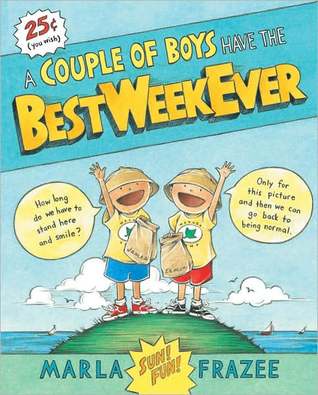
LRBC01-A Couple of Boys Have the Best Week Ever


written and illustrated by Marla Frazee
published by Harcourt, 2008
40 pages/picture book

This book has already been recognized by the Horn Book/Boston Globe Book Awards as an excellent title in the picture book category. (It’s an honor book.)

The two people chatting about this book are Roxanne and Lily Feldman.

Leave a comment

Filed under Book Notes

2008 Anaheim ALA Highlights in Pictures

I’m back home in warm and breezy New York City. It’s beautiful here by the Hudson. The sun just set. And we saw many beautiful white sails on the river in the dimming sunlight…. Now it’s time to upload some pictures from the ALA Annual Conference. I never remembered to bring a camera but this time, I did and boy did I go a bit crazy! I should have taken some pictures of the Notable Children’s Books Committee but I got too nervous and too focused on “work” and never thought of capturing those moments which were super important. These pictures here preserved the moments that I relaxed and had fun with friends — old and new.

But before the people pictures… see the carpet in the Ballroom of the Disneyland Hotel…. can you “Spy Mickey”?

Yes. Monica and I (and Nina) went to Disnleyland!

Peter Sis

Orson Scott Card

Nina Lindsay, Me, Candace Fleming, Eric Rohmann, Richie Partington at the Lucky Strike Bowling Lane (Orange Block)

Andrew Clements

Reunion with the 2002 Newbery Committee
(Kathy Odean, Ken Setterington, Louise Sherman, Jeri Kladder,
Patty Carleton, Me, Vaunda Nelson, Vicky Smith)

Lisa Falk, Vicky Smith, Elizabeth Overmeyer, and Kathy Odean

I also saw Joanne dinner and “glanced” and said hi to Deb. Junko is in Germany and Gail and Shron were not at the Conference.

THE CALDECOTT/NEWBERY BANQUET, JUNE 29th, 2008.

Yup, it’s me with the 2008 Caldecott Medal winner Brian Selznick. Our footwear matched!

2008 Newbery Winner Laura Amy Schlitz with Nina Linday, Newbery Chair.

2002 Newbery winner Linda Sue Park with me.

Me, Kathy, and Louise pre-banquet

Jonathan Hunt, friend, librarian, reviewer, and 2008 Printz Committee member Monica Edinger, friend, teacher, author, blogger of children’s literature, and 2008 Newbery Committee member. At the banquet.

Me with Hope Anita Smith, poet, author of The Way A Door Closes and Keeping the Night Watch.

Leave a comment

Filed under Field Reports, Views

In the Land of The Mouse

Writing this from The Anaheim Hilton. On a warm evening in Southern California. This is a strange land and I still feel a total stranger. The reason for me to be here? The many exciting things happening at the American Library Association’s Annual Conference. Among these exciting things:

The 2009 Children’s Notable Books Committee has met for the past three days, discussing the merits and concerns of 59 books for children from the Spring 2008 offering. I am so pleased to be on this committee, with ten other thoughtful readers and critics who really understand books and especially books for children. Here is the list of the books in excel form that we discussed from the ALSC Web Site.

The interesting and often illuminating conversations: with authors, illustrators, editors, critics and other librarians: Candace Fleming, Orson Scott Card, John Green, Peter Sis, Eric Rohmann, Linda Sue Park, Dinah Stevenson, Laura Godwin, Brenda Bowen, Anne Scwartz, Vicky Smith, Nina Lindsay, Monica Edinger, Jonathan Hunt, Elise DeGuiseppi, Martha Walke, Eliza Dresang, and many many others.

Of course, there was the Newbery/Caldecott Banquet to celebrate this year’s award winners and honorees. Anyone who attended this year’s Banquet would probably agree with me that the two speeches were magical, all done without the help of Mouse Ears or a Fairy’s Wand. Here’s a detailed blog entry by Wendie Old about the evening. Thanks to Tim Jones, Marketing Director at Henry Holt, I was seated with the coolest people in children’s publishing: poets Nikki Giovanni and Anita Hope Smith, author/illustrator Laurie Keller, author Mary E. Pearson, publisher and author Laura Godwin, and editor Christy Ottaviano (who now has her own imprint!)

Some other personal highlights:

  • I want to publicly congratulate on a job so brilliantly done by Karen Breen and Nina Lindsay, chairs of Caldecott and Newbery Committees in their introduction of each title. It was a pleasure to listen to their descriptions of the books. And both of them looked so beautiful on stage, too!
  • Brian’s “starry shirt” and silver boots were “the talk of the banquet hall!” I had the chance to capture both in pictures.
  • It was wonderful to hear Eeyore’s Books for Children mentioned by Brian. He worked there. I did, as well: Brian on the West Side store and I on the East Side. (And he wasn’t exaggerating when describing the somewhat demanding and difficult patron, either.)

Leave a comment

Filed under Uncategorized

A Couple of Boys Have the Best Week Ever

This is our first episode of The Living Room Book Chat with Lily and Roxanne podcast.

Enjoy!

1 Comment

Filed under Uncategorized

Bear’s Picture

Author: Daniel Pinkwater; illustrated by D.B. Johnson
Rating:
Reading Level: pre-k, k, 1, 2

Pages: np
Publisher: Houghton Mifflin
Edition: Hardcover, 2008

Bear's PictureAbsolutely fabulous! The text is matter-of-fact; straightforward; and it conveys a great sentiment — the artist’s own interpretation is enough to make any artwork worthwhile. A bear can be a painter and he can paint whatever he feels like and see whatever there is in the picture without being told by others that he can’t paint or what his artwork means.

And the ART in this book is unusual, for sure. The contrast between the gray-scale color scheme of the three characters and the vibrant multi-colored painting keeps the readers’ focus on the “real” protagonist of the story: the painting, in progress and in its final state. I love how the bear’s scarf gets progressively messier, with more colors until it’s completely covered. And of course, the page where you must turn the book around to see the final picture from bear’s point of view of a bear that is embedded within the autumn honey tree, cool stream, hollow log, field of flowers, and the two gentlemen’s hats is such a beautiful and breathtaking moment! The color scheme reminds of of Kandinsky and Klee in their modern, abstract style. The final image of bear sleeping in the hollow log (his own creation) engulfed by the snow is the perfect and calm end note to a rigorous story.

View all my reviews on GoodReads.

Leave a comment

Filed under Book Notes

The House in the Night

Author: Susan Marie Swanson; illustrated by Beth Krommes
Rating:
Reading Level: Pre-k, K, babies

Pages: np
Publisher: Houghton Mifflin
Edition: Hardcover, 2008

The House in the Night This one has a classic look and a classic feel — from its scratch board, 3-colored (black, white, yellow) illustrations to its minimalistic and poetic text — a great addition to bedtime lullaby stories. This one doesn’t make me say, “Who needs another bedtime story? Don’t we have ENOUGH?” Obviously, we don’t since talented writers and artists like Swanson and Krommes still have new things to offer for new generations of children and their parents. The pictures are worthy of looking closely over and over again (thanks to the artistically and strategically placed yellow ink and the cosmic scope of the “story”.) This repeatability is definitely one reason why parents and children can enjoy the book night after night.

View all my reviews on GoodReads.

Leave a comment

Filed under Uncategorized

Bird Lake Moon

Author: Kevin Henkes
Rating:
Reading Level: 4th, 5th, 6th

Pages: 179
Publisher: Greenwillow
Edition: Hardcover, 2008

Bird Lake MoonHenkes is such a craftsman. I can appreciate all the skills and thoughts and wonderful passages that he puts into this and many other titles: all of them high quality works! But my realization today is that I don’t particularly love the Impressionistic artworks. I have seen and “understood” the “Water Lilies” of Manet, for example — hey, I even visited and was thrilled by Monet’s garden at Giverny. And I understand how impressive the techniques are to combine Just Right those small patches of colors to capture light and mood and impressions. But, when you stand back and take a look at a painting of a bridge or a pond of water lilies — they are a bridge and a pond of water lilies: it does not excite me. Bird Lake Moon is sparkling at many points, mysterious as well, and a young coming-of-age story done poetically. Many “patches” of beautiful language and revelation are combined just right to capture this significant summer in two little boys’ lives. But, this is not a story that took me to another plane. I am never a lover of representations of objects in art. Maybe because I want someone to surprise me, to make me laugh or to awe me, or to perplex me (can perplex be used this way?): so, give me Cubism, Surrealism, or even Post-modernism, and I am thrilled — finally, I understand myself and how I can categorize a bunch of books as impressionistic and explain why I am not entirely taken by them!

View all my reviews.

Leave a comment

Filed under Uncategorized

Garmann’s Summer

Author: Stian Hole
Rating:
Reading Level: K to 3rd

Pages: n.p.
Publisher: Eerdmans
Edition: Hardcover, 2008

What an unusual book. At first glance, the images turned me off — from the cover to the first pages — with the weirdly proportioned heads/bodies done with photo-collages. Then.. I got sucked into this style and most importantly, I got mesmerized by the text and by the matter-of-fact tone of everyone’s answer to Garmann’s queries about death and fears. The illustrations eventually reminded me of Terry Gillian’s work for Monty Python’s Flying Circus with many pages featuring curving flower stems and vines and the unlikely pairings of objects: the ancient aunt on a skateboard above skyscrapers or the bus load of images of famous jazz and other musicians… So, this is a very strange experience: from “Ugh” to “Brilliant!!!”

View all my reviews.

Leave a comment

Filed under Book Notes

Sunrise Over Fallujah

Sunrise Over FallujahAuthor: Walter Dean Myers
Rating:
Reading Level: 6th, 7th, 8th, YA

Pages: 290
Publisher: Scholastic Press
Edition: Hardcover, 2008

It took me a while to read this one — in between, I finished quite a few other books — my opinions of the story and the telling wavered like a pendulum: sometimes I felt detached, bored and other times my heart almost stopped and I did not want to read on for fear of what was to come in the story, to the soldiers, to the “enemies.” It was at times, predictable, like the last death of the story — you did see it coming, somewhat. However, it did not diminish its impact and the manner of the soldier’s death elevated the book for me — the last letter was so real. So my final “verdict”? This book feels “real” — the mundane parts are mundane, because that is what an ordinary life is and we are seeing just an ordinary young person’s life, in an unusual setting. It is also real when things get to be so surreal that not the character, nor the reader can really absorb or interpret what’s going on. The emotion is true and raw and the manner of telling matches the character. So, all in all, an excellent book about a timely and important topic.

View all my reviews.

Leave a comment

Filed under Book Notes

Planting the Trees of Kenya

Author: Claire A. Nivola
Rating:
Reading Level: K to 4th grade

Pages: np
Publisher: FSG
Edition: 2008, Hardcover

Planting the Trees of Kenya: The Story of Wangari Maathai Planting the Trees of Kenya: The Story of Wangari Maathai by Claire A. Nivola

My review


rating: 4 of 5 stars
This true story, simply and elegantly told, moved me tremendously. The illustrations match the style of the text and have a child-like innocent quality that is truly appealing.

An excellent title, and it even conveys important messages!

View all my reviews.

Leave a comment

Filed under Uncategorized

All I do is not reading…

This entry is sparked by Neil Gaiman’s blog entry of today — someone asking about becoming an editor because she loves to read and being an editor, in her mind, will be all about reading. Gaiman posted a really good response from a TOR editor, and it boils down to the fact that, no, an editor’s job is not reading all day.

Same thing that I often experience when people talk about wanting to become a Librarian because they love books and reading and in their mind, Librarians seem to be doing nothing but reading. The truth is, at least in my case, I almost NEVER read on the job. I read on the way to and from work on the subway, I read at night, I read brushing my teeth in the morning, I read on the weekends, I read in bed, and I read on vacation. But, if I can steal 10 minutes in any given day to read a chapter or so, I’ll count myself lucky! There is a lot of data management, program preparation, PR, reference assistance, readers’ advisory, reading list compilation, finding resources for patrons and for the web pages… all those little “tasks” that take up all the time in an 8-hour day that a passionate reader will definitely find frustrating if he or she got into this profession thinking that they wouldn’t need to do much else. (HA! Think again!)

I am fortunate that I love to read AND love to do all the other things that come with the job (umm… maybe not that much chasing down overdue books, cleaning my desk, or shelving…) and I’d recommend anyone who wants to be a librarian thinks about this job as a service profession, as a PR profession, and as an Information Management profession, on top of a Reading Profession.

Leave a comment

Filed under Uncategorized

Keeping Score

Author: Linda Sue Park
Rating:
Reading Level: 5th to 7th grade

Pages: 202
Publisher: Clarion
Edition: Hardcover, 2008

Keeping Score Keeping Score by Linda Sue Park

My review


rating: 4 of 5 stars
It does not take much for me to cry over characters and events in books. However, often I feel manipulated and eventually resentful because the author did something to “make” me cry for the wrong reasons. Not this one. My tears (they came toward the end in several places) were well worth the shedding. I got to really admire Maggie and completely believed in all her feelings: the indignation of how her prayers and sacrifices did not work out the way she had hoped for; the anger fits; the holding on to the hope; her compassion… Thank goodness that she is not perfect! But, so admirable and a character that readers might feel being able to emulate. I enjoyed reading the whole art of baseball score keeping and how Park weaves the baseball stories with the Korean War stories and the personal growth stories all into one neatly wrapped package. The fervor for the game is definitely palpable and contagious.

View all my reviews.

Leave a comment

Filed under Book Notes

Six Innings by James Preller

Six Innings Six Innings by James Preller

My review


rating: 4 of 5 stars
My reaction after finishing this short novel for pre-teen and teens, especially who are really into the finer points of baseball playing and the spirit of the game was a tremendous respect for the author. James Preller poured much of his passion for the game into a finely crafted story set in just ONE little league game: 6 innings, character sketches of 12 players of one visiting team, and the framing, soul-searching story of the 13-year-old severely ill ex-ballplayer-turned-announcer…

I am not particularly into baseball: enjoy watching the game once in a while, of course, but do not personally collect memorabilia or statistics as a life-long hobby. This book makes me want to know and learn more about the game, its history and all the psychological aspects of the players and the plays; it also makes me believe that there is a reason for someone, young or old, to be completely lost in the world of sports and get much of their life’s wisdom out of these games.

Preller also has quite a way with words and turn of phrases:

p. 15: “Aaron Foley, short and stocky with a squashed-in face that reminded Sam of an English bulldog, did more than toss his cookies. No Aaron projected his vomit across the room, spewing his insides as if fired from a cannon, a thunderous blast of wet barf splattering onto the tile floor.” p. 16… That’s how Sam and Mike began their friendship, sealed with a simple exchange, a look across a silent (but foul-smelling) distance.

p. 18: (About the five tools of baseball: speed, glove, arm, power, and the ability to hit for average.) Branden Reid, however, posesses a sixth tool, amnesia, the art of forgetting. Baseball is, after all, a game of failure. The only thing that a player can influence is the next play, the next at bat.

p. 22 (this describes the game, but somehow fittingly describes the book as well): “The slow rhythm of the game, a game of accumulation, of patterns, gathering itself toward the finish…” AND what a finish this book has! I felt like I witnessed a historic game after reading the last page of the book (and it isn’t even about the game or the innings or the winners and the losers.)

p. 63: “There’s a squarish, two-story bulding — an overachieving shed, really”

p. 46: On the field, baseball is a game of isolation, nine singular outposts of shared solitude… You are a “team” immediately before and after each play. (This does get repeated on page 132.)

p. 106: Tragedy, the stuff of comedy.

There are a few specific references that will definitely date the book — which is too bad: p. 40: the boys talking about Jessica Simpson and someone listening to the lyrics to a Jay-Z tune.

View all my reviews.

Leave a comment

Filed under Book Notes

Edgar Awards Nominees and Winners

The Edgar Award winners of the YA and Juvenile categories are: Rat Life by Tedd Arnold and The Night Tourist by Katherine Marsh. It was announced on May 1st. Congrats to the winners. Of course, the nominated titles are worthy of note as well. Here they are:

Best Young Adult

* Rat Life by Tedd Arnold (Penguin – Dial Books for Young Readers) – WINNER
* Diamonds in the Shadow by Caroline B. Cooney (Random House Children’s Books – Delacorte Press)
* Touching Snow by M. Sindy Felin (Simon & Schuster Children’s Publishing – Atheneum Books for Young Readers)
* Blood Brothers by S.A. Harazin (Random House Children’s Books – Delacorte Press)
* Fragments by Jeffry W. Johnston (Simon & Schuster Children’s Publishing – Simon Pulse)

Best Juvenile

* The Name of This Book is Secret by Pseudonymous Bosch (Little, Brown Books for Young Readers)
* Shadows on Society Hill by Evelyn Coleman (American Girl Publications)
* Deep and Dark and Dangerous by Mary Downing Hahn (Clarion Books)
* The Night Tourist by Katherine Marsh (Hyperion Books for Young Readers) – WINNER
* Sammy Keyes and the Wild Things by Wendelin Van Draanen (Random House Children’s Books – Alfred A. Knopf)

Leave a comment

Filed under Uncategorized

Come Lady Death

Author: Peter S. Beagle
Rating:
Reading Level: Young Adult/Adult


Edition: Podcast/Podcastle, 2008

This is the first podcastle episode, released on April 1st, 2008. Read by Paul S. Jenkins. It’s a delightfully dark piece that has a very Victorian undertone but it was first published in 1963. Just a fun “listening.” It makes me really want to produce my own podcast stories — not read by me, but produced and directed by me. That will be much fun. Wouldn’t it?

Leave a comment

Filed under Book Notes

Moribito: Guardian of the Spirit

Author: Nahoko Uehashi
Rating:
Reading Level: 4th to 8th grade

Pages: 272
Publisher: Arthur Levine/Scholastic
Edition: Hardcover, 2008 (ARC)


I posted this on Goodreads but want to highlight this one specifically here… for anyone searching for a good fantasy that is not the typical English original — this is a GREAT new offering:

It’s a book that I can feel entirely enthusiastic about recommending to children who look for fast-paced and action packed stories with magic.

It’s a book that features unusual characters: the protagonist is a 30-year-old warrior woman who wields a spear with great skills and who has a rich back story and an intriguing future story to look forward to.

It does not alter its sensibilities for an American audience.

It has incredibly visual action scenes (yes, they do read like Animes, but this was turned into an anime series and I believe the lines between novels/mangas/animes are fairly blurred and cross-able and re-cross-able in the contemporary Japanese culture.)

The exploration of the “storytelling” theme strikes a chord with me, especially the idea that children’s rhymes and folklores are “real” messages, to deal with real life crisis and issues.

The idea of overlaying worlds of the Real and the Fantastic are not uncommon in fantasy traditions and especially in the Manga tradition — but here the author so tangibly captured the moments and the imagery of the two worlds when someone straddles the two realms. It made me feel as if I were the character who peeks into the fantastic realm and that that world could very well be next to me, waiting at my next breath.

Of course, there is quite a bit of nostalgia here, too — this story echoes those martial art novels (wu xia) that I grew up with in Taiwan. The characters, their relationships, the fighting skills and scenes, the themes, etc. are all exactly what I liked as a young reader and still like as an adult.

I am just so pleased that this series is brought to the States and may allow more titles like this or even open the door to translations of wu xia xiao shuo… That will be truly a dream comes true!

Leave a comment

Filed under Book Notes

Webkinz as Stories

This is what was told me by my 9-year-old daughter who is an avid Webkinz player. Rumor #1: If you complete the Legendary Crown of Wonder and you put it on your Webkinz pet. The pet will die. Rumor #2: Ms. Birdie (who runs the Adoption Center) will steal your Webkin or she will stab your webkin. Rumor #3: Dr. Quack (the Vet) has a gun and shoots your pet behind the curtain when you take it for a check-up.

Webkinz is an online game site which is designed to be gentle and all the games (even the shoot-them ones) are revised so no one is ever killed and the violence level is probably 5 on a scale of 0 to 100.

And yet, young children obviously create and relish their own darker and more frightening stories. I found this deeply interesting and illuminating.

Leave a comment

Filed under Uncategorized

Balancing Act

I have been thinking … not only authors have to balance the plot, the tone, the characters, the excitement and the poetic moments, a reader, especially a critical one that has some responsibilities to other readers (such as a teacher or a librarian,) has to perform such acts constantly when recommending and sharing books. I really love Wilson’s 100 Cupboards and yet I can totally see some flaws. Do I have to preface my recommendation by “although there are parts of the book that might not seem convincing…” before getting into all the exciting stuff that I believe most children would love? Or, do I just enthusiastically “push” the book like I did today to a bunch of 6th graders without mentioning my own reservations because they might not find those parts as annoying as I did? Shouldn’t I somehow be honing their literary critical thinking abilities? If there is a major flaw, shouldn’t I point out and “enlighten” these young readers? This dilemma applies to the opposite situations as well — when I “know” that a book is very well written and painstakingly crafted, but I am not personally responding to it or moved by it, do I then not advocate for it? Or, shouldn’t I muster some pretend enthusiasm in hope that maybe some young readers will appreciate the story, the character, the subject matter, etc., even if I have not? I don’t do this very well… not well at all.

Leave a comment

Filed under Uncategorized