WIWIK – What I Wish I Knew

I have been thinking how I may contribute to the #weneeddiversebooks movement. One strong belief of mine is that we not only need diverse books but amazing and accurate diverse books. Two more blog posts in the Doing The Diversity Thing Diversely are forthcoming. More thoughts have been brewing. In the meantime, is there something I can do on an ongoing basis? And how do I gather all of these under one thread?

Last night, reading Wendy Mass’s The Candymaker and encountering this declaration: “alphabet is the foundation of every language” gave me an idea. This is an incredibly fun book, extremely popular with my students. I am thoroughly in love with the intriguing plot line and mesmerized by the candy factory! But reading that sentence, my instinctual reaction was, “um, no, the Chinese language is not built on a system of the alphabet. And there are more than a billion people who use this language daily!” I know that this is from Miles’ mind, a 12-year-old boy in a book. The author must have known that there are languages in the world that were not built on alphabets! She just made her character think this way. And yet, I wonder. Miles is a highly intelligent, book-loving, code-making, language-creating child. So it is also highly likely that he does know that “not every” language in the world is founded on a set of alphabets. A simple “almost” before “every” in this sentence would have been more accurate without sacrificing the authenticity of the character.

But, could it be possible that the author and the editor really did not know that there are non-alphabet based languages? If so, then perhaps I can contribute by questioning and discussing such matters for practitioners — authors, editors, librarians, teachers, etc.!

Thus a new TAG on Fairrosa Cyber Library was born. wiwik — What I Wish I Knew. With this tag, I can collect questions I have regarding cultural references in children’s books and give myself homework to research and find out accurate information. Others can join in to discuss and enlighten me, too! (I’m also adding this tag to some older posts and the link to the sidebar.

Leave a comment

Filed under Views, WIWWAK

Doing the Diversity Thing Diversely, Part 3: How Can We Know When We Don't Know What We Don't Know?

One form or another “matrix of knowledge” is often presented at educators workshops, especially when the discussion is about diversity.  These are the four quadrants of such matrix: 

KNOW
KNOW
DON’T KNOW
KNOW
KNOW
DON’T KNOW
DON’T KNOW
DON’T KNOW

When I read Malinda Lo’s blog post on YA novel reviewing, I realized that many of the problems cited in her article come from the lower-right quadrant.

We can look at these quadrants in light of book reviewing:

  • KK: One has a firm grasp of a particular knowledge and can readily access and utilize such knowledge.  Most reviews are done by reviewers familiar with the content or genre in order to accurately assess the quality of the book.
  • DKK: One sometimes is not consciously aware of possessing particular knowledge since such knowledge has become second nature.  Most reviewers will not have to put in extra effort to notice typos in a finished book.
     
  • KDK: One is consciously aware that one lacks particular knowledge or set of knowledge. In this case, research and inquiries are made and new knowledge is gained. Faced with a book where the main character has an unfamiliar medical condition will prompt any reviewer to do some research in order to assess the accuracy of the tale.
  • DKDK: One is unaware of one’s lack of knowledge in a particular area. More often than not, one also believes that he/she actually has solid knowledge about the matters at hand. This often makes it difficult for anyone to obtain actual knowledge.  In Lo’s “Perceptions of Diversity in Book Reviews,” most if not all of the examples cited in part 1 “Scarcely Plausible” and part 4 “Readers May Be Surprised” fit squarely into this  DKDK box.

I have no doubt that the reviewers in Lo’s examples believe that they KNOW about peer cultures or that they really KNOW how potential readers will react, and thus evaluate the books accordingly: all based on the self-trust in one’s knowledge and also on an urgent sense of mission to be the gatekeeper, warding off culturally insensitive materials.  But, as explained clearly by Malinda Lo, such heroic protection could result in damning certain books for committing crimes against cultural accuracy while in truth that the book might be indeed culturally accurate.  Such as the demand of having a glossary, since it has been standard practices and requirements on books with “exotic” and “unfamiliar” (read: non-white) words or expressions and that lack of such glossary signifies inferior quality. 

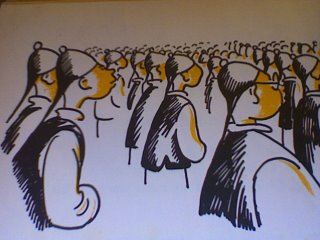
I myself have engaged in several discussions over the years on the portrayal of Chinese culture and characters in children’s and YA books.  I always do this with much trepidation: since there is no way that I can truly be the spokesperson for an entire (and extremely complex) culture, even if it is considered MINE.  (I am now even more aware of the differences between Chinese and Chinese American Cultures.) Take my post on Five Chinese Brothers for example.  This old picture book is often criticized as racially insensitive (or downright racist.) I addressed this controversy back in 2008, in Examining The Five Chinese Brothers, mostly defending the illustrations by Kurt Wiese. I pointed out that if one examines the pictures carefully and accurately, without being influenced by an overblown sense of social justice, one can easily see how many of these cartoon faces have different features: nose shapes, eyebrow angles, even ear shapes and sizes.  The well-intentioned critics usually claim that Wiese was being racially insensitive because he perpetuated the “oh, they all look the same; I can’t tell them apart” concept. These critics didn’t seem to realize that perhaps they themselves Don’t Know how to read cartoon/stylized lines of Chinese features.  To me, all five viewable faces in the two pictures below are distinctly different — are they?

 Photo-38-751016

Photo-43-785330

However, since posting about it 7 years ago, I have also come to realize how much I also DKDKed!  My insistence to support the use of yellow for the faces is based on my personal experiences: as a Chinese girl growing up in a homogeneous environment, proud to be a member of the “yellow race,” and never having to contend with my ethnic identity.  It is a highly biased stance (and I wanted to break the connection of Yellow=Undesirable, what an naive idea!)  I disregarded the real experiences of Chinese and Asian American child readers.  Just because I don’t find being labeled “yellow skinned” hurtful does not mean that there are not many who are indeed hurt.  In this case, I believe that their views are more valid than mine.

Yes, I have to update my own mindset, bringing myself from the DKDK quadrant to at least the KDK quadrant and striving to listen and learn from others. 

Since my pervious post in this series was about Africa Is My Home, I decided to look at reviews from 2 years ago when the book was first published.  I found this review from Kirkus and decided that a discussion about parts of the review fits nicely here.  

I have some disagreements with the review, but most can be chalked up to personal tastes and subjective views.  I would not have classified this book as a “text-heavy picture book” but a “heavily illustrated historical fiction.”  I don’t feel that Robert Byrd’s illustrations are “frequently cramped,” although there are definitely a few busy scenes: at the market place, in the court house, and on the Amistad.  I (and my students) also don’t find the text befuddling in any way.  

What made me wonder the most is this claim of one of the book’s several “flaws:”

“Its illustrations…offer minimal variety in the characters’ skin tones and facial features.”

The reviewer seems to say that it is quite problematic in depicting the people (adults and children) from Mende Land (Sierra Leone) with very similar skin tones: perhaps to the point that implies Robert Byrd’s lack of respect for the people depicted.  Most racially sensitive folks believe that “not all Africans have the same skin tones” and that “no one should lump all all Africans as being the same.”   We should treat them as individuals and as humans equal to everyone else.  This is all I hold true as well. However, the reason we see distinctly different shades of skin tones in the States (or other non-African continents) is the result of the long and vast history of African diaspora and racial mingling.  And in Africa Is My Home, the illustrator Robert Byrd shows his awareness of this in his illustration of  the market place scene set in Cuba:

IMG_20150227_092333

IMG_20150227_092315

(note the two women shopping for vegetables/fruits)

Byrd, using water color and non-realism style,) depicted Mende Land children and adults with very similar skin tones.  The variation, if any, is extremely subtle.

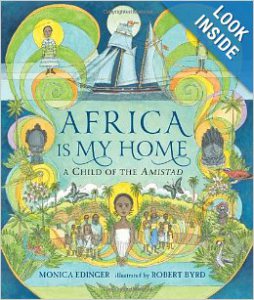
africaismyhomepageimage

There are also some very similar facial features, for sure: The shape of the nose, the large round eyes with the whites showing, etc.

Curious, I searched for recent photographs of Sierra Leone children and came across many group photos such like this one from the BBC News Magazine.

_69801704_children

And cannot quite bring myself to label Byrd’s choices as a flaw in the book.

If Byrd had made the skin tones and facial features a lot more varied for the Mende Land people, just like what he did for the Cuban market place scene, would the Kirkus reviewer then praise him for his cultural sensitivity, even if that might have been an even more inaccurate depiction?  From where I stand, this well-intended criticism, aimed to point out “cultural insensitivity,” seems to lack cultural understanding itself.

Like I said earlier, I’m always really fearful when I hold different opinions about books regarding cultural references: since perhaps I am so off base.  So, I’d love to hear from others who have better understanding of the topics addressed here and would love to be enlightened about anything that I Don’t Know that I Don’t Know!
8 Comments

Filed under Views, WIWWAK

Doing the Diversity Thing Diversely, Part 2: The Importance of Fretting

africaismyhomecoverYesterday marked the paperback release of Africa Is My Home, by Monica Edinger, a dear friend and colleague.  I always think of Monica as a fellow journeyer in the fantastic and sometimes treacherous, but always rewarding, territory that is Children’s Literature.  Monica and I met online 20 years ago over the Child_lit listserv.  Our mutual admiration for Lewis Carroll and his creations (Wonderland, puzzles, games…) made us fast virtual friends.  Since 1997, I have worked with Monica on numerous projects both at Dalton where she teaches 4th grade and I am the middle school librarian and out of Dalton, co-teaching a Fairy Tales course online for Rutgers’ Youth Literature Certificate program and co-planning SLJ’s Battle of the Kids’ Books for the past 7 years (with Jonathan Hunt and the good folks at SLJ,) among others.
I did not write a blog post for the book’s hardcover release two years ago, feeling self-conscious about how I probably could not really be objective in “reviewing” this book, being the first person who read Monica’s very first draft more than a decade ago.  However, to celebrate the release of the paperback edition and to contemplate how this book fits within the recent discussion on the various ways Diversity in children’s books can be achieved, I am compelled to write about it even more — even if I cannot extract my knowledge of the creative process of the book from how I view the final product.

I know intimately what Monica went through in writing and re-writing this book: switching narrative voices, changing from nonfiction to fiction to nonfiction to fiction several times, “shopping” it around to various publishers and working with various potential editors.  I also knew first hand how much she invested in making this (slim in size and yet hefty in subject matter) book: remembering what Sierra Leone was like when she spent two youthful years there, connecting and reconnecting with people from Sierra Leone to check and re-check facts, traveling to Connecticut (Amistad Museum) and Ohio (Oberlin) to immerse herself in primary materials about Sarah Margru, not to mention all the online researches she conducted through a decade.  I also listened to her fret, and fret, and fret.

Ah, the fretting.

Monica Edinger is a German Jew.  She is not of African descent.  She is white.  She lives in the 20th and 21st century.  Sierra Leone is not exactly the same as Mendeland those many years ago.  And this is NOT her own conjured-up story but the tale of a real person who lived and felt. It is also a story that has to work for a child reader when it’s told.  So many details to consider…and to fret over.

How would the world receive this book when it finally got published?  Would the book receive positive or negative reviews?  Would the people whose story she chose to tell understand how much respect and care she had in the making of the book?  Would the book and the story be dismissed?  So many questions and potential pitfalls to imagine…and to fret over.

All that fretting is what I think needs to go into writing any book, but perhaps especially into writing “diverse” books where cultural authenticity and respect are extremely important.

I believe that Monica’s relentless drive of writing this book as authentic as she could manage came from several places: her sincere passion to tell this less-known story, her perfectionist’s need to be meticulous and accurate, her true fondness of researching and verifying facts, her strong dose of a healthy fear of not getting it right, and her tremendous respect and caring of the welfare of the people and culture of Sierra Leone.  She did not write a book in the vein of what I have started thinking as a “third world tragedy story” told by a well-intentioned white person from a completely outsider viewpoint, often tinged with a sense of superiority and savior mentality.  She wrote a story (with assistance from historical documents, her editor Sarah Ketchersid, and the talented illustrator Robert Byrd) that brings a historical tale to life with a high degree of authenticity and no outsider judgment.  It enriches and will continue to enrich the reading and cultural experiences of young readers.

I’m so glad that Africa is My Home has received much praise and accolades: the result of the incessant fretting from all parties involved.

In the next post, I will discuss a particular review of Africa is My Home and when it first hit the market and ponder over similar questions of what Malinda Lo wrote on her blog post about reviewers’ perceptions when it comes to diversity topics in children’s and YA books.

1 Comment

Filed under Views

Doing the Diversity Thing Diversely, Part 1

The many discussions face to face and online about We Need Diverse Books in children’s and YA literature have informed me that there simply isn’t a cure-all solution when it comes to creating and promoting diverse books for young readers.

So, I plan to share some thoughts on this Diversity Thing from my vantage point, which is many folds and diverse and also in flux as I learn more from others.  Before putting up these blog entries, I’d like to first describe who I am in relation to children’s literature and where that background fits into the Diversity conversation, so readers may have a firm grip on where I come from when expressing my ideas, which, I guess, is something we all need to start doing — sharing of where we come from and why we feel certain ways and understanding where others have come from and why they feel certain ways.

I am a Taiwanese/Chinese American.  I was born in the 60s, attended a public elementary school, then went on to attend the Catholic Sacred Heart Girls’ middle and high school (boarding), and finally National Taiwan Normal University (teacher’s college.) My double degrees were BAs in Education and English Lit.  After graduating, I taught English (as required foreign language) in a public middle school from 1987 to 1989.

My parents were from Mainland China, part of Chiang Kai Shek’s (Jiang Zhong Zheng) army retreat to Taiwan after the Chinese Civil War in the 1940s that resulted in the divide between the Communist China and the (more) Democratic Taiwan (Republic of China) regimes.  We still have a whole clan of the Xu family in Yunnan Province in China that I am attempting to re-establish relationship with.

  • Growing up in a largely homogeneous environment, being a member of the dominant class (my father was a member of the inner circle of both Chiang Kai Shek and his son, President Jiang Jing Guo,) and doing well in school in a climate that revered the intellect made it impossible for me to truly understand the feelings of being an underdog.  (Fortunately my near-sightedness, my short stature, and the fact I was not considered a beauty and was reminded of such fact by family and friends alike all through my youth balanced out that cockiness and allowed for some humility.) I also never had an ethnic identity crisis as many Asian Americans might have to struggle through since I was never a Minority!

As a young person, I was addicted to books and reading: my favorite stories came from Taiwan, China, Germany, France, Japan, Sweden, India, Italy, the US, Colombia, Russia, Greece, and many other countries. Most were classics but also plenty of contemporary (60s to 80s) writings.  All of my closest friends loved books.  However, reading novels was not considered the best way to spend one’s time.  Philosophical and personal essays were all the rage when I was growing up — all about how to better oneself, morally and worldly.

I came to the United States to study children’s literature in 1989 and received my MA from Simmons College in 1991.  In 1996, I received an MLS degree with a concentration on services to children.

  • One of my youthful aspirations was to win a Nobel Prize in literature.  I was a good writer, in those popular short essay forms.  I couldn’t and still can’t create fiction.  I revere the art form that is literature and since I’m so invested in literature for children, it is almost a sacred form to me.  This is why I am a very critical reader and get easily frustrated when I see something not done right that can be easily fixed.

I have been working since 1991 in New York City alone and have not lived elsewhere but NYC since 1991.  My string of jobs were all related to children’s book:

sales clerk for Eeyore’s bookstore for children (1991-1992)

subsidiary rights assistant to the department head at Macmillan Children’s Publishing (1992-1994)

children’s librarian at the New York Public Library (1994-1997)

middle school librarian at The Dalton School (1997-)

  • There are, in my head, inherent biases about racial compositions of peer groups by living only in New York City for 20+ years and working in a school where at least 40% of the students are not white. Immersed in such a diverse environment, it is hard for me to visualize, although I am cognizant to the fact, that in many States/Cities/Towns, young people do not meet “others” on a regular basis.
  • My continuous interaction with high achieving students who read regularly, have a passion for books, and can dissect literature aptly for the past 18 years greatly colors my view of what books are best for which age range and the kinds of books I promote at my workplace and on my blog.

I have been a member of the Association of Library Services to Children (ALSC) at ALA for almost 20 years and have served on two Newbery Committees, Notable Children’s Books Committee, and also recently Best Fiction for Young Adults for the Young Adult Library Services Association (YALSA) — among other non-book related committees.  I have also been involved in co-planning and co-maintaining SLJ’s Battle of the Kids’ Books site for the past 7 years.

  • This resulted in reading, thinking, and writing about children’s and YA literature on a regular basis and discussing books with thoughtful and experienced colleagues and practitioners such as Nina Lindsay, Monica Edinger, Vicky Smith, Kathy Odean, Phoebe Yeh, Junko Yokota, Jonathan Hunt, Adam Gidwitz, and many others.
  • Fairrosa Cyber Library (since 1994) is my site/blog devoted to children’s books that was one of the oldest online resources for children’s literature (and needs to be re-vamped, I know!)

A note on my reading habit: I still read English painfully slowly — having to sound out pretty much every word.  This is both a curse (I cannot read as many books as I’d like to) and a blessing (I am told often that I am a “careful” reader and that my slow-reading habit allows me to cite specific examples about style, tone, authenticity, etc.) 

A note on my reading preferences: I like unconventional and challenging literary forms and gravitate to fantasy and science fiction readily but can easily enjoy any genre, as long as I deem it “well written.”  Now, that’s another can of worms that I won’t open here.

A note on my attitude about this whole Diversity thing: The cliche is true: It is a long, hard, and never ending journey, and one cannot get anywhere without throwing something out there that might upset some folks, stir up the pot, generate passionate dissents, etc.  I am always willing to be made to see a different side of each matter and understand where others have come from, even if I might still disagree with them.  It is also of utter importance to me that during the discourse, others understand my efforts in upholding a professional mindset and stance, even when I appear to be extremely passionate and emotional (which I can be, often) about the matters at hand.  

5 Comments

Filed under Views

We Need Diverse, AND Amazing, AND Well Informed, AND Creative, AND Mind Stretching, Books

Last night, I rushed home to watch the Oscars live broadcast.

I was not following the news or discussion over the “All White Nominees” situation. So, it was a surprise to me that not a single person of color (brown, yellow, black, what have you) walked onto the stage to receive the golden statuette.

This morning, I woke up still pondering: hmm… what happened?  Was there not a single worthwhile movie featuring or made by people of color during the year 2014 that warranted some recognition?  If not, what happened?  Were there no creative or talented POC in the entertainment industry or were they not given the opportunities by the studios and the gatekeepers to showcase their talents?  If they never got to be SEEN, how could they have been nominated, or have won?   Then there’s the question of what happened with Selma and its actors, director, and writer?

The Youth Media awards press conference each year (where Newbery, Caldecott, Coretta Scott King, Printz, etc. awards are announced) has been dubbed, “The Academy Awards of Children’s Literature,” as if that’s high praise and what we children’s lit folks should strive to be.   At this point, I don’t want my beloved children’s literature field to be linked with the Academy Awards, especially after a strong showing of diverse topics, characters, and creators this year: a proud moment for many practitioners and champions of children’s lit.

And yet, the heated debate sparked by Malinda Lo’s and Roger Sutton’s recent blog posts (Lo’s Perceptions of Diversity in Book Reviews and Sutton’s Are We Doing It White?) reveals that even in the wake of a year of diverse winners, the children’s literature industry still has a long way to go in diversifying on all fronts, especially the gatekeepers (editors, publishers, reviewers, librarians, etc.) and their views.

I have been taking notes on others’ and my own thoughts and will post my reactions and observations in a few installments. Lots of soul searching and perspectives changing on-going in my head!


1 Comment

Filed under Views

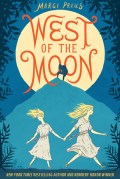
West of the Moon

westofthemoon by Margi Preus

One of my favorite folk tales is East of the Sun, West of the Moon, and many children’s books have been inspired by this tale, such as East by Edith Pattou, a beautiful fantasy reimagining. I enjoyed reading this book by Preus, but due to my own preferences for “real” magic and fantasy, I found myself unsatisfied by the dreams/magical realism/faux fantasy elements in what is really a tale of immigration. That said, I appreciated greatly Preus’ ability to give deep and complex emotions to Astri and her deft hand at portraying vivid landscapes and adventures.

Leave a comment

Filed under Book Notes

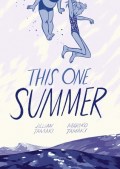
This One Summer

thisonesummer by Mariko Tamaki and Jillian Tamaki

Love the art in this bock, especially the skillful and creative ways many emotions are conveyed through imagery and hinted via lines and swirls. This is a quiet graphic story that eloquently showcases the interior life of a precocious prepubescent mind. Many of the double spreads are breathtaking and heartbreaking. It feels like a privilege to be allowed to peek into the minds of Rose and those around her.

4 Comments

Filed under Book Notes

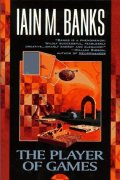
The Player of Games

playerofgamesby Iain M. Banks

This second volume of The Culture series by Iain Banks kept me entranced throughout its sprawling telling of a brand new “universe” in my reading world.

Banks created a Utopian future where ownerships of objects, places, or people (as in, exclusive relationships) are no longer the norm and where sexual identities and preferences are all treated equal: in fact gender changes and and having partners in both genders are considered common place. In such a “Culture,” how do people entertain themselves and what matters and what matters not? Fun questions to ponder and explore. However, most of the story was set in the off world of Asad which bears similarities to our own human world — or perhaps the more barbaric ages of our world. Asad’s social structure is highly organized around rules and punishments — and there are some very cruel ways that criminals are dealt with (also what constitutes a “crime” can be quite shocking.)

I enjoyed reading the many theories of how the games are constructed and played and the author kept me guessing as to what the outcome would be. Thanks to my role playing game friend Brian who introduced me to this book! I’m onward to the first book of the series: Considering Phlebas.

Leave a comment

Filed under Book Notes

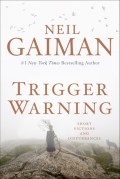
Trigger Warning: Short Fictions and Disturbances

triggerwarning by Neil Gaiman

This is typical Gaiman: disturbing and unsettling little scenes, interesting observations of human natures, everything floating in between waking and dreaming. My favorite are the longer tales, “The Truth Is A Cave in the Black Mountains,” “The Sleeper and the Spindle,” and “The Black Dog.” The first two are folk/fairy tale reimagined, while the last one is an American Gods’ short with Shadow’s adventures continuing. Another small dosage to hold us over for the sequel to American Gods? Calendar of Tales with its many weird crowd sourced tales is also highly enjoyable. Oh, I can’t wait to actually WATCH a special episode (of the 11th doctor and Amy Pond) made based on “Nothing O’Clock.”

Leave a comment

Filed under Book Notes

Over There at SLJ’s Battle of the Kids’ Books…

As one third of the Three-Headed-Battle-Commander, I’m now directing my and your attention toward this year’s Battle of the Kids’ Books, hosted annually by School Library Journal.

It is a way for us to highlight many outstanding titles from the previous year, be they award winners already or sleepers until now.  Read all sixteen books, follow the judges’ decisions, vote for the Undead, and make your opinions heard in the Comments!

Leave a comment

Filed under Book Notes

It Is Done! BFYA 2015 and Top Ten

It has been a year of rigorous reading and note taking and thinking hard on the 2014 YA fiction for me and my 14 fellow committee members. 

Now the list is finalized: http://www.ala.org/yalsa/2015-best-fiction-young-adults

And the top ten YA fiction of the year (out of more than 600 submitted titles)  are:

The Carnival at Bray. By Jessie Ann Foley.

The Crossover. By Kwame Alexander.

The Gospel of Winter. By Brendan Kiely.

I’ll Give You the Sun. By Jandy Nelson.

Jackaby. By William Ritter.

Noggin. By John Corey Whaley. 

The Story of Owen: Dragon Slayer of Trondheim. By E. K. Johnston.

Vango. By Timothee de Fombelle.

We Were Liars. By E. Lockhart.

The Young Elites. By Marie Lu.

Leave a comment

Filed under Book Notes, Field Reports

Another almond post but the blogger failed to…

Another almond post… but the blogger failed to mention that ALMOND EYES originated from traditional Chinese texts where women were frequently described as having “almond eyes“ meaning larger than usual eyes shaped like an almond — so, kind of what the generic “western eyes” might look like! Since it is rarer, it is more desirable (like the double eye-lids and really pale complexion.)

http://www.npr.org/blogs/codeswitch/2013/09/16/219402847/-almond-shaped-eyes-remarkably-exotic-yet-too-foreign

Leave a comment

January 18, 2015 · 1:45 pm

I'm Not Sure I'm So Fond of Almonds

I like many different kinds of nuts. I actually am QUITE fond of almonds and many things made from almonds, even Toasted Almonds.  However, in the past few days, reading different books, written both by non-Asian and Asian authors, I have found myself puzzled by the insistence of the shade of my kind of skin as “toasted almond.”  It feels like a lazy throw-away descriptor, much like that of “olive skin tone” (as referenced in my other post.)

Here, depending on the lighting and different parts of my body being highlighted, are some sampling of my skin color from photos taken in 2014:

Screen Shot 2015-01-18 at 11.57.56 AMScreen Shot 2015-01-18 at 11.57.07 AMScreen Shot 2015-01-18 at 11.56.41 AMScreen Shot 2015-01-18 at 11.55.55 AM

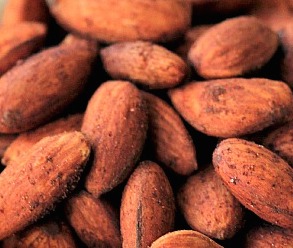
Here are pictures I took off the internet, showing what toasted almonds might look like in different settings, I guess, under different degrees of “toasting”?

almond1almond2almond3


I can definitely see Some resemblance between some of my photos and those of the almonds, after the toasting process. But for some reason, I feel heavily reduced since that seems to be the only way to describe my skin tones and those of millions of others who share my skin tones.

A plea: can we possibly build up some newer vocabulary, phrases, and ways in describing physical attributes, especially varying skin tones?  Perhaps more precise, and not always resorting to food comparisons?  (Another recent weird encounter — some Chinese girl’s complexion is described as “white rice noodles,” as a way of non-offensive, or even complimentary description — I can’t imagine any Chinese girl being too excited being told that their skin reminds people of white rice noodles. Just imagine, if you are reading a book where a white girl’s complexion is described as reminding the boy next door of a plate of “steaming ziti.”)

This site might not offer the ultimate answer to all questions about describing complexions and other physical attributes, but it serves as a starting point and a reminder of how not to resort to stock phrases and cliches. http://writingwithcolor.tumblr.com/FAQ

7 Comments

Filed under Views, WIWWAK

When a reader completely missed the author’s intent or craft

First morning of 2015. 

Just finished a very powerful book with a strong, convincing, well constructed multiple view points narrative structure and challenging ideas that demand the readers to live with the discomfort of not-knowing the whole truth, to understand that life is complex depending on the the angles of the viewers, and to mull over the potential futures of the varied characters.

Headed over to goodreads and see other readers’ reactions.  Many positive ones and especially from those who have lived through similar circumstances as the characters did in the book.  But then, I found a review complaining that because “the reader” finds it confusing how the story is told with so many different POVs and that “the reader” cannot see the point of some side characters’ remarks even though they give a fuller picture of how complex such matters can be and “the reader” cannot accept a book with no clearcut facts presented even though that is the whole entire point of the narrative.

I wanted to leave a comment and requested that “the reader” to admit her own shortcomings in her inability to appreciate challenging literary constructs and demanding ethical quandaries.  But then, I wonder: can we ever fault a reader for her inabilities to meet the author at the author’s level?  Is it the reader’s responsibility to challenge herself that way? 

This comes down to how we view books:

Is a book a sacred or demi-sacred object and deserves reverence and hard work to decipher by every reader?  Or is a book just another consumer product and the reader can register complaints and give poor ratings purely based on personal preferences without considering the crafts and intents of the author?

I have been thinking about subjective and objective analyses of arts in all forms for a while and this goodreads review just brought it home for me that I cannot treat books as mere goods to be liked or disliked but artistic expressions that need critical examinations even if a reader’s emotional reaction can be a major component in evaluating a narrative’s success. 

Leave a comment

Filed under Views

On a wet wintry night last week 12…


On a wet wintry night last week (12/10/2014,) I participated in a panel discussion where the question of how to bring more international YA literature into the American market was raised and pondered. Hosted by Words without Borders and NYPL and moderated by Marc Aronson. Other panelists are Arthur Levine, publisher of Arthur Levine Books/Scholastic, Padma Venkatraman, author of A Time to Dance, and Briony Everroad, guest editor for the Words without Borders December issue on International YA literature. This is a summary of the evening.

Leave a comment

Filed under Field Reports, Views

BFYA 2015 Nominations – Final List

We did it!  Our Committee of 15 nominated 113 titles to be considered for Best Fiction for Young Adults, 2015.  You can find out what the titles are with short annotations on the official ALA/YALSA site.

Here’s a simplified list with just titles — Any surprises? Favorites? Comment away :)

Al Said, Adi Let’s Get Lost
Anderson, Jodi Lynn The Vanishing Season
Arnett, Mindee Avalon
Aronson, Marc One Death, Nine Stories
Bassoff, Leah & Laura DeLuca Lost Girl Found
Brezenoff, Steve Guy in Real Life
Caletti, Deb The Last Forever
DeWoskin, Rachel Blind
Fine, Sarah Of Metal and Wishes
Foley, Jessie Ann The Carnival at Bray
Fombelle, Timothee de Vango
Giles, Gail Girls Like Us
Gold, Jennifer Soldier Doll
Griffin, Bethany The Fall
Hosie, Donna The Devil’s Intern
Kiernan, Celine Into the Grey
King, A.S. Glory O’Brien’s History of the Future
Knudsen, Michelle Evil Librarian
LaMarche, Una Like No Other
Maas, Sarah Heir of Fire
Magoon, Kekla How It Went Down
Mathieu, Jennifer The Truth About Alice
McGovern, Cammie Say What You Will
Mesrobian, Carrie Perfectly Good White Boy
Miller, Lauren Free to Fall
Moracho, Cristina Althea & Oliver
Nix, Garth Clariel
Parker, Natalie C. Beware the Wild
Parsons, Mark Huntley Road Rash
Pearson, Mary E. The Kiss of Deception
Polonsky, Ami Gracefully Grayson
Ritter, William Jackaby
Smith, Andrew 100 Sideways Miles
Smith, Jennifer E. The Geography of You and Me
Spears, Kat Sway
Stiefvater, Maggie Blue Lily, Lily Blue
Talkington, Amy Liv, Forever
Tregay, Sarah Fan Art
Walrath, Dana Like Water on Stone
Zarr, Sara Roomies
Aslan, Austin The Islands at the End of the World
Fredericks, Mariah Season of the Witch
Kizer, Amber Pieces of Me
Phillips, LInda Vigen Crazy
Schrefer, Eliot Threatened
Smith, Sherwood & Brown, Rachel Manija Stranger
Tintera, Amy Rebel
Willey, Margaret Beetle Boy
Alexander, Kwame The Crossover
Almond, David The True Tale of Monster Billy Dean
Anderson, Laurie Halse The Impossible Knife of Memory
Armentrout, Jennifer Don’t Look Back
Bedford, Martyn Never Ending
Blankman, Anne Prisoner of Night and Fog
Brown, Jennifer Torn Away
Brown, Skila Caminar
Burgess, Melvin The Hit
Carleson, J.C. The Tyrant’s Daughter
Colbert, Brandy Pointe
Combs, Sarah Breakfast Served Anytime
Dellaira, Ava Love Letters to the Dead
Giles, Lamar Fake ID
Graudin, Ryan The Walled City
Green, Sally Half Bad
Griffin, Adele The Unfinished Life of Addison Stone
Han, Jenny To All the Boys I’ve Loved Before
Hattemer, Kate The Vigilante Poets of Selwyn Academy
Herbach, Geoff Fat Boy vs. the Cheerleaders
Howe, Katherine Conversion
Hubbard, Jenny And We Stay
Johnston, E.K. The Story of Owen: Dragonslayer of Troneheim
Kephart, Beth Going Over
Kiely, Brendan The Gospel of Winter
Kuehn, Stephanie Complicit
Kulper, Kendall Salt & Storm
LaCour, Nina Everything Leads to You
LaFevers, Robin Mortal Heart
Lloyd-Jones, Emily Illusive
Lockhart, e. We Were Liars
Lu, Marie The Young Elites
Maciel, Amanda Tease
Maguire, Gregory Egg & Spoon
Nelson, Jandy I’ll Give You the Sun
Neri, G Knockout Games
Oliver, Lauren Panic
Paige, Danielle Dorothy Must Die
Philbrick, Rodman Zane and the Hurricane: A Story of Katrina
Pratt, Non Trouble
Quintero, Isabel Gabi, a Girl in Pieces
Reinhardt, Dana We Are the Goldens
Reynolds, Jason When I Was the Greatest
Rutkoski, Marie The Winner’s Curse
Sedgwick, Marcus She Is Not Invisible
Sharpe, Tess Far From You
Shepherd, Megan Her Dark Curiosity
Shinoda, Anna Learning Not to Drown
Smith, Andrew Grasshopper Jungle
Smith, Lindsay Sekret
Strasser, Todd No Place
Taylor, Laini Dreams of Gods and Monsters
Templeman, McCormick The Glass Casket
Tripp, Ben The Accidental Highwayman
Venkatraman, Padma A Time to Dance
Vlahos, Len The Scar Boys
Waller, Sharon Biggs A Mad, Wicked Folly
Walton, Leslye The Strange and Beautiful Sorrows of Ava Lavender
Westerfeld, Scott Afterworlds
Whaley, John Corey Noggin
White, Kiersten & Jim Di Bartolo In the Shadows
Wiles, Deborah Revolution
Wolitzer, Meg Belzhar
Wood, Fiona Wildlife
Winters, Cat The Cure for Dreaming

Leave a comment

Filed under Book Notes, Field Reports

School Library Journal’s Best Books of 2014 are…

School Library Journal’s Best Books of 2014 are announced. Four categories: Picture Books, Middle Grade, Young Adult, and Nonfiction. Use the list to buy books for your library, find gifts for your loved ones, or for your personal reading pleasure: http://www.slj.com/best-books-2014

Leave a comment

November 30, 2014 · 3:45 pm

Peace Corps Volunteer’s Africa Book Honored by Smithsonian

sherbro foundation's avatarSherbro Foundation

Fellow former Sierra Leone Peace Corps Volunteer Monica Edinger was honored yesterday at the Smithsonian for her children’s book – Africa is my Home: Child of the Amistad.  It tells the story of a child captured into slavery on the Amistad ship and her eventual return to Sierra Leone.

edinger coverThe Smithsonian’s National Museum of African Art (NMAA) held their  22nd annual Children’s Africana Book Awards (CABA) in Washington, DC.  CABA was created by Africa Access and the Outreach Council of the African Studies Association to honor authors and illustrators who have produced exceptional books on Africa for young people.

Four books were honored in this category for young people, including a book authored by Desmond Tutu. Not bad company to keep, Monica.  Congradulations!

I introduced her book on the blog last September. Check it out.  Looking for an Xmas gift for a child in your life?  This would make a…

View original post 9 more words

Leave a comment

Filed under Book Notes, Field Reports

Listening to a short story collection of Mark…

Listening to a short story collection of Mark Twain and am so delighted. The Diaries of Adam and Eve is simply brilliant! Also almost done with The Unfinished Life of Addison Stone by Adele Griffin.

Leave a comment

November 3, 2014 · 10:35 am

Fight Club

fightclubFight Club by Chuck Palahniuk

I never watched the entire Fight Club movie — only bits and pieces. Now I have to find time to watch the movie in its entirety to see how they managed to adapt this superb novel into its very successful screen counterpart. Granted, I probably do not wish to see all the gruesome and gross scenes literally translated for film, although those are the scenes that definitely appealed to my reading self. Whether it’s intended by the author or conjured up by my own protective mechanism, the over-the-top crazy schemes and bloody messes always seem to take on a humorous tone — sometimes light and oftentimes really dark, but always laugh-out-loud hilarious. I can see re-reading it in a few years just to trace the narrator’s slow unraveling and downfall and see all the telltale signs of the final reveal along the path. Can’t help but giving it a five star, highly recommended rating!

Leave a comment

Filed under Book Notes