7 years ago, my friend Monica Edinger and I made some points about young readers (and how we should not assume or presume) via a fun Horn Book Article called: CLAT Level III (Children’s Literature Application Test). It is archived on the Horn Book site and Monica wrote a reflection piece today confirming that much of what we thought still ring true today. I wonder if that’s other librarians’ and teachers’ experiences as well!
Shadow Scale
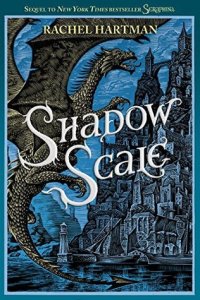 by Rachel Hartman
Since I loved Seraphina so much and had waited for the sequel with huge anticipation, it was not surprising that I didn’t quite feel satisfied with this second volume. It took me a long time to get through it not because of its heft (almost 600 pages) but because I just didn’t quite feel compelled to know what’s happening next. Partly because I pretty much knew how things would have panned out, that readers would eventually see that Seraphina, after SOOOOOO many pages and chapters of self-doubt, self-pity, and self-blame, would have come through and be the amazing power that helps destroy the “evil side”; and partly because I was really tired of those self-deprecating qualities that were somehow more endearing in the first book. I do appreciate the varied and very invented half-dragons and their special talents and feel emotionally connected to quite a few of them. I also absolutely appreciate the non-traditional relationships between Phina, Selda, and Kiggs. Just wish that I had been swept away by this volume as I was by the first book.
Filed under Book Notes
Snapshot of the Day

A quick snapshot of some books returned by my students (mostly in 4, 5, and 6 grade) on a random spring morning. It makes me happy to see that classics, new titles, and a variety of genres live harmoniously side by side, waiting to be checked out again and enjoyed by young readers.
The titles from left to right:
11 Birthdays (Wendy Mass)
Fever, 1793 (Laurie Halse Anderson)
Letters from Rifka (Karen Hesse)
Cardboard (Doug TenNapel)
Ten (Lauren Myracle)
Moribito (Nahoko Uehashi, translated by Cathy Hirano)
Five, Six, Seven, Nate (Tim Federle)
The Mother Daughter Book Club (Heather Vogel Frederick)
Trial by Jury (Kate Kliss)
Splendors & Glooms (Laura Amy Schlitz)
Ranger’s Apprentice: The Burning Bridge (John Flanagan)
Earth Afire (Orson Scott Card)
Habibi (Naomi Shihab Nye)
Magyk (Septimus Heap) (Angie Sage)
Million Dollar Throw (Dan Gutman)
Chains (Laurie Halse Anderson)
Quarterback Walk-On
Kiki Strike: Inside the Shadow City
Vango (Timothée de Fombelle, translated by Sarah Ardizzone)
Ranger’s Apprentice: The Royal Ranger (John Flanagan)
Mary Poppins (P.L. Travers)
The Golden Compass (Philip Pullman)
Every Soul a Star (Wendy Mass)
Gregor the Overlander (Suzanne Collins)
The True Meaning of Smekday (Adam Rex)
The Scary States of America (Michael Teitelbaum)
Mad Dogs (Cherub) (Robert Muchamore)
Filed under Field Reports
Fun Home: A Family Tragicomic
 by Alison Bechdel
I savored every page, every sentence, every word of this graphic-narrative memoir. Still didn’t pay enough attention to the details of each panel and will hopefully go back to the book one day to closely examine all the illustrations as well. The tenderness and unflinching truth=telling of Bechdel’s own painful life events touch me deeply. A sense of vicarious catharsis presented itself every time I opened the book in the past few days. I want to “study” this literary masterpiece in an English class so badly — to engrave every overt and covert meaning onto my mind!
Filed under Book Notes
Intersectionality
Thinking about how this has been a recent buzz word when it comes to discussing diversity topics. It is truly the reality of our identities: one cannot just be Asian, but Asian and female, Asian and female and middle class, and Asian and female and middle class and not 100% straight, so on and so forth. And I always want to honor others’ views and feelings when in a heated discussion. However, it seems that sometimes when intersectionality is mentioned, it is someone’s way Out of the more uncomfortable strain of the topics. If talking about Race is the most uncomfortable, then let’s introduce the intersectionality of Race and Class. Then let’s shift the focal point to Class.
So can I ask this question in future discussions when intersected identities are introduced: which topic makes one the most uncomfortable? Then I will insist on not wavering from That one because it is obviously the topic most needed addressing and worked on.
Listening to Ralph Ellison’s Invisible Man + Reading…
Listening to Ralph Ellison’s Invisible Man + Reading Fun Home by Alison Bechdel == doubly impressed!
April 29, 2015 · 10:10 pm
What Do Covers Say?
Working on making a poster in anticipation of Jacqueline Woodson’s visit to my school next week — and finding images of the book covers of middle grade and YA titles by her. The fact that quite a few of the covers feature brown people without their faces shown feel uncomfortable to me. Don’t know how others might feel… 
Of course, there are plenty of other books and different editions featuring prominently the characters’ faces.
 |
Filed under Views
I did not get to read this article…
I did not get to read this article until today even though it was published last year — but What White Children Need to Know About Race should be a Must Read for anyone involved in the lives of our children — teachers, school administrators, librarians, and parents. Especially parents. Because, when it is all said and done, “professional” educators (like me, a middle school librarian) only have your kids in our hands part of the day, part of the week, and part of the year, and part of their lives while you (parents) influence your children all the time.
Actually, this article is also informative even for those who are NOT directly involved with educating children — it probably should just be called, What White PEOPLE Need to Know About Race (and how to engage in meaningful and courageous conversations!)
April 14, 2015 · 10:15 pm
Listening to the audio book version of The…
Listening to the audio book version of The Windup Bird Chronicle — feeling slightly removed because it is a reading (not by a native Japanese speaker) of a translated work from Japan and I can tell that the names are not pronounced well. However, the reader is very skilled in changing his voices/tones for different characters and the actual content of the book is fantastic. Only wishing that I were able to read in its original language.
April 4, 2015 · 8:01 pm
Children’s Book Publishing, Hot Men, and Sexism
After reading and posting comments on Roger Sutton’s blog post from yesterday presenting questions and a snapshot regarding gender representations in YA and children’s books, I recalled another similar post from a while back (8 years ago) The other g-word and all the impassioned, albeit a lot less heated, and eye opening comments following that post.
Many of the comments, including my own, allude to the Hot Men phenomenon of children’s publishing: both behind the scene in the publishing process and in the front line at promotional and other events.
I was definitely trying to stir up the pot a bit but I still wonder if so many of the comments, especially from female children’s book creators, don’t tell quite a bit of the truth!
Such as this one: When I got my first book illustration job at a major publisher, I noticed something that made me feel instantly uneasy. It was a male illustrator’s headshot taped to the wall with hearts around it. I asked about it, and got giggles and swoons about his cuteness from the all female dept. My first thoughts when I saw this photo were: is this just a little office joke or is he actually be more likely to get offered a ms. then a similarly talented female or male? and: does he feel weird when he comes into the office and sees that?
Or this one: When I was studying illustration, a teacher took me and some of the other female students aside for a talk at the end of the year. He said he had no idea what was going on, but he wanted to warn us of something. He said that in his experience, year after year, he not only had more female illustration majors then males numbers wise, but that in his opinion they were overall better illustrators, and that after graduation most of the women faded from the scene while more men made it. He was utterly perplexed, had no answers, but urged us to be aware of this and to please not quit and to press on despite the odds. He literally begged us not to get discouraged and quit the field.
Over at Read Roger Horn Book a small…
Over at Read Roger (Horn Book,) a small word/ideology battle over female representation in children’s and young adult books. Gender by The Numbers. Take a look!
I posted a couple of responses — here’s the most recent one, in response to two other commenters:
Maia said, “Wouldn’t it be nice if having female authors or protags guaranteed that what was being written reflected a feminist worldview?”
Yes, wouldn’t it? From earlier March to now, one of my thoughts was: how many women writers who write stories with female protagonists have pretty much “subjected” their main characters to fit the negatively stereotypical young women mold? Vapid, romance-crazed, hyper-appearance-conscious (toward themselves, their peers, or their love-interests), etc.? I’d rather take Avi’s Charlotte Doyle or M.T. Anderson’s Violet (from Feed) over Stephanie Meyer’s Bella (Twilight Saga) or Cecily von Ziegesar’s Blair or Serena (Gossip Girl) any day.
So, the bottom line: numbers definitely do not always tell the whole story. If any of us wishes to engage in truly fruitful discussions on these issues, we all have to first do our homework and read A LOT of the books under examination and THINK carefully about our initial, intuitive responses and then THINK again and again about whether these responses have solid basis in reality — and then LISTEN to each other and CONSIDER the many other sides of the same issue.
And, by the way, as a middle aged woman who has lived in the States for the last 25 years, I must agree with Maia that, to me, rage, pent-up or otherwise, is never a good starting point to initiate a conversation and is definitely not a valid excuse to ignore facts or to lash out at random strangers. I am almost offended by Mike Jung’s sentiment that these women are somewhat excused for their bad behaviors because of their rage — would you excuse men the same way? Can they lash out at women? If not, then perhaps you are still thinking that women are not sensible creatures who should have the ability to engage in logical and reasoned discourses even when they feel wronged? Are we so unreasonably emotional that we cannot be held accountable for our actions?
April 1, 2015 · 1:56 pm
Life As We Knew It
 by Susan Beth Pfeffer
I went into this book with a lot of trepidation — believe it or not, drastic gravitational changes to Earth by the altered distance between Moon and Earth was one of my all time environmental fears, probably from when I used to watch Twilight Zone as a kid. Pfeffer managed to tell the story with a pretty tame disaster setting: the town our heroine lived in has faced much milder impacts and although you hear about quite a bit of “the rest of world is disappearing and people have died everywhere,” you only experience her personal (and none of the immediate family members) losses a few times and the heroine’s reactions do not make the readers feel completely devastated. I thoroughly appreciated the author’s ability to show the shifting in priorities, attitudes, and family relationships as the story progresses.
This is a survival story that I can feel quite comfortable giving to 5th or 6th grade students, especially those who enjoy Hatchet.
Filed under Book Notes
But I NEVER imagined him as being like me. In my head, he’s white.
With the #WeNeedDiverseBooks movement, many gatekeepers and practitioners of children’s literature have been publishing thoughtful articles and having deep conversations on the urgent need to publish and promote books featuring diverse characters. To highlight how important this movement is and how decades of mostly “white” books have “trained” our young readers what to expect from books, I’d like to swing the spotlight directly on some young readers themselves:
The Setting
Time: A sunny Monday morning in winter. 3rd period. Individual choice time.
Place: A comfortable School Library Reading Room, Upper East Side of Manhattan. This is an independent school where 60% of students are white and the rest are made up of darker skinned students (if we also consider East Asian as “darker” skinned.)
Character List
F – The Librarian, Female, Asian American, 50-something
A – Student, 7th Grade. Male. Half Black, Half Jewish
R – Student, 7th Grade. Male. Twin of A.
W – Student, 7th Grade. Male. African American.
J – Student, 7th Grade. Male. Caribbean Black.
N – Student, 7th Grade. Female. Jewish/White.
A, R, W, J, N are all devourers of books, especially action packed Science Fiction or Fantasy novels.
The Scene
The students sprawled on the comfy chairs and benches with their laptops, half participating in a discussion on books featuring African American characters and history as they had just finished a unit on African American Authors and Stories (Day of Tears, Carver, We Are the Ship, The Other Wes Moore, Brown Girl Dreaming, among others.)
Suddenly, A exclaimed, “Oh my god. The main guy in the book I just finished is black! He’s super cool! But I NEVER imagined him as being like me. In my head, he’s white.”
R, J, and W immediately jumped into the conversation and were all in agreement how they also never imagined a superhero with their own faces. N, usually talkative, remained silent. The kids and the librarian then started talking about how there are also so few black action heroes in movies except for perhaps Will Smith and Samuel L. Jackson.
The period ended. Everyone picked up their new reads and left the Reading Room.
End Scene
The previous was based on a recent informal conversation I had with those five kids. I didn’t detect any sense of outrage or dismay. The boys simply accepted the lack of dark skinned heroes as the norm. I, on the other hand, could not stop wondering about that one statement, “I NEVER imagined him as being like me. In my head, he’s white.”
Is this a shared sentiment across the country by non-white young readers who seldom see themselves on book covers or between the covers? When they do encounter people of color in books, most of these characters seem to always need some form of “saving” — from poverty, from political or racial injustice, or from other dire situations (human trafficking, child soldier, etc.)
Isn’t it high time for us all to change that default and reshape the landscape of American children’s books?
Let’s have non-white heroes and let their faces show on the covers.
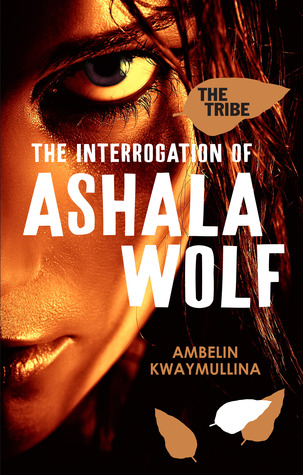 |
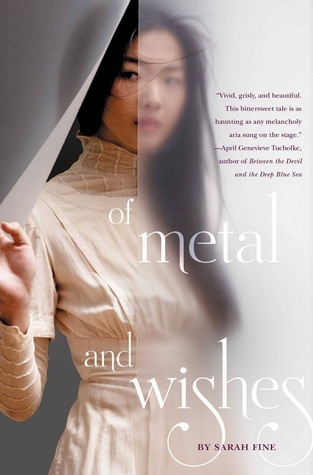 |
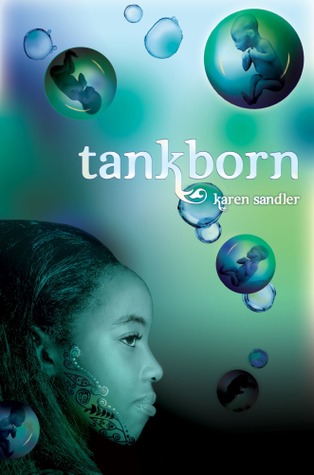 |
| 2014, Candlewick Press Australian Import Vol. 1 in Tseries |
2014, Margaret K. McElderry Vol. 1 in series |
2011, Tu Books Vol. 1 in trilogy |
Filed under Field Reports, Views, WIWWAK
The Magicians of Caprona
 by Diana Wynne Jones
I haven’t read a Diana Wynne Jones for a while and am so glad that I picked this one up. So enjoyed her storytelling tones: very traditionally British, witty, childlike but with age-old wisdom. The storyline plays off of the “family feud/Romeo & Juliet” trope, set in Italy, nonetheless. Of course, the magic and scenes are all so cool, too. One can really see how other writers like JK Rowling, Terry Pratchett, Neil Gaiman, etc., all came from this same magical storytelling tradition. With this one done, I have finished the first four books in the Chrestomanci series. There are two more novels and a collection of short stories to be done — looking forward to those treats!
Filed under Book Notes
Not quite in the mood for Independent Study…
Not quite in the mood for Independent Study, sequel to Testing. Switched to Magicians of Caprona – the one Christomanci books that I never got around to read. Ah… Diana Wynn Jones — you were such a witty and talented fantasy writer for young people. I can see why Neil Gaiman reveres you and your work. I’m always in awe. So, two fantastic fantasies this weekend: Shadow Scale + Magicians of Caprona!
March 21, 2015 · 9:46 am
The Testing
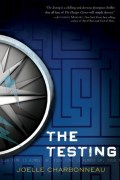 by Joelle Charbonneau
I like this book partly because some of my students really took to the series and I can see why they love it. The different stages of the testing, the unflinching gruesomeness of certain deaths/acts, and the still unclear intentions of the Officials (and of some other characters’) at the end of the book (with a cliffhanger that makes you really want to read the next book) all make this a compelling and fast read. However, much of the book also feels quite derivative and pieced together from many other, better penned stories: Ender’s Game, Fahrenheit 451, The Enemy, or Battle Royale, that it probably will not be my top recommendation to some other students.
Filed under Book Notes
Haven’t had a chance to read all the…
Haven’t had a chance to read all the abusive words thrown at Andrew Smith that caused him to shut down both his twitter and facebook accounts. I did have the chance to read the VICE interview and saw what he had said (as published by VICE) and simply couldn’t fathom how an honest, although tongue-in-cheek, and quite humble remark such as, “I consider myself completely ignorant to all things woman and female. I’m trying to be better though” would have been the cause of so much personal attack and pain. I read couple of responses that more or less match what I think: Andrew Smith is a brilliant author who deals with issues in his books mostly through male perspectives: raw, honest, frequently biased or myopic (because it IS raw and honest) — and is obviously aware of the criticism that he’s not fleshing out his female characters as much as his readers would have liked. I’m trying to make sense of all this… I have not read Alex Crow — but I did read 100 Sideway Miles and found Julia to be independent, mature, and an incredibly strong and positive influence over Finn — an entirely different female character from Shann in Grasshopper Jungle. I need to do a lot more digging to figure out why the outcry and also whether I find it justifiable to condemn a human being and his character simply by the characters they put in books and also by some sentences in an interview that, to me, seem to be interpreted to carry very different meanings than intended.
Here are links to the original interview and some responses:
The original interview:
http://www.vice.com/read/failure-of-male-societies-869
An interpretation that states Andrew Smith, by saying (tongue-in-cheekly) that he’s ignorant of how women function, Andrew Smith is admitting that he considers women “LESS THAN HUMAN.” I can easily, by the same ignoring-all-logic-or-facts method used by Tessa Gratton here, claim that he is considering women “MORE THAN HUMAN” and thus harder to grasp and he’s trying to do a better job at learning how to WRITE THEM as characters. Sorry. Grrr…. :
A well-argued essay in response to the twitter witch hunt and Gratton’s attack
A long list of thoughts that present many ideas that I think about what Andrew Smith had said:
March 13, 2015 · 10:43 am
I am not happy with the WIWIK tag…
I am not happy with the WIWIK tag — I don’t think it expresses the correct sentiment. So bear with me as I change it to What I Wish We All Know. Either something that I know that I wish others do, too; or something that I have questions and wish to be informed: all of them should be something that is under each practitioner’s belt. So, perhaps, it should be WIWWAK: What I Wish We All Know! And it is still pronounceable.
March 13, 2015 · 9:46 am
Just started two books The Testing by Joelle…
Just started two books: The Testing by Joelle Charbonneau, as highly recommended by some of my 7th graders; Shadow Scale by Rachel Hartman, the HIGHLY anticipated (by me) sequel to Seraphina. Also reading a book translated from Taiwan: The Man with the Compound Eyes by Wu Ming-Yi (but really want to read the original text.)
March 13, 2015 · 9:12 am
Candymakers
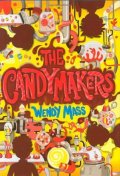 by Wendy Mass
A delightful concoction of implausible coincidences, innocent spying, interconnectivity, and childish pleasures. I can’t quite stomach the excessive amount of sweets being served as main meals but I imagine my younger self would have been quite fascinated. The candy making process and rules are highly entertaining, and perhaps even informative! As most Wendy Mass books, this one is all about how to appreciate one’s life and accept one’s lot while still strive to expand understanding of the world around. No wonder my students love it so much and it appeals to both genders and mystery and friendship book lovers.
Filed under Book Notes

