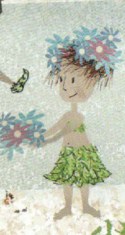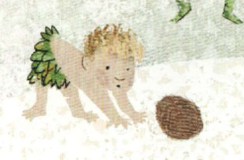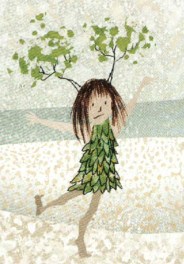
My DKDK (Don’t Know Don’t Know) Moments – Or What I Learned From My Online Discussion Mistakes

On July 17th, I posted “A Tribe of Kind Souls: a closer look at a double spread in Lane Smith’s There Is a TRIBE of KIDS,” offering my views on a particular spread of illustration after a couple of days engaging on Reading While White, and other online interaction places (email listservs and twitter.)

During those days and ever since, I have not stopped thinking about the many different reactions I received both publicly and privately (via emails and in person.)  I also have not stopped thinking about Debbie Reese’s public declaration of how, for a couple of decades, her impression of me has been that I am on the opposing side of her convictions — which is, simply put, to have accurate, and dignified, representation of American Indian content, and a lot more of it, in Children’s Literature.

This revelation both shocked me and saddened me.  It is also a prime example of how I did not follow my own advice — to acknowledge that this could have been a case of I “Don’t Know That I Don’t Know” and to spend more time listening and considering others’ views than defending my own.  I don’t mean that I should not have expressed my views, but I think I could have done better in the “listening” and “considering” department, and less on the “defending” my views department.

So, here are some things I have been thinking about for the last ten days:

I Failed at Being A Visible and Vocal Ally

First and foremost, I realized that I have not been a vocal enough ally to Debbie.  When I agree with her views and her tireless work as an advocate, I usually sit back and agree in silence.  I pretty much only speak up when I have questions about how she interprets something, and wants her to either defend further or clarify more.  I also want her to see how I come to have my opposing views.  (An example was over The Hired Girl on Heavy Medal blog.)  These disagreements occupy a very small percentage of how I normally react to Debbie’s views: I fundamentally agree with everything she stands for and have always benefited much from her sharing of her thoughts and feelings (yes, Debbie can be very emotional when she writes about the hurt and injustices she sees in books for children).  I have based my collection development for my library on many of her recommendations.  However, since I have not been actively and visibly expressing my support, it is of course impossible for Debbie to know.

This has been a wake-up call for me to be a better ally and supporter – not just to Debbie Reese, but to others who have been taking up the banner for a better, more equitable, and authentic children’s publishing world.

Online Discourse Is Real Life, Too!

A second thing that I learned is how even when I started off trying to simply parse out a thorny issue intellectually, social media and online engagement could easily bring in emotional responses, mostly due to the quick turn around back-and-forth and the misinterpretations of tones due to the lack of physical and tonal cues.

I need to adhere to the Real Life practices that have served me well:

1. Take time to cool off and consider the others’ views and feelings before shooting off an email to express dismay or outrage.

2. Go directly to the person who I feel that has “wronged me” and find out the reasons behind any public (or private) outburst, in a way that is genuinely to solve the issue and not to express my own displeasure.

3. Do not engage emotional discourses between publicly: especially between friends and friendly colleagues.

What Should Drive Children’s Publishing?

The DESIRE to Do It Right and not the FEAR of Doing it Wrong!

A third thing that I have been considering has more to do with an aspiration for my publishing colleagues and it will be in a separate post.  Just to forecast here: I yearn for the day when the driving force of publishers, editors, authors, and illustrators to create powerful and accurate books that are accepted readily and praised by outsiders and insiders alike is a strong and genuine desire to DO IT RIGHT after lots of soul searching and professional training, and not the fear of DOING IT WRONG and being called out after the fact!


13 Comments

Filed under Views

Absence Heightens Presence

Walking down Seattle night streets, I came upon these trees adorned with Christmas lights.  My aesthetic mind created an instant division: I loved the moving lights up in the branches and had next to no emotional reaction to the static lights on the tree trunks.  What made the moving lights so much more appealing?

Could it be that each absence of light makes the presence of it more vibrant, more intense.

Could this same revelation be applied to my reading aesthetics?

Is this why I find books filled with figurative language page after page less appealing than books that only feature effective and well developed figurative language when absolutely necessary?

Like the static lights on the tree trunks, the too frequent presence of metaphors, similes, and analogies reduces my appreciation of an author’s artistry.  I need the appropriate absence of figurative speeches to fully feel the impact of their presence.

Leave a comment

Filed under Views

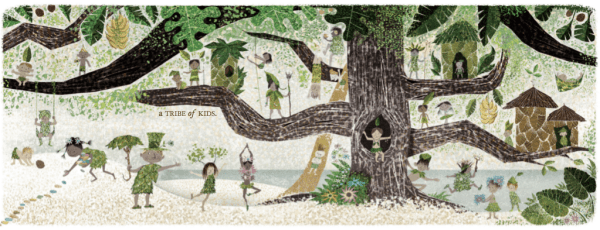
A Tribe of Kind Souls: a closer look at a double spread in Lane Smith’s There Is a TRIBE of KIDS

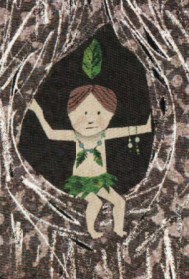
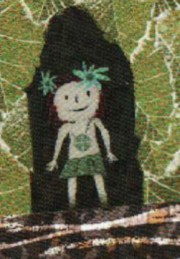
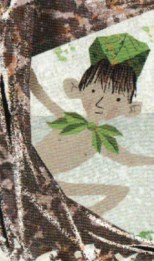
There Is a TRIBE of KIDS (capitalization as part of the title/design), written and illustrated by Lane Smith (Stinky Cheeseman, The Happy Hocky Family, It’s a Book, etc.), was published in May, 2016 (two months ago.)

This book has received four starred reviews from major review sources and positive reviews from others. However, the use of the word TRIBE and some of the images on a particular double-page spread toward the end of the book have sparked heated debate (in which I took part) in several online places.  A short description and link to each of these reviews (with comments) can be found at the end of this post.

I read and re-read this book many times and have considered all the reviews cited below and many additional comments sprinkled throughout the internet.  Finally, I feel that I am ready to share my own take on this book.  I must stress that this is but ONE of many potential interpretations of the book which features very few words and delivers most of its “messages” with pictures that can be differently interpreted.

By no means do I want to discount Debbie’s and others’ pain when they face certain images (that they see on the second to last double spread) which definitely trigger strong emotional reactions from past and personal experiences.  (My own triggers are seeing erroneously attributed so-called Chinese cultures or imageries and boy do those get me seeing red!)

So here it is,

Fairrosa’s Interpretation of the Double Spread in There Is a TRIBE of KIDS:

I must confess that my initial reaction to the word TRIBE in the title was a skeptical one: how would it be used in the book?  to indicate some relations to Native American cultures?  to indicate something primitive?  When I finally read through the book (many times over,) I realized that, as Debbie Reese and many reviewers pointed out, it is a play on word.  Tribe is a collective noun for a group of “young goats” (kids) and Tribe is also a collective noun for many human groups that share the same cultural, geographical, or historical experiences.  The word is still used widely.  It is used by American Indians as their official group names.  It is used by the Jewish people.  It is also used by groups who need to bond over their unique identities and experiences, such as the deaf community (as found in Tribes, a play by Nina Raine from 2015.)

In the case of this book, Lane Smith used it to indicate a very specific “kind” of human beings: children. The child protagonist, after mimicking all kinds of animals, finally found his own “tribe.”  The text is all in past tense — until the very last spread which is in present tense, proclaiming the currency and the universality of childhood.

Here is my interpretation of the second to last spread accompanying the text, There was a TRIBE of KIDS (note the past tense!)

Screen Shot 2016-07-17 at 11.11.46 AM

(reproduced with permission from Roaring Brooks Press)

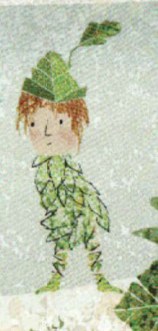
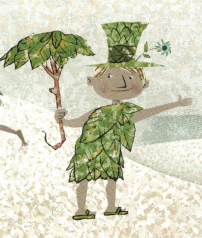
Since our child protagonist is not in this picture, so unlike the previous encounters, we don’t see him mimic or play act.  We see this child (looking a bit like Burt in Mary Poppins, doesn’t he?) welcoming the new child (our protagonist, off page, unseen) into a TRIBE.


tribe07

We, readers, along with the child protagonist, observe the scene with keen interest:

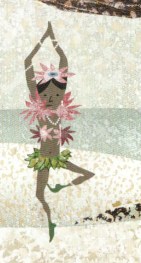
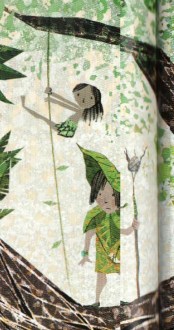
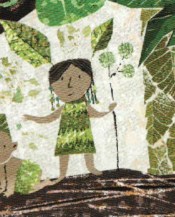
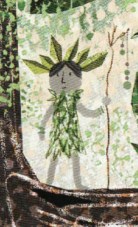
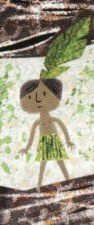
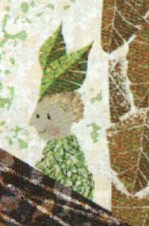
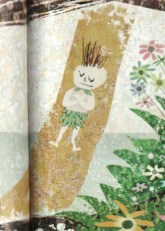
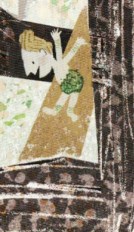
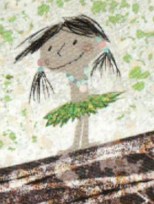
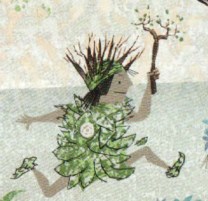
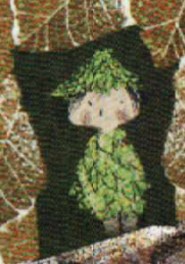
A TRIBE of kids from around the world and from both yesteryears and now, dressed much like our protagonist (in leaves, branches, and flowers,) being themselves and playing like all children might:

We watch, as they

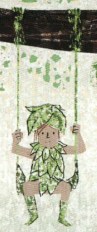
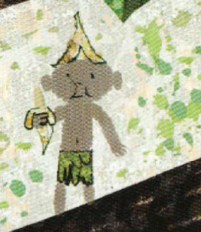
swing, eat and play with their food,

tribe02 tribe15 tribe08

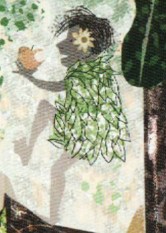
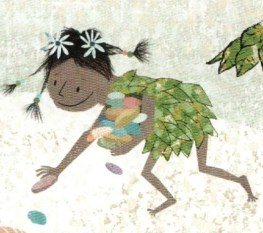
collect seashells and flowers,

tribe04 tribe25

play balls, crawl, balance, dance,

tribe03 tribe09

tribe11 tribe12

scout, explore,

tribe13 tribe26

take care of a younger sibling, 

tribe10

dress up like an adult (a princess, a king, a judge?)

tribe19  tribe20 tribe27

give a hug,

tribe01

dangle, slide,

tribe14 tribe17 tribe16

model, run (like an olympian with a torch,)

tribe23 tribe24

hide, and seek.

tribe28 tribe18

tribe22  tribe21

What I do not observe is the child protagonist attempting to mimic any of these KIDS, as if these are roaming animals. I also don’t see the “wildness” linked to a colonial sense of the word TRIBE (as stated by Minh C. Le and as troubling to others). I see children engaging in regular childlike and childhood activities.  And if I were to read this book with a young child, that’s how I would posit it — “Look, do you play hide and seek, just like these kids?  Do you pretend to be a king or a princess sometimes?  Do you play with your food?  Do you love going down the slides or sit on a swing?  This makes you part of the TRIBE of all children in the world.  You belong with each other and you accept and embrace one another.”

As I pointed out in the beginning of this post, my interpretation is different from some others’ views, including those of Minh C. Le’s, Sam Bloom’s, and Debbie Reese’s. All three wrote thought provoking reviews of this title — and I urge all to read them and take their concerns or potential hurt and mis-use of this book seriously.

Il Sung Na’s ‘The Opposite Zoo,’ and More by Minh C. Le (New York Times)
Le feels that the “juxtaposition of the word ‘tribe’ with the woodland utopia conjured uncomfortable associations,” and a particular image is problematic “in its echoes of the longstanding trope in children’s literature that uses Native imagery or ‘playing Indian’ to signify wildness.”

Reviewing While White: There Is a Tribe of Kids by Sam Bloom (Reading While White)Bloom finds himself in agreement with Le’s take on the book and ponders why all the reviewers for the major publications have given this book such favorable feedback when he sees even more images that are problematic.  He posits that perhaps it is due to Lane Smith’s long-time fame and status as a celebrated children’s book creator.  He also links to a page delineating the negative associations that the word TRIBE contains from the Teaching Tolerance site. Bloom concludes his essay by strongly indicating that he does not recommend this book. He writes, “If it wasn’t Lane Smith’s name on the front cover, could we more easily see the problems inherent in There Is a Tribe of Kids? I don’t know the answers to these questions, but I do know that this is a book that I personally won’t be sharing with (human) kids.”

Lane Smith’s new picture book: There Is a TRIBE of KIDS (plus a response to Rosanne Parry) by Debbie Reese (American Indians in Children’s Literature)
Reese details the picture book and focuses first on the word play and the repeated pattern of a child going through the natural world, mimicking behaviors of groups of animals, while garbed in leaves.  Reese then moves on to discuss the double spread that features a TRIBE of KIDS (children) and the specific images she finds objectionable.  She also delineates many counter-points to Rosanne Parry’s review of the book.  Reese uses words like “rolling your eyes” and “grinding your teeth” to express how irate she is with Parry’s proposed interpretation of the book’s images.

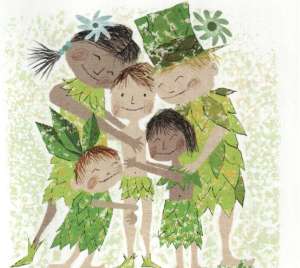
Rosanne Parry also wrote a blog post in response to Sam’s post: A Tribe of Book Reviewers (Writing in the Rain Blog). Parry writes to share her interpretation of this book and her disagreement with Sam’s take on the book as a reinforced negative portrayal of children “playing Indian.” Parry’s take on this book is in accordance with reviewers who see that there are multiple cultures represented in the book and that the book’s focus is on the importance of a sense of belonging and the warmth of acceptance in every child’s life, regardless of their origins or skin tones.  The final “snapshot” seems to encapsulate this sentiment — the kids of pale and dark skin tones locked in a friendly embrace to show their kinship and solidarity:tribehug

For those interested, here are links to all four starred reviews:


5 Comments

Filed under Book Notes, Views

Facebook Black & White

As a librarian for young people, I tend to prioritize literature, believing that introducing great books to my students will inform them and cultivate them to become reasonable, compassionate, and socially conscientious adults.  Adults who will make a difference in our world and our collective future.  And that is also why this particular blog was set up more than 20 years ago (it was not a blog then, but a “website”) to focus on no more than children’s literature.

I have, however, evolved, through the years.  I still believe in the power of books, of course, but I also realize that I have a lot more to say about the world we live in than just which books to give to the next group of 4th graders or what books should have won an award, etc.

So, officially as of today, Fairrosa Cyber Library will be a place where I toss in whatever I am compelled to write about and to open discussions on.  I welcome comments and debates and please share widely if you think the posts are worthy.

Here are two Facebook posts that I read, from former students who are young adults (in their early 20s) in regard to race relations in the United States on this July 2016 weekend.  (I have permission from both of them to publicly post their opinions as written, attaching their names to their words.)

I saw this post first thing in the morning, from Clyde Lawrence, white:

clydelawrenceI normally only post about music and the mets because they’re the only things about which I feel I can speak with authority, but I just wanna say that what’s going on across the country is really terrible and I’m filled with rage and sympathy on behalf of all the people of color affected daily by systemic racism and violence. Although I try to talk in-person about this stuff as much as possible, I have mostly remained silent on social media because I had been unsure of whether my digital voice being distributed to a community of almost-exclusively like-minded people would be productive (or worse, diluting the voices of those who know what’s up). But recently/particularly today, I’ve seen so many people I trust to know what needs to happen more than I trust myself saying that silence on the part of white people simply needs to stop, and I feel that. So here I am, saying two things: I stand with the ‪#‎blacklivesmatter‬ movement, but also I hope to learn about more specific and productive ways I can help. Hit me up on messages or something if you have ideas about what I, as a white person who wants to be part of the solution, can do, not that it’s the responsibility of others to figure that out for me.

This was actually from yesterday, but we just Facebook friended each other today, so it’s new to me, by Jeremy Allen, black:

jeremyallen[A friend/white] inspired me to say something. I too have a difficult time posting on social media on issues of social justice due to a mixture of finding it kind of self-indulgent and fear of the reaction it may cause. I think that the majority of my Facebook friends unanimously agree that what is occurring in our country is wrong. Radical change must happen, and fast, I think that much is clear. If you disagree with me on that, reevaluate yourself/unfriend me plz.
But what is perhaps even more disheartening to me are the comments that I continue to read that are starting a kind of race war, “us vs them,” mentality. This is especially upsetting to see among the young adults I went to school with whom I consider to be fantastic, educated, well informed, and reflective individuals. As someone who feels they straddle the line between both the “black” and “white” world, I offer an opinion to each.
To my white friends: Show support in the ways you believe are righteous, but be open to criticism if they are not well received, and adapt. You do not understand their struggles the way that blacks inherently do. I live a very privileged life, I do not try to deny that. And yet I am familiar with the discomfort of being on the street alone at night and having a police officer pull you aside to question what you’re doing, when really you’re just walking home. Or being stopped in Soho pushing your little sisters empty stroller and being interrogated about where you got it (no, I’m not into stealing strollers). It sucks, it’s awkward, it’s unnecessary, and it’s racist. Yet I have it far better than most. So, just be mindful that sometimes your words — no matter how well intentioned — come off ignorant. If you are a true supporter, you will not be disgruntled by constructive criticism but rather happy that you are able to participate in a way that is constructive to all. This is a learning process.

To my black friends: Do not silence the people who are trying to show support. Saying that it’s “not their place to comment” because of their skin color, economic status, or whatever, is only going to make the problem worse. This is us vs them. But the “US” is the educated and informed, those who strive towards true equality, regardless of race, age, economic position or gender, and the THEM is those who seek to oppose that very same spirit. To make blanket generalizations about white people, or to shame an individual for trying to express solidarity, is to regress. If the wealthy white kid feels so moved as to make a comment, despite them having truly no reason to, let them! If they make an off mark comment, inform them. But do so constructively, and inclusively. There is too much change to be made, and too many issues at stake, to alienate those who are trying to help.

I cannot be more moved by their thoughtfulness, their courage to speak up, and their willingness to continue the work to change our world.  Like Jeremy said, this world of racial bias and bigotry has to be radically changed, and fast.  We can all educate ourselves by reading and by reflecting and by learning from our peers, and those who are older or younger than us.

Please comment and have a dialog and also go out and DO something to change the world for the better.  Starting, perhaps, with reading up on information and how you can take actions here:

Campaign Zero

Leave a comment

Filed under Views

Kadir Nelson’s New Yorker Cover: A Guessing Game

This image is the cover of this week’s New Yorker Magazine — by artist and children’s book creator Kadir Nelson.  It’s almost unbearably ironic that this issue comes out during a week of highly publicized, video-recorded, social-media plastered images of black men killed by the police with apparently little or no justifications and five policemen gunned down by an irate sniper at a peaceful rally for racial equality. I saw this image posted by friends on facebook and read some of the comments beneath this picture and found out how differently this picture could be interpreted by different viewers.  Someone thought that the father in the picture feels desolation and is not having a fun day at the beach; while others see this as family and harmony.  Someone questioned why there are clouds reflected in the sunglasses, and I immediately thought that the comment maker was criticizing the image.  This showed how I presumed and assumed others’ intents and how I definitely need to change the way I post on social media to build understanding and not alienation.  The comment maker wrote back to say that there might be a “hidden message” in those reflections and I can see that now — and have started to wonder, what do those clouds reflected in his sunglasses mean?

Art is like that.

So many possible interpretations.  I have a few thoughts in mind — what are yours?

13 Comments

Filed under Field Reports

2016 ALA Annual at Orlando, Final Recap

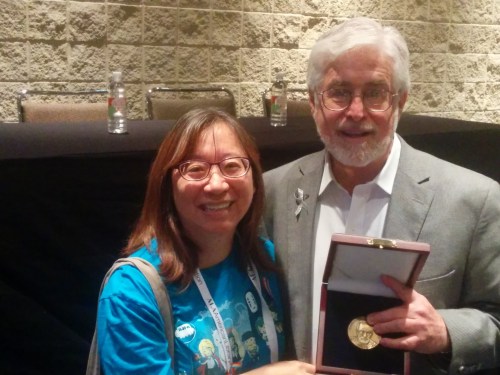
In between the ALSC Awards and the Odyssey Award presentations, I attended the ALSC Membership Meeting and were updated on what this Division has been working on all year. I also joined everyone to celebrate the presentation of the professional awards. Distinguished Services Award recipient Pat Scales is a former school librarian and past ALSC President and she so deserves this Award for her 38 years of and continuing services to children, the library profession, and to ALSC.  Other awards and grants and this year’s recipient information can be found on this page.

ALSC Office also has gathered all the award acceptance speeches in one easily accessible page.


Of course, the Conference was not just about media and professional wards, it was also about professional development and teaching and learning from each other with many workshops and sessions going on in the Convention Center.  To get a broad sampling of all the offerings and what ALSC conference attendees gleaned from this Conference, visit ALSC’s 2016 Annual Conference Blog Roundup page.

Finally — but truly NOT leastly — I thoroughly enjoyed the two meetings on Saturday and Sunday (5 hours and 2 hours long respectively) with my fellow Odyssey Audiobook Award selection committee members.  We’re from many different parts of the country, with different professional duties, varied audiobook listening and evaluating experiences, and distinct personalities — and I met each and everyone of other eight members for the first time at Annual and felt completely grateful for everyone’s diligence, insights, and good humor.  I can’t wait to see everyone and have those meaty discussions about each audiobook we have all carefully listened to at Midwinter (in Atlanta)!


Leave a comment

Filed under Field Reports

2016 ALA Annual at Orlando – Recap, Part 2

Following the CSK Awards breakfast were ALSC awards celebrations on Sunday and Monday.  ALSC (Association for Library Services to Children) is the administering body for many well known (and some lesser known but equally high quality) Youth Media awards.   Youth Media = books, videos, and audios.  Newbery and Caldecott are the two longest standing American Children’s Book Awards, of course, but then there are also: the Belpre for Latina/o Book Creators, Batchelder for Books in Translation, Arbuthnot Lecture, Wilder Lifetime Achievements, the Sibert for Nonfiction, the Geisel for Beginning Readers, the Carnegie for Videos, and the Odyssey for Audiobooks.  All of the 2016 winners and honorees were publicly celebrated on these two days.

The Newbery/Caldecott/Wilder banquet is always an elegant and happy affair with more than 1,000 in attendance, well crafted speeches, and a long receiving line that pushes the event way past midnight if you choose to hang around (or don’t have a choice because you work for the publishing companies!)  The three acceptance speeches are printed in this month’s Horn Book Magazine: Newbery, Caldecott, Wilder.  I also took a couple of snapshots and posted them at the end of this post.

Each year, I have also routinely attended the Monday morning award presentation of Sibert, Geisel, Batchelder, and Carnegie since ALSC started hosting this celebration and have always come away awed by the richness and dedication of writers, artists, editors, producers in creating high quality works that powerfully impact young people’s lives!  This year was no exception.  The bonus reel for me was meeting David Adler, the 2016 Geisel Award winner for Don’t Throw It To Mo.  Adler has been a beginning readers author for almost half a century and his Cam Jansen series held special significance in the Feldman household: it marked my daughter’s journey from a pre-reader to a completely independent reader back in 2006.  I had to take a picture with Adler and told him that it was Cam Jansen that made my daughter a true reader.  He humbly replied that if it were not his series, some other beginning readers would have done it, too.  But I must beg to differ here — it is because Adler not only understands text cadences for very beginning readers, but he also understands that perhaps a young and bright minded girl would want to see herself reflected in some way in the stories she encounters so there is a connection between the act of reading and the reader herself.   No, it had to be Cam Jansen and not just “some other series.”

Here’s David Adler with his much deserved Geisel Medal!

IMG_20160627_095727


For the first time, this year I also attended the Odyssey Award for audio book production presentation Monday Afternoon and it was simply fabulous.  We were treated to a humorous Infographs slideshow documenting the total minutes the Committee spent listening, the yardage of yarn knitted, the sacrificed one must make (not spending time with the family, not watching football on TV, not reading print books, etc.,) and the number of headphones used to their bitter-ends and many other Odyssey Committee Only Experiences!  We then were treated to the amazing live performances and speeches from the voice actors and musicians!  I especially adored the impassioned speeches by the performers and producers that sheds light on what a labor of love and how much expertise it is needed to produce a single good audiobook.

My biggest take-away from this event is that even though Odyssey is for audiobook Production and not for the Content of the original text, these two are indeed deeply intertwined.  Jayne Entwistle, the reader for The War That Saved My Life, told us that she was so deeply moved by the book and its characters, she cried multiple times at the studio while recording this book.  She teared up and pretty much sobbed just to recall how much she loved this text.  Her narration and character acting showcase not only how highly skilled she is but also why there is a certain kind of genuine gravitas and presence that a lesser text would not have inspired: the skills would still have been there, but the not-at-all-easily-quantifiable, extra LIFE would not have.  Attending this event, I gained added insights for my own task in being part of the selecting committee of the 2017 Odyssey award winners — hope to see many people joining us at this really lovely event next June in Chicago!


IMG_20160626_203028

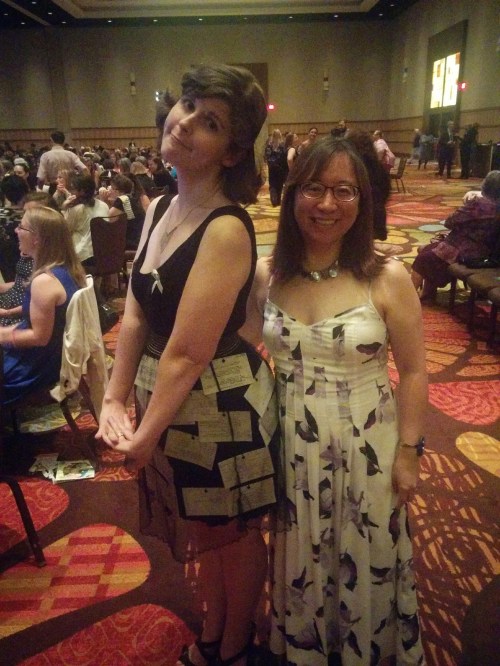
Betsy Bird in her Caldecott/Newbery Winners library catalog cards dress especially made for the Banquet.

IMG_20160627_001255

The long receiving line that kept us way past midnight.  (I went out with friends old and new for a late night snack of root beer floats and apple pies that lasted until 2:00 a.m.  Feeling very indulgent, of course! Pictures are on someone else’s phone!)

6 Comments

Filed under Field Reports

2016 ALA Annual at Orlando – Recap, Part 1

When it dawned on me that attending the American Library Association’s 2016 Annual Conference meant that I would be in Orlando not even two weeks after the massacre in Pulse Club, I felt a sense of powerlessness and loss.  Was there something I could do to make it clear, at least to myself, that I mourn the victims (not just this year, not just the LGBTQ+ community, bur all innocent lives lost to the easy accessibility assault weapons)?  Was there some way to mark the weekend in some small ways to remember the victims and to remind all those around me to continue fighting for gun control? When ALSC (Association for Library Services to Children) president Andrew Medlar posted on the members listserv that there was going to be a Memorial Service for Pulse Victims, along with other volunteer opportunities, I felt so grateful.  Thanks to ALA’s GLBT Round Table for organizing this memorial, I could at least show my respect and support for the causes.

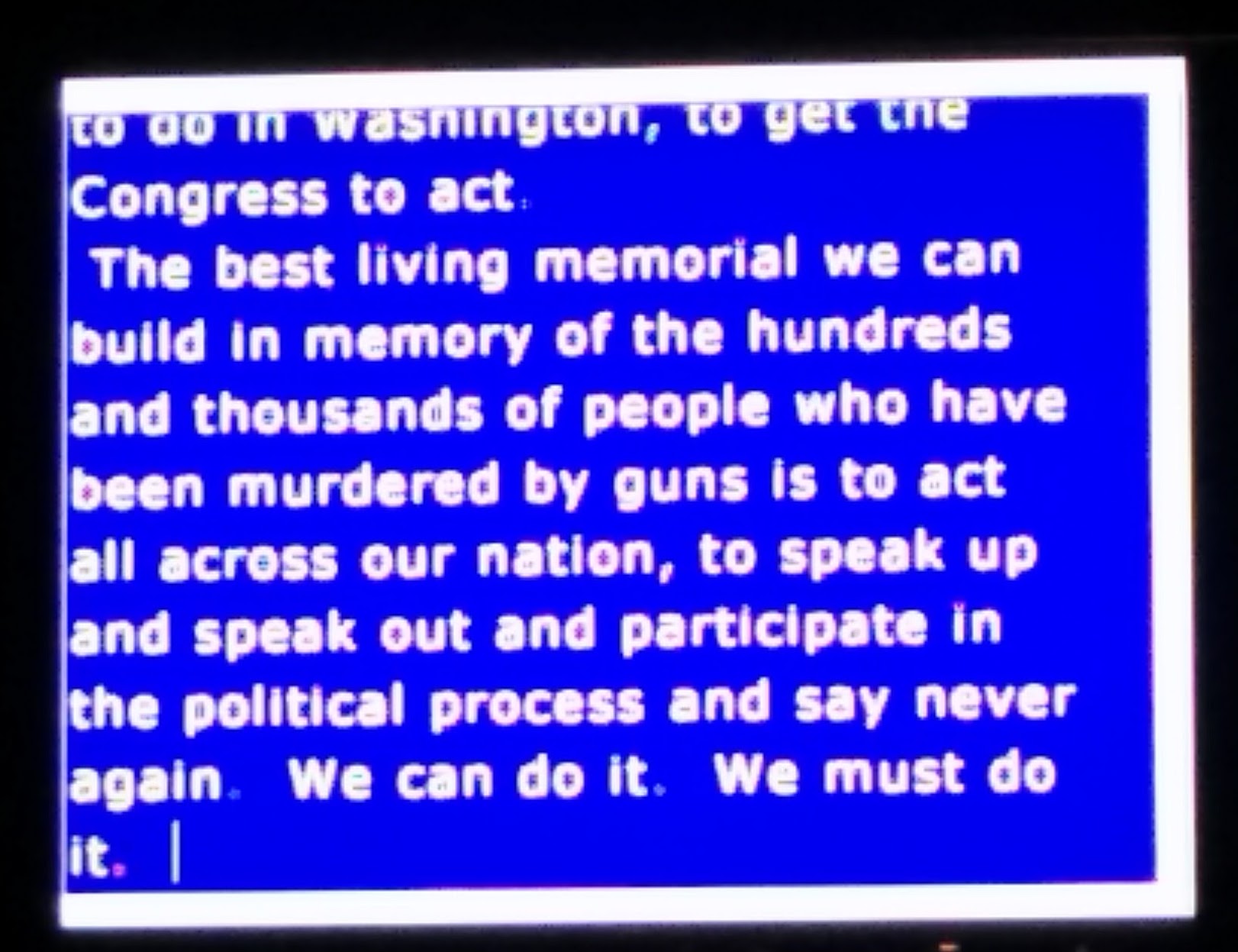
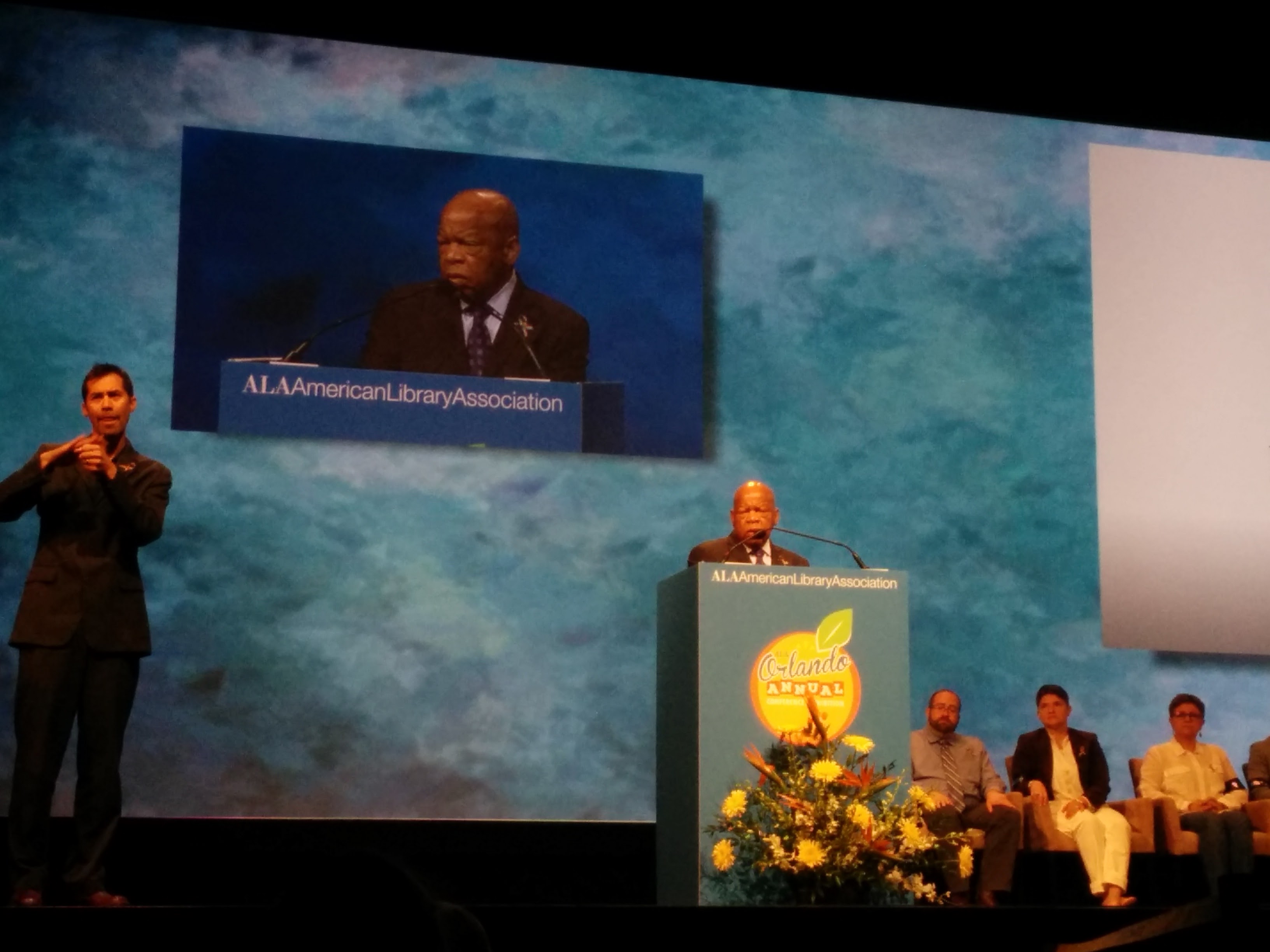
Saturday, June 25, at 8:00 a.m., hundreds gathered in the convention center’s Chapin Theater – we listened to impassioned speeches about the work still needs to be done, including a short talk delivered by special guest Congressman John Lewis.  His powerful remarks reminded all of us the importance to ACT.

Here’s a segment of his talk, captured in close caption:

IMG_20160625_082326 (2)IMG_20160625_082244 (1)

We then stood in silence when all 49 names scrolled on the large screen — reminding us how many of them were so young and how many of them were of Latino heritages.  As a community of librarians whose goals are to better our communities with literature, literacy, and community activism, the words I heard from the GLBT Round Table chairs (both present and former) at this memorial strengthened my conviction and commitment to continue such work as a member of the Round Table.

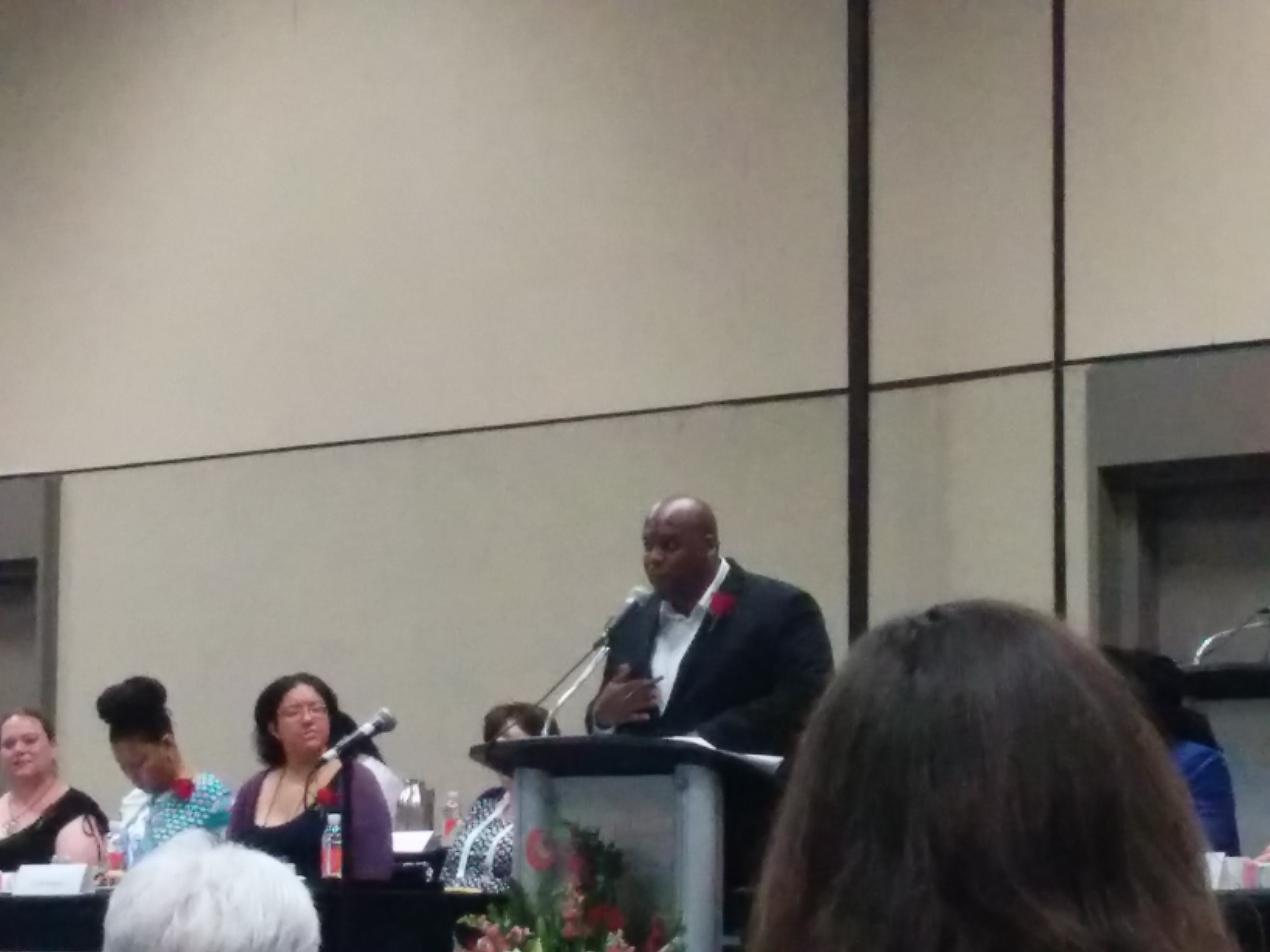
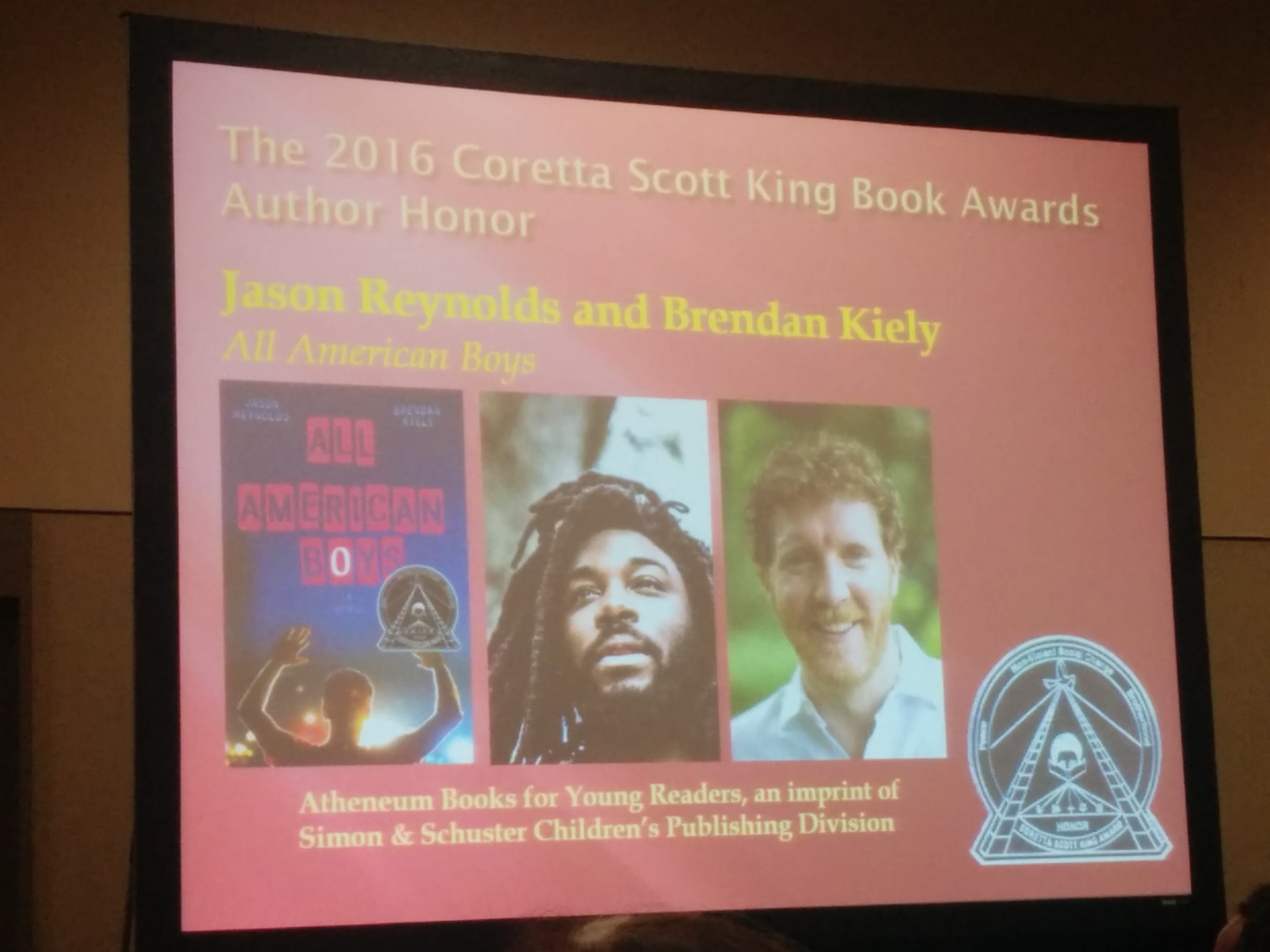
I also belong to another Round Table at ALA: EMIERT – Ethnic & Multicultural Information Exchange Round Table which administers the Coretta Scott King Book Award each year to “outstanding African American authors and illustrators of books for children and young adults that demonstrate an appreciation of African American culture and universal human values.”  Every year, during the Annual Conference, the CSK Award Breakfast on Sunday (at 7:00 a.m.) is always a rousing, powerful, and moving event.  I look forward to it and always know I will be in the strong embrace of like-minded librarians and book makers and will be exposed to significant speeches.  This year was no different.

CSK speeches are from all winners and honorees.  We had the great pleasure to hear from these book creators:

Rita Williams-Garcia, Bryan Collier, Ronald L. Smith, Ekua Holmes, Jason Reynolds, Brendan Kiely, Ilyasah Shabazz, Kekla Magoon, R. Gregory Christie, Christian Robinson, and Jerry Pinkney for Virginia Hamilton Lifetime Achievement.

Each speech was different, some humorous, some somber, yet all were true and inspiring. Many young folks were in the room and I saw their heads bobbing in agreement throughout the speeches, affirming the power of words and the promises to keep doing important work.  I teared up multiple times: of course, that’s not a unique phenomenon.  I attend the CSK Breakfast to celebrate and to have a good cry and to renew my faith in advancing equity and social justices through the power of literary works that channel the power of their creators.

A few of the texts of the speeches are printed in the Horn Book: Rita Williams-Garcia for Gone Crazy in Alabama, Bryan Collier for Trombone Shorty, and Jerry Pinkney for his Lifetime Achievement recognition.  (Just keep in mind, in the LIVE version of these speeches, things said are not always the same as the printed text, and the deliveries… oh the deliveries — that do make a huge difference!)

But this year, there was also the un-prepared and oh so smooth and sincere speech by Jason Reynolds, a love song to his mother, who was IN THE HOUSE!  And the exhilarating, eloquent calls to action by Ilyasah Shabazz, daughter of Malcolm X.  Ronald Smith’s reminder that not all African American authors must or do write about realistic, historical, African American lives but they should own the full range of literary genres and themes, fantasy, science fiction, and beyond.  Christian Robinson’s love for his Nana was evident; Kekla Magoon’s sense of responsibility was energizing; Ekua Holmes is not only a wonderful artist, but an impressive public speaker — I can’t wait to hear and see more from her!

I wish everyone could have been there listening to Bredan Kiely’s on-the-verge-of-tears-oh-no-I’m-actually-sobbing-as-I-lisetn-to-this highly self-aware and conscientious white, sis-gender, straight, privileged male (as he declared in his speech for All American Boys, co-authored with Jason Reynolds) author whose heart is on his sleeve and who shares his vulnerability without qualm.  (Have you read Gospel of Winter yet?  No?  Go get it!  It was the 2015 Top 10 Best Fiction for Young Adults!)  I really would love to see all of the speeches in print somewhere (since Horn Book only publishes the winners’ speeches).

Not only in print, actually!  I want video recordings so others can witness Jason Reynolds’ raw power when he declaimed his long, audience-jumping-up-from-their-seat-to-give-a-standing-ovation spoken word poem [which is published on the brand new CSK blog, entitled Clap Clap.]

[Since posting earlier today, Sam Bloom, a member of this year’s CSK Award Jury has sent me the link for a partial video of Jason’s speech posted by Patricia Enciso.  Click on the image to watch it!]

Screen Shot 2016-07-02 at 5.34.38 PM

Here are just a couple more snapshots of that auspicious morning which will forever imprint in my mind, same as last year and all the years before.

IMG_20160626_081238

IMG_20160626_084653

10 Comments

Filed under Field Reports

The Tangled Web that is Amazon, Goodreads, B&N, and Consumer Self-Education

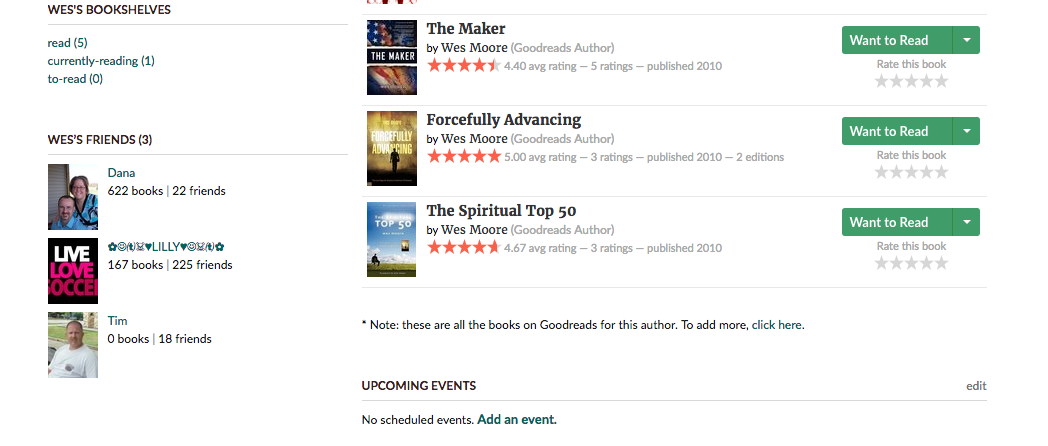
This morning, when I looked up reviews about This Way Home by Wes Moore and Shawn Goodman, I discovered the following:

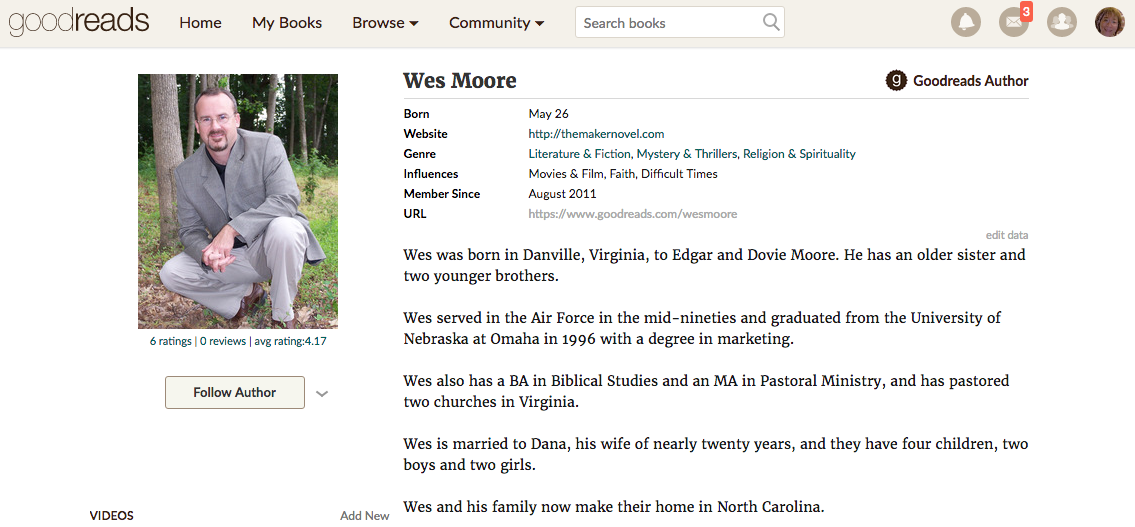
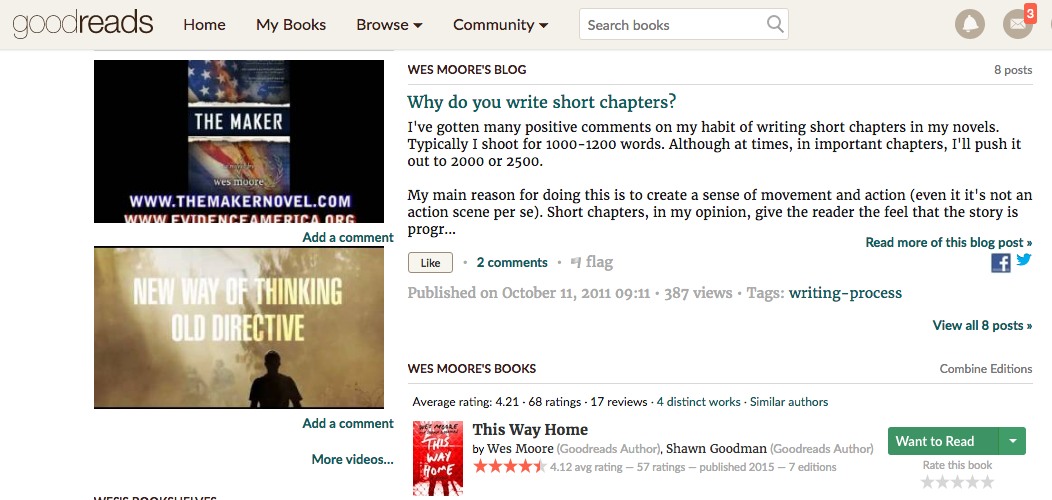
  1. On Goodreads, the book is linked to Goodreads Author Wes Moore who wrote and self-published? books The Maker and Forcefully Advancing — both with 4-and-above star ratings (with 5 and 2 ratings each.)  Upon close examination, the actual author Wes Moore of This Way Home is not tagged as a Goodreads Author and on his author page This Wawy Home is not listed along with his three other titles. This could be the reason why the book was attributed to the wrong author.  Goodreads seems to rely on Goodreads Authors’  to actively remove books not written by them from their books list.  I sent a message to the Goodreads Author Wes Moore and will report back if he takes action to correct this mistake.
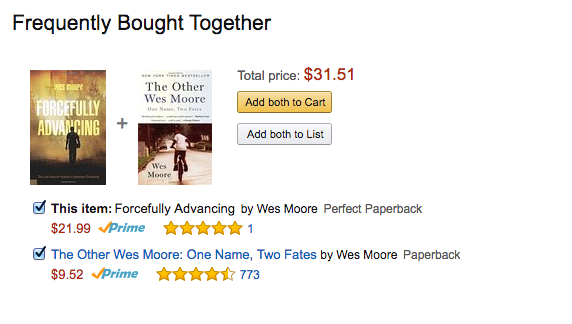
  2. On Amazon, This Way Home was linked to the correct Wes Moore.  However, an author search of Wes Moore brings up both This Way Home and Forcefully Advancing.  Navigating to Forcefully Advancing page, I saw that this book is frequently bought with The Other Wes Moore, a powerful and popular book (so ironic and confusing since there is a third real person Wes Moore whose story is told in The Other Wes Moore but is not either of these two authors.)  According to the book summary of Forcefully Advancing, r eaders will “learn how to make friends, start conversations, understand spiritual background and barriers, overcome objections, and share the message of Jesus” and “see what America could be like if the Great Commission is implemented across the nation.”
  3. Barnes & Noble also show that these two Wes Moores’ books are often viewed/bought together. `

What I learned today is:

  1. Goodreads or Amazon system administrators probably would NOT easily have caught or fixed these mistakes.
  2. The big consumer sites system designers sure will not make it a priority to report this kind of “small” mistakes.
  3. Even if it were easy to report, I wonder what they can actually do about it — manually remove “bought together” or “viewed together” data? Create a warning label that says, “Hey, there are more than one Wes Moore author up here, proceed with caution”?  Probably not!
  4. What it comes down to is for me the consumer to be more aware and vigilant of what I am reading and buying.  (Which kind of applies to all the discussions over online discourses about children’s literature, doesn’t it?  We should always be vigilant about what is being said, who says what, and why they say what they say.)

Here’s what I encountered and the process of determining for myself if I were to purchase a book by Wes Moore who wrote The Other Wes Moore which my upper middle school students gobble up and find compelling:

Definitely read the book description carefully.

This Way Home is about basketball, sinister street gang, courage to take a stand against the gang and that in the end, hope, love, and courage are our most powerful weapons.  Examining the other titles by this Goodreads Author Wes Moore, I realized that there must have been some confusion.

Screen Shot 2016-06-05 at 10.11.10 AMScreen Shot 2016-06-05 at 10.11.23 AMScreen Shot 2016-06-05 at 10.11.34 AM

I also took note how the number of ratings/reviews given to each title and evaluate the true meaning of the STARS.

Here on Amazon, Forcefully Advancing has a high-flying five-star rating (with 1 review) and The Other Wes Moore that is “Frequently Bought Together” has 4.5 stars (with 773 reviews).

Screen Shot 2016-06-05 at 10.10.21 AM

The bottom line – as a librarian for young consumers of both material goods and information, I shall focus more and more on how to educate my students to be clear-headed, detail-minded, and persistent when navigating the extremely tangled and confusing world of information.

2 Comments

Filed under Field Reports, Views

Boston Globe-Horn Book Awards, 2016

The winners and honor titles are now public!!!  Watch the video announcement here!


Fiction/Poetry

Winner

The Lie Tree
by Frances Hardinge

Honor

The Hired Girl by Laura Amy Schlitz
Goodbye Stranger by Rebecca Stead

Picture Books

Winner

Jazz Day: The Making of a Famous Photograph by Roxane Orgill, illustrated by Francis Vallejo

Honor

One Day, The End.: Short, Very Short, Shorter-Than-Ever Stories by Kai Dotlich, illustrated by Fred Koehler
Thunder Boy Jr. by Sherman Alexie, illustrated by Yuyi Morales

Nonfiction

Winner

Most Dangerous: Daniel Ellsberg and the Secret History of the Vietnam War by Steve Sheinkin

Honor

Symphony for the City of the Dead: Dmitri Shostakovich and the Siege of Leningrad by M.T. Anderson

Voice of Freedom: Fannie Lou Hamer by Carole Boston Weatherford, illustrated by Ekua Holmes

Having read a host of titles this year, I can vouch for the excellence and brilliance of each and every one of our final selected titles. I couldn’t have been prouder or more grateful to having served on this committee. Hope more readers will discover/rediscover these books!

Below are many other titles that I would also highly recommend to readers, by categories:

Fiction/Poetry:

whengreenbecoomestomatoes allamericanboyscurioustaleoftheinbetween

Bardugo, Leigh: Six of Crows
Brown, Peter: The Wild Robot
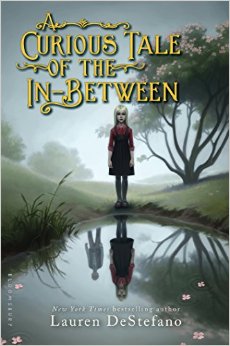
DeStefano, Lauren: A Curious Tale of the In-Between
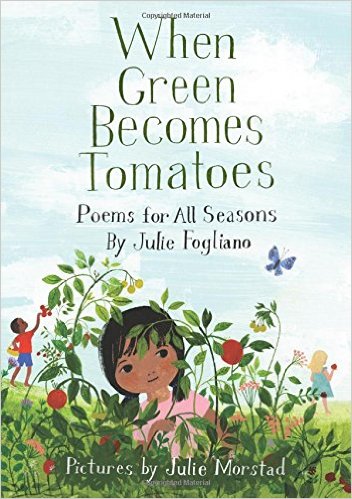
Fogliano, Julie: When Green Becomes Tomatoes
Lu, Marie: Rose Society
Nelson, Marilyn: My Seneca Village
Oppel, Kenneth: The Nest
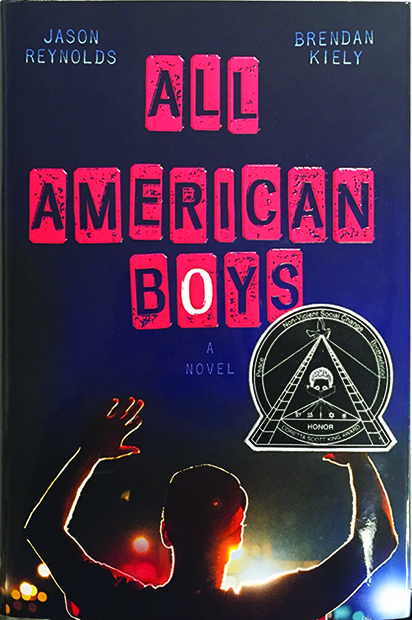
Reynolds, Jason & Brendan Kiely: All American Boys
Riordan, Rick: Sword of Summer
Rundell, Katherine: Wolf Wilder
Savit, Gavriel: Anna and the Swallow Man
Selznick, Brian: Marvels
Sepetys, Ruta: Salt to the Sea

Picture Books:

billysboogerfreedomincongosquare bookitch

Atinuke: Double Trouble for Anna Hibiscus!
Barnett, Mac: Leo: A Ghost Story
Buitrago, Jairo: Two White Rabbits
Daywalt, Drew: The Day the Crayons Came Home
Fan, Terry & Eric Fan: The Night Gardener
Goodrich, Carter: We Forgot Brock
Henkes, Kevin: Waiting
Hurley, Jorey: Hop
Jenkins, Emily: Toys Meet Snow
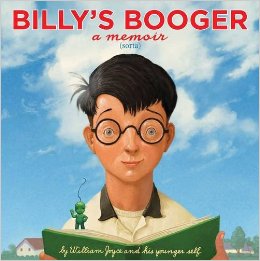
Joyce, William: Billy’s Booger
Light, Steve: Swap
Miyakoshi, Akiko: The Tea Party in the Woods
Miyares, Daniel: Float
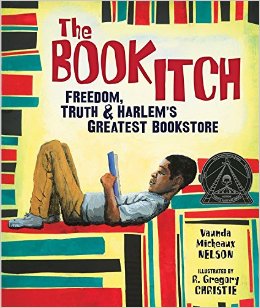
Nelson, Vaunda: The Book Itch
Park, Linda Su: Yaks Yak
Smith, Lane: There Is a Tribe of Kids
Stead, Philip C: Ideas Are All Around
Tate, Don: Poet
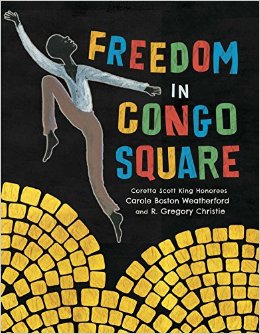
Weatherford, Carole Boston: Freedom in Congo Square
Yoon, Salina: Be A Friend


Nonfiction:

samurairising breakthrough terribletyphoidmary

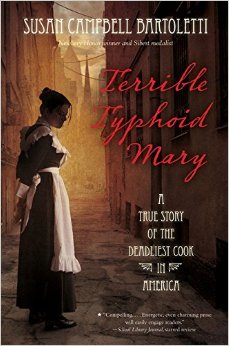
Bartoletti, Susan Campbell: Terrible Typhoid Mary
Brown, Don: Drowned City
Engle, Margarita: Enchanted Air: Two Cultures, Two Wings: A Memoir
Freedman, Russell: We Will Not Be Silent
Hendrix, John: The Miracle Man
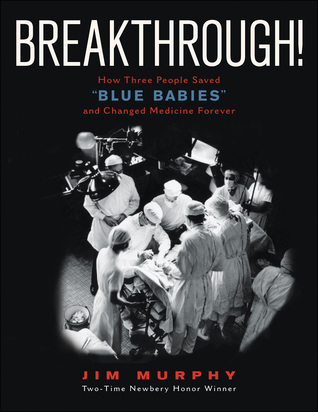
Murphy, Jim: Breakthrough
Pinkney, Andrea Davis: Rhythm Ride
Samanci, Ozge: Dare to Disappoint: Growing Up in Turkey
Silverberg, Cory: Sex is a Funny Word
Tonatiuh, Duncan: Funny Bones
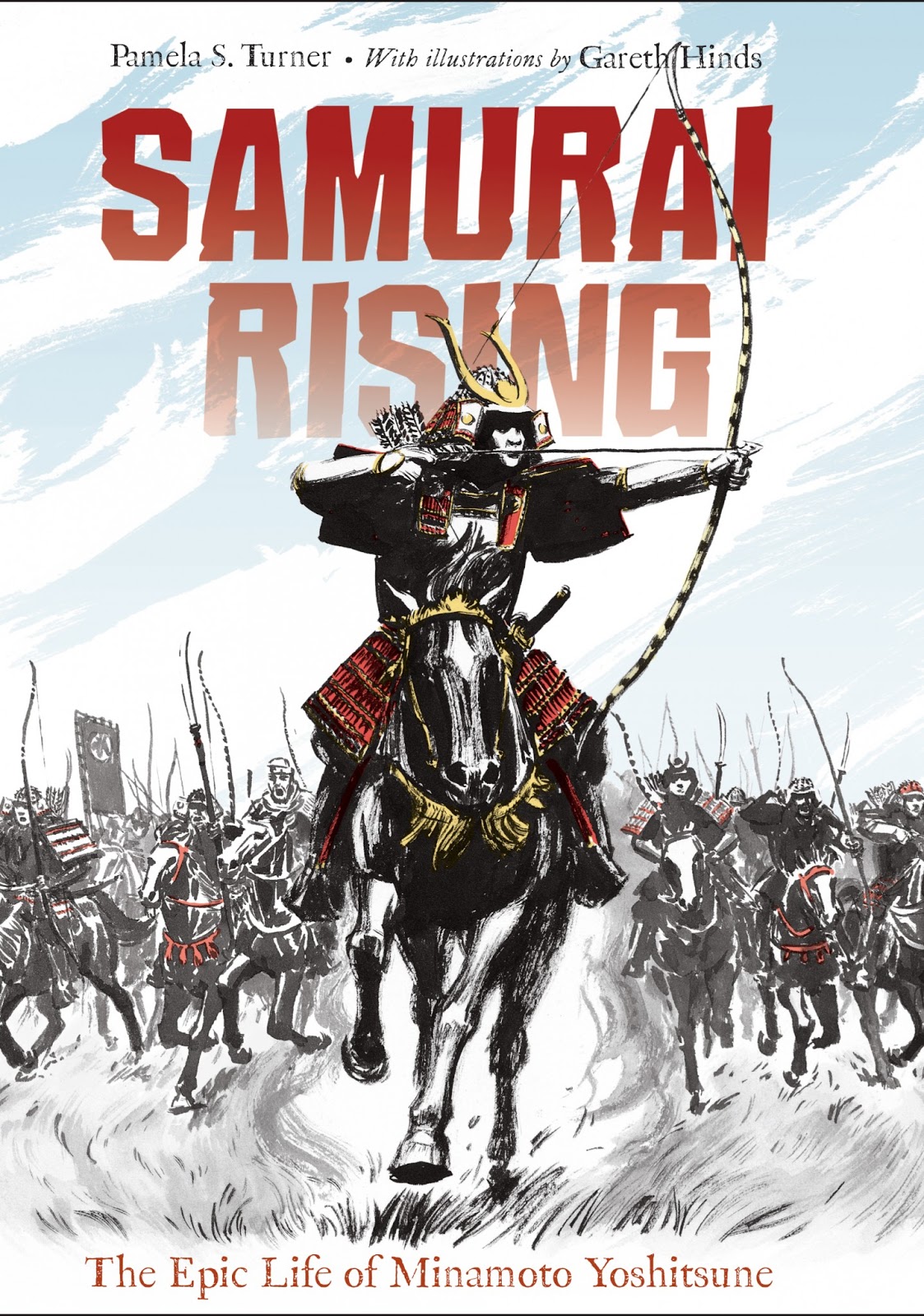
Turner, Pamela S.: Samurai Rising: The Epic Life of Minamoto Yoshitsune


4 Comments

Filed under Book Notes, Field Reports

Last Day of Asian Pacific American Heritage Month

It is the last day of the 2016 APA Heritage Month — but it will not be the last time I write about media representation of Asian Americans or about the importance of respect, integrity, diligence, compassion, empathy, knowledge, open-mindedness, inclusion, and collaboration in regards to improving accurate and nuanced representations.

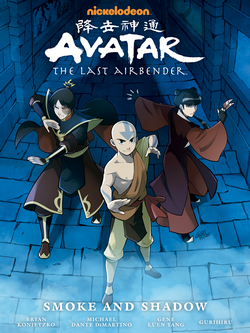
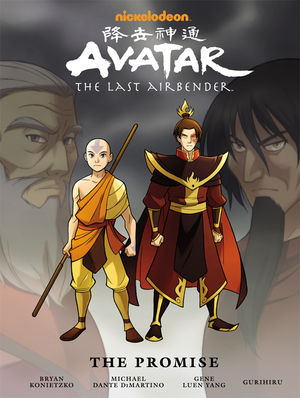
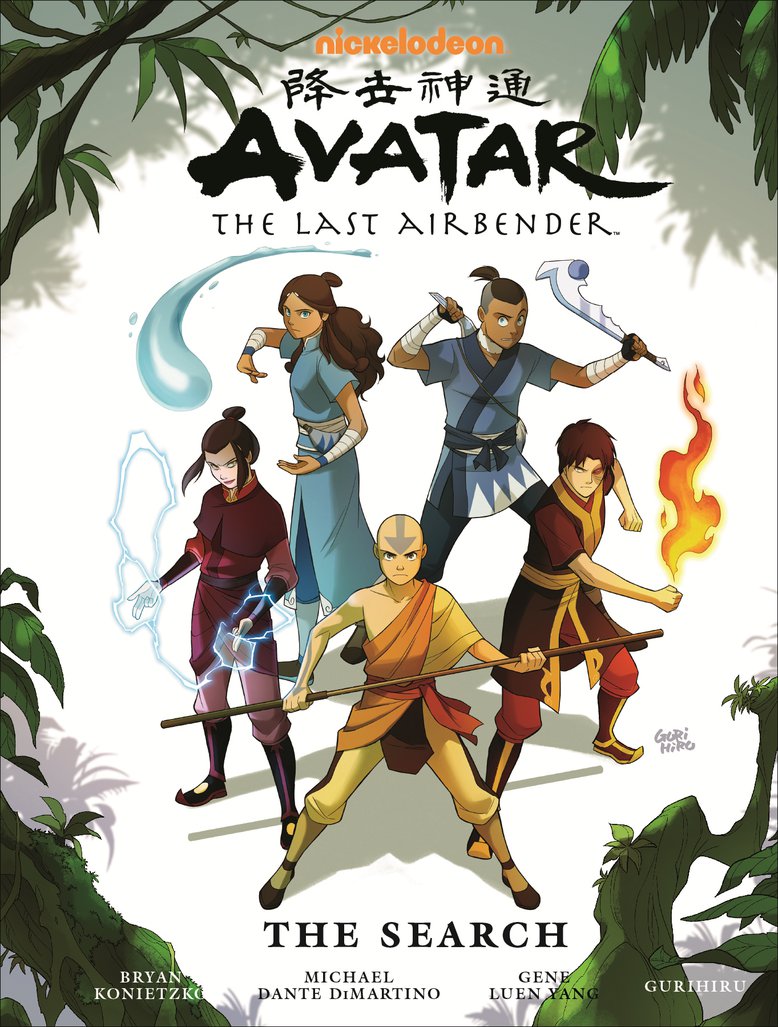
Smoke_and_Shadow_hardcoverToday, I want play an upbeat note and share my adoration to the wonderful Avatar: The Last Airbender series penned by Gene Luen Yang. Currently there are four completed stories, each told in three paperback volumes and also collected in a library binding oversize single volume.  They are: The Promise, The Search, The Rift, and Smoke and Shadow.  Of course, for fans of the Nickelodeon TV show like me, these stories are like lush oases in the parched void left by the ending of the original series.  We get to see Aang and his gang grow up a bit, deal with more complex issues, and find out answers to some questions left unresolved by the show!

avatarthepromiseHowever, I have also observed many young readers encounter these as stand alone series and thoroughly enjoy the adventures, character relationships, humor, and the conflicts.  This is a series that could easily err on the side of “appropriation” because it definitely mimicked the Japanese anime style and the several nations’ customs and philosophies or even “national traits” are loosely and (one might argue) stereotypically based on certain Asian cultures — another potentially incendiary aspect of the show.

avatar___the_search_hard_cover_by_antomori-d6pbo7vInstead, it is accepted and even embraced as appreciation and celebration by viewers from all racial backgrounds, including many Asian Americans — one of the super fans is Gene Luen Yang.

Many factors contributed to why the show worked in building and not destroying positive representations: characters are deftly portrayed as individuals, whether they’re from a specific culture or not, the show creators are always careful when cultural details are represented — all Chinese characters and sentences are correctly written out and composed, and the relationships between characters and nations are complex and nuanced.  Not to mention the artistic rendering of the images and the exciting plot progression through the 61 episodes!

The_Rift_hardcoverThe book series written (not illustrated) by Gene Yang, published by Dark Horse, are equally, if not more, complex, thrilling, and satisfying! Please read them, share them with people in your life, young or not so young, and celebrate everything that works well in these volumes!

For those interested, there are some great questions and answers about the creation of the TV show and the outcry against the casting of the 2009 life action movie based on the show at racebending.com.

Leave a comment

Filed under Book Notes, Views

Boston Globe-Horn Book Awards: We Made Our Selections!

For the last many months, Boston Globe-Horn Book Awards Chair Joanna Rudge Long, fellow committee member Betsy Bird, and I, have been reading and communicating electronically about excellent books for young readers published between June 1st, 2015 and May 31st, 2016.  This past weekend, we finally met face to face and discussed our nominated titles for these three categories: Fiction and Poetry, Nonfiction, and Picture Book. For each category, we were to select one winner and up to two honor books.

On Saturday afternoon, we started with 50 nominated titles.  (Selected from more than a thousand submitted titles.)  Discussions went smoothly but like all book selection committees, some compromises must be made — and some strong opinions were shared!

By the end of the evening, we managed to talk about every single title, expressing our appreciations: from superb character development, to excellent presentation of complex historical accounts, to a particularly delightful visual surprise, and also voicing critical evaluations: be it a weak link in the plot progression, a slightly less affecting tone in a nonfiction narrative, or a layout that could have been more fluid and supportive of the text.  We agreed on which titles to eliminate from our final discussions and brought down the number of book for further discussion to below 30.

Sunday was devoted to making tough decisions.

For each category, we figured out a different way to further narrow down our choices.  Once we reduced the number of contenders even more (after careful consideration,) we could allot more time for in-depth and rigorous discourses on each title most likely to receive the award. Professionalism, courtesy, and plenty of humor marked our work together.  By the end of the day, we had our winners and honor titles for all of the categories!

Did we initially all agree on the final choices?  Of course not!  But did we come to consensus and will we support our choices as a team?  You betcha!  I feel grateful to have had the opportunity working with these two thoughtful and knowledgeable literary critics who helped me see certain aspects of many books that I didn’t notice before and who also listened attentively to my views on many titles. All three of us changed our minds multiple times to serve the communal goal.

The perfect team work was made even better by the hospitality of our hosts: Joanna and her husband Norwood.  They opened their home to Betsy and me and cooked every meal for us.  I loved every book discussion, every casual chat, every short hike, and every bite of all the meals this weekend! And I will never forget Brym for being a perfect, quiet, and gentle companion!

Here are a few photos to commemorate this occurrence — (I didn’t take pictures of the books that we discussed but will share some of my favorites after the official announcement is made this coming Thursday – June 2nd.)

IMG_20160529_120517

IMG_20160529_120217

IMG_20160529_115847

IMG_20160529_115053

IMG_20160530_102805

IMG_20160529_193912

IMG_20160529_130904

IMG_20160529_075445


Leave a comment

Filed under Field Reports

19th Day of Asian Pacific American Heritage Month

As we continue to understand and learn about Asian Americans and their (our) histories and cultures, it is also important to keep offering truthful windows to the contemporary Asia and its multitudes of cultures.

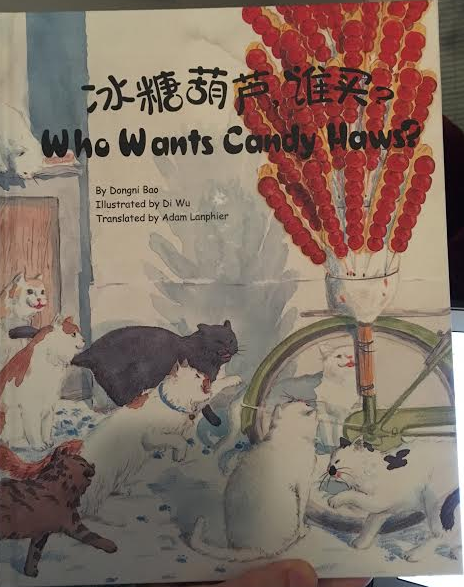
Earlier last year, I made a vow to help bridge the U.S. and the China children’s literature fields and because of lucky circumstances, I have been able to work with some dedicated publishing folks in Beijing to bring recent Chinese picture books in bilingual form to US readers.  As seen on Betsy Bird’s BEA round up for some noteworthy upcoming titles, picture books from Candied Plums will be available for purchase later this year!

I’m so pleased that Betsy enjoyed and highlighted this sweet tale:

Haws

and can’t wait to share the other titles with everyone soon!

Leave a comment

Filed under Field Reports

18th Day of Asian Pacific American Heritage Month

It has become more and more apparent to me that the experience of an Asian person is so drastically different from that of an Asian American’s.

An Asian who grew up in her own country (like myself) didn’t have to struggle to be recognized or represented in books or other media.  In Taiwan where I was born and lived until my late 20s, the demographics were almost 100% ethnic “Chinese.”* Even if, like most young people, I experienced much self-doubt and dark days when constructing my own identity, dealing with my “ethnicity” was never part of that process.

On the other hand, my young Asian American students (Chinese, Korean, Japanese, Vietnamese, Filipino, Nepalese, Bangladeshi, Indian) must contend with the fact that their ethnic backgrounds are a significant part of their identity forming process.  Even in a city that is highly diverse, they still belong to only about 12% of the total NYC population (and about 6% of the U.S. population.)  This means that if you evenly spread out all Asian Americans in NYC, there is about 1 person of Asian heritage per 10 people in any room.  We can further break down the population by ethnic groups.  For example, there are about 20,000 ethnic Japanese and 100,000 ethnic Koreans living in New York City (approx pop 8.5 million).  This means that you will have to put about 500 people in a room to encounter a single Japanese person and about 100 people to meet a Korean person.  It is then of little wonder that many things that do not bother me in the least might really offend my Asian American students: I was never under the threat as being “the other” nor would I ever have to explain or defend my culture to my peers.

Since I can only consider Asian American youth experiences,  as an “outsider,” the only way for me to learn is first to not impose my own past experiences onto them and then to keep listening to Asian American friends and students so hopefully I can gain some degree of understanding in order to act as a supportive and effective ally.

* Due to the complex modern history this accounting is not truly accurate: there are those who migrated from Mainland China in 1949 (14%), those who had migrated from Mainland China some 400 years ago (84%), and the aboriginal tribes, who were colonized and have lost most of their cultures and languages (2%).

1 Comment

Filed under Views

17th Day of Asian Pacific American Heritage Month

Today is for celebration!  Celebrating one of my favorite Asian American authors – Gene Luen Yang.

Gene is generous. Gene is funny. Gene is wise. Gene is brave.

Gene is generous.

In 2013, he came to my school and met with high school students in the Asian Cultures and Science Fiction/Fantasy clubs to chat about graphic novels, Boxers & Saints, Avatar: The Last Airbender, and growing up as an Asian American nerd and answer many many questions — all on his own time, without charge!

Addendum: A friend of mine pointed out to me that such “free” visits are not the norm for most libraries or authors — my school is in NYC where Gene’s publisher is located, this was part of his promotional tour for Boxers & Saints, and I and the school I work for are frequently tapped by the NYC publishers to host informal author events like this.  This is yet another case of how one person’s view can be so influenced by the circumstances and thus limited without the reminder from someone else who has the view from a different vantage point.  That said, Gene’s generosity is not limited to “free visits” but is demonstrated his willingness to engage the students and freely shared thoughts and views.

geneyang2 geneyang1

Gene is funny.

I had the great pleasure to listen to Gene talking about Graphic Novels on a panel at last year’s USBBY Conference.  He used humor to drive home some serious considerations in a way that the audience would easily accept.

Gene is wise.

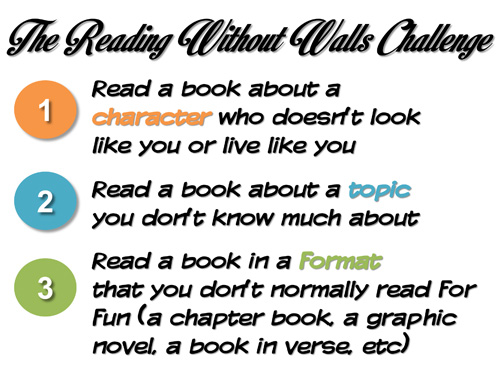
As a recently appointed National Ambassador for Young People’s Literature, Gene has set up a great campaign for all readers to Read Without Walls with three simply stated but significant goals that will advance the scope of diversity in any young reader’s world:

RWW-Criteria

Gene is brave.

He spoke the hard truth publicly without skirting around the issues.  One such memorable speech was delivered at the National Book Festival gala in September 2014.  You can read the whole transcript at The Washington Post.  These words were not only wise, almost prophetic, they should be heeded ever more now that so many of us get our news and views from extremely short, often volatile, and sometimes sensationalized sound bites littering the edge-less world of the Internet.

But I have noticed an undercurrent of fear in many of our discussions. We’re afraid of writing characters different from ourselves because we’re afraid of getting it wrong. We’re afraid of what the Internet might say.

This fear can be a good thing if it drives us to do our homework, to be meticulous in our cultural research. But this fear crosses the line when we become so intimidated that we quietly make choices against stepping out of our own identities.

After all, our job as writers is to step out of ourselves, and to encourage our readers to do the same.

I offer three further thoughts inspired by Gene’s words:

First, I think this call for “doing homework” should not be limited to authors, illustrators, or editors and publishers.  The demand of meticulous cultural research must extend to all the critics of books — we must also do our homework before delivering verdicts to praise or condemn a literary work, especially when large swatches of the text contain cultural allusions unfamiliar to us.

Second, I think it is crucial for those who are promoting works about and by diverse creators to remember that simply “of a culture” does not guarantee any book creator having understanding of the multiplicity of the entire history or full scope of that specific culture.  Even those writing “within” a culture must do their homework!

Third, although book creators must heed Gene’s call for NOT fearing of where their creative hearts tell them to go, I feel compelled to call on critics and advocates to educate ourselves on informative and productive ways to critique literature so that we may uplift the whole field.  We must figure out ways to turn our initial anger and frustration into useful and illuminating insights and advices to help improve representation and authenticity in all future books for young people.


3 Comments

Filed under Views

15th Day of Asian Pacific American Heritage Month

Starting today, I’ll post here and on other social media some articles and perhaps my own thoughts on media representations of Asian Pacific Americans in the United States.   Here Media include movies, tv shows, books, and games.

Today’s offering from the New York Times, an article by Keith Chow, first published on April 22, 2016.

Why Won’t Hollywood Cast Asian Actors?

The TL:DR version:

Even a modest hit like the “Harold and Kumar” trilogy, starring John Cho and Kal Penn, was able to quadruple its production budget after box office and home media sales. Meanwhile, films with white stars fail at the box office all the time. Chris Hemsworth, who stars in this weekend’s “Huntsman” sequel, has had many more box office flops than successes, yet he is considered a bankable movie star.

Such facts reveal Hollywood’s dirty little secret. Economics has nothing to do with racist casting policies. Films in which the leads have been whitewashed have all failed mightily at the box office. Inserting white leads had no demonstrable effect on the numbers. So why is that still conventional thinking in Hollywood?

And don’t forget to scroll through the

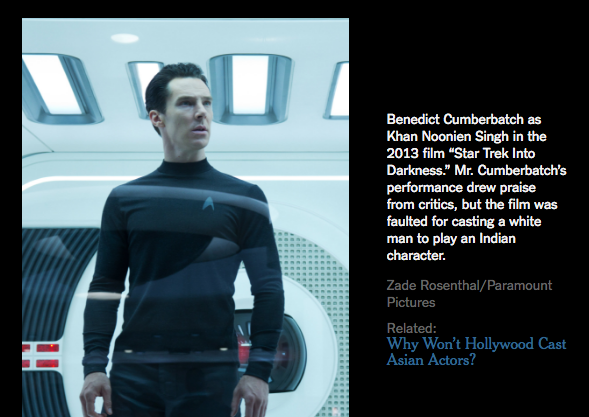
Whitewashing, a Long History slide show, featuring slides such as this one:

Screen Shot 2016-05-15 at 4.49.11 PM

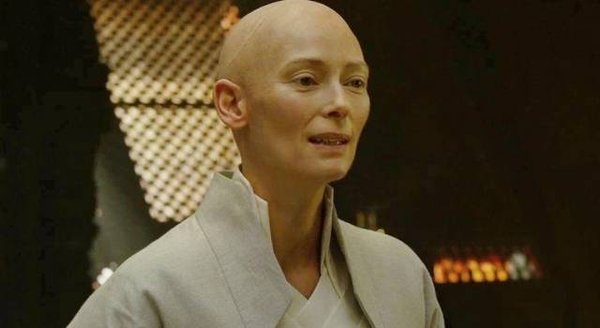
And they didn’t even touch on Tilda Swinton cast as a Tibetan (now Indian?) Mystic (The Ancient One) in Marvel’s upcoming Doctor Strange or Scarlett Johansson as Mokoto Kusanagi in the American Remake of a Japanese SciFi film, Ghost in the Shell. 

ancientoneghostintheshell


Leave a comment

Filed under Field Reports, Views

The 2016 International Children’s Literature Winner: Cao Wenxuan from China! 曹文轩

Cao-300x300So excited to report that Cao Wenxuan (曹文轩) won IBBY’s Andersen Award this year. According to Xinhua news outlet, this award is given only ONCE in a lifetime for an international author/illustrator for “the aesthetic and literary qualities of writing and illustrating as well as the ability to see things from the child’s point of view and the ability to stretch the child’s curiosity and imagination.”

Read about it on this official press release.

Leave a comment

Filed under Field Reports

Dear Ellen Oh, You Are Not Me!

I was going to challenge Ellen Oh’s use of “WE”  when I read the first paragraph of her blog post “Dear White Writers“ because I had a knee-jerk reaction and found the use of this collective pronoun problematic. Indeed, I often find sweeping generalization of all kinds problematic.  And because I believe strongly that ANYONE CAN write about ANY topic and create ANY character they are passionate about as long as they have done diligent preparation, her proclamation of “Yes We Need Diverse Books. But that doesn’t always mean that we want YOU to write them” made me feel that I was not included in that general “We.”  My thoughts went immediately to these queries: What did she mean by “We”?  Who are the “We”?  Did she include me, a Chinese American librarian, when she used “We”?  Or did she mean only the people who are officially involved with the #WeNeedDiverseBooks organization?  (By the way, when I submitted my volunteer form through the site, I was informed that too many people were interested in being involved so that my request was denied.)  Or did she mean just the Korean American writers, like herself?   Or all the Asian American writers?  Or anyone that is not White?  Or simply all those who agree with her?  You see — the use of We is too imprecise and too absolute at the same time to not make me think of all the possibilities in one shot!

But I went on and read the entire post and found that I actually agree with most of her points, except perhaps this following accusatory sentiment.  She wrote,

Don’t do it because “you believe in diversity and want to help the cause.” Don’t do it because you think you are helping us. Because you’re not. The truth is, you’re only doing it for yourself. Because you think it is going to help you get published.

I think it is GREAT if all writers believe in diversity and want to help the cause — regardless of their skin colors.  Actually, I think many of such efforts could be very helpful.  In any kind of social movement, ally-ship between the insiders and the outsiders is crucial in its success.  So, I say, please do include diverse characters and address many topics in your books: whether you are white or a person of color and whether you are writing from an insider or an outsider lens.  Just be very aware of which lens you are using and do not presume that you know it all.  You just may be helpful.  I also feel very uncomfortable seeing a universal condemnation to an entire group (white writers, in this case) and accusing them all for wanting something (to be published) that is simply a natural desire for anyone in the field (children’s and YA lit world.)

Aside from this strong disagreement, I want to specifically endorse these following points.

Ellen wrote in her blog post:

We don’t want publishers to say, “Well, we already published a book about that,” and then find that it was a book that did not speak the truth about us but rather told someone on the outside’s idea of who we are.

And I cannot agree more!  “That” refers to topics or characters existing to fill a “diversity quota.”  There should not be a quota.  The publishers of children’s books must start examining their own output and ensure the widest possible diversity in character representations, subject matters, and book creators.  Diversity should not be something that needs policing and reminding.  It should be so natural that no publishing teams would think twice about offering all kinds of books and about all kinds of characters and experiences.  In fact, the publishers themselves should be the frontline champions of diverse books!

Ellen also wrote this paragraph that a white author who has been worrying about whether they are “allowed” to write POC stories should take to heart:

So here’s the truth that needs to be repeated again and again. Don’t write a POC’s story unless you need to tell it with such a burning desire that it will eat you alive and so you will come into our houses and walk in our shoes to get it right, and that way it isn’t written ONLY from a white lens. Don’t do it unless you are willing to invest in a whole lot of time and commitment and get into some heavy conversation about what it is like to live our lives, deal with racism and micro-aggressions and fear and hate. Don’t do it because you think it is a hot trend. Don’t do it because you think it will help you get published. Don’t do it because you just love Kpop and Kdramas and oh wouldn’t it be cool to bring it to an American audience? Don’t do it because your mama is 1/32nd Native American and somehow that gives you a pass to write about the culture (it doesn’t). Don’t do it because it is exotic, mystical, spiritual, etc.

Thank you, Ellen Oh, for proposing these sensible and achievable goals for your fellow writers.  Even though you are not me, WE (two) definitely share a lot of common expectations and aspiration.

5 Comments

Filed under Views

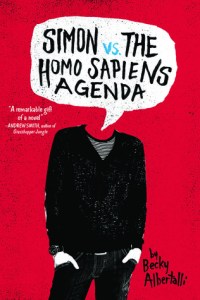
Simon vs The Homo Sapiens Agenda

Ssimonvshomosapiensimon vs. The Homo Sapiens Agenda
by Becky Albertalli

Listening to this book was a bit like watching a John Hughes movie… actually, it was a lot like watching a John Hughes movie. It is kind of sweet, there might be some heart-breaking moments, some misunderstandings, some bullying, but definitely a lot of friendship, quite a bit of sweet-loving, and totally easy to get hooked on and want to know more and want everything to work out at the end — and boy did EVERYTHING get worked out! Mostly believably so but definitely veering toward the hyper-optimistic end of possibilities: which, we all need from time to time!

I was a little sad that once Simon & “Blue” met up in real life, the author pretty much stopped giving us their exchanges of ideas: no more interesting emails to read of their views on the world around them or the quirky questions and answers. In the last part of the book, the readers are left with just observing their physical (sweet) contacts and first explorations: as if all those emails were just a precursor to what REALLY matters: kissing and other physical relationships…  It would have been more fulfilling an emotional journey for me as a reader if both physical and intellectual aspects of their relationship had been more equally represented during the last part of the story.

(And a potential quibble: I am still baffled why the characters refer to Tumblr as “the Tumblr” — was it that the author does not understand the teen-lingo these days or that it is THAT specific Tumblr page reserved for the kids in that particular town/high school — thus the article?)

Leave a comment

Filed under Book Notes

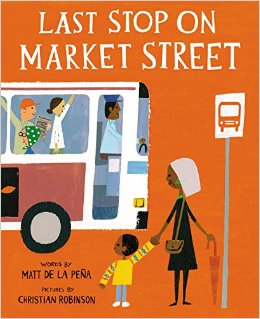
A Picture Book for Newbery! Last Stop on Market Street

laststoponmarketstreetLast Stop on Market Street by Matt De La Peña
Illustrated by Christian Robinson

I jumped up and down when this book was announced at the Youth Media Awards press conference — after the initial “WHAT? Really?  A picture book text?” Then, it was, “YAY!  Finally.  A real picture book has won the Newbery!”  Great job.  Committee!

However, it was not until today, when I finally re-read the text, blocking out all the illustrations, just paying attention to the rhythm, the word choices, the imagery, the heart and soul of this seemingly simple text for the very young that I realized how marvelous a choice this book is for the award.

By recognizing the text, which allows for so much imagination and chances of deep discussions, especially literary ones, the Newbery Committee has affirmed the significant value of finely crafted text for young children.  I can still recite many passages from Margaret Wise Brown’s The Important Book because I read that book to my daughter when she was still in her crib.  Every night, for months, and no matter how many times I read it aloud, I found myself admiring the genius writing page after page.  I am quite certain that the reason my daughter appreciates poetry and what she calls “good writing” in the adult books she reads now that she’s 16 is her wide exposure to excellent texts like The Important Book,  So Said the Little Monkeys, Chicka Chicka Boom Boom, Madeline, and many others.

I am ordering copies of Last Stop on Market Street for my Middle School Library and will encourage middle grade teachers to use the book to inspire students to interpret the text as they envision in their mind.  CJ could be anyone.  Nana could be anyone’s grandma.  The boys on the bus with something CJ envies do not have to share ear-buds on their iPod and the imagery of the large tree “drinking through a straw” was never depicted literally in the illustration anyway.  The students in a language arts class will simply bask in the glory of the text like “The outside air smelled like freedom,” and “rain, which freckled CJ’s shirt” and have a rigorous mental workout to understand the implied interactions and emotions.

And ample discussion opportunities for the ending, when Nana does not give her usual deep laugh… now what is that all about?

De La Peña sure wrote a distinguished book!

Leave a comment

Filed under Book Notes