Publishers, Editors, Everyone: Keep Your Courage and Keep Up the Good Work!

I unpacked a box of galleys for early 2016 titles from a children’s publisher yesterday and noted that quite a few titles feature POC characters or are written by POC — in all genres and reading levels.  I hope this is not just a fad, not a trend, not a reactionary act to a current movement, but the sign of real change and the harbinger of the new norm!

I want to publicly say this to publishers, editors, marketing folks, sales reps, authors, agents, anyone working in the Children’s publishing world:

With recent disputes on many titles for young readers, it might seem extremely daunting to move forward, to have to tread so carefully, to have to hear so many conflicting and often angry voices, to have to defend or admit missteps — especially if and when you are all trying hard and working diligently and honestly to AVOID offenses or mistakes. Just know that mistakes will be made, the readers and critics will continue pointing things out and reminding all of us how to do it better the next time, and It will take a while and much learning before any equilibrium is even a possibility.

I know this must seem such a heavy burden and you might just want to put it down and forget about all that’s unpleasant or painful.

But, please keep up the good work. Actually, please do a lot more good work. Please do listen. Please listen for the message and do not stop listening simply because you do not like the tone the message is delivered in. Please continue to to evolve.

We are all lovers of literature.  One thing I see literature lovers most capable of is the immense scope of our imagination in dealing with complex issues.  Do we not always applaud great children’s literary works for their complexity, for their bravery, and for their visionary integrity?

Perhaps we need to remind ourselves of these much valued qualities in times of conflict?

Please tell each other and yourselves that, “No, this is NOT the time to put down the heavy pack of all the issues. It is NOT the time to turn away from the road leading to a better future.  It is NOT the time to leave other travelers by the road side to struggle by themselves. And, it is NOT the time to seek each other’s defeat.”

I know that I need to consciously remind myself all of these on a daily basis and it is taking a toll on my own sense of balance. But then I think of all the good that this will accomplish and believe that the peace of mind will come and it will all be worth the burden.

We need to help each other understand and unpack superbly complicated and often painful issues. The ultimate goal shall be that we all succeed TOGETHER. Just know that it will take a lot of determination and courage — especially from those whose daily jobs are to produce children’s books.

We need you to continue the journey upward, especially when the going gets really really tough.

Let us walk and talk in each other’s company, help each other grasp difficult and emotional concepts. And let us find each other in the not too distant future on the summit of true equity, TOGETHER.

4 Comments

Filed under Views, WIWWAK

Sunday Select, November 8, 2015

FCLSS

Quote of the Week

Updated — I have now included also the entire Panel discussion — which Sean Qualls & Sophie Blackall also shared their views.  They all do not agree with each other.

Around 26:00 — Sophie Blackall talked in details about her own reactions toward the controversy over her book A Fine Dessert; 35:00 – Sean Qualls starts talking; 38:00-ish, he touches briefly on A Fine Dessert; keep watching and you’ll hear Susannah’s views as well.

— Daniel Jose Older
 “Daniel José Older on A Fine Dessert

A Fine Dessert – Multiple Conversations

Collected below are various online articles, conversations, and comments about the picture book A Fine Dessert written by Emily Jenkins, illustrated by Sophie Blackall, published by Schwartz & Wade, an imprint at Random House.  The book has been under careful scrutiny by many – when it was highlighted as one of the Caldecott hopefuls, when it was among the 10 illustrated books of 2015 chosen by The New York Times, and when it received objections by readers who found certain text and images hurtful.  I did not read or look at the book until this past Monday, after many others already grappled with the book for a while.  The conversations are important to note and should continue, not only about one book, but about the entire Children’s Publishing industry.  More on that from my own viewpoint is forthcoming.  Since Debbie Reese has been diligently documenting and collecting all the pertinent links.  I’m providing only ONE link here in this section.  Do read as much as you can and consider and re-consider!

Not recommended: A FINE DESSERT by Emily Jenkins and Sophie Blackall by Debbie Reese — from American Indian in Children’s Literature

Books & Awards

The Scholastic Picture Book Award 2015 Winners  — from Scholastic Book Award/Asia

SIMMONS COLLEGE AND LEE & LOW BOOKS ESTABLISH NEW SCHOLARSHIP   — from Lee & Low Books

An Interview with Kate DiCamillo — from The Horn Book Magazine

Please don’t air brush African teen fiction by Ellen Banda-Aaku — from The Guardian

‘Monstress’: Inside The Fantasy Comic About Race, Feminism And The Monster Within by Graeme McMillan — from The Hollywood Reporter

I gathered these entries from various sources such as Facebook, Twitter, Goodreads, and specific sites that I follow such as Educating Alice, Pub Peeps, Book Riot, School Library Journal, The Horn Book, We Need Diverse Books, American Indians in Children’s literature, etc.

Leave a comment

Filed under Book Notes, Field Reports, Views, WIWWAK

Can We Talk of Solutions? Regarding Diversifying Children’s Literature

Over at Horn Book, I joined the conversation over this month’s Editorial by Roger Sutton, entitled, “We’re Not Rainbow Sprinkles.” It is a heated conversation over representation and lack of fictional existence (of marginalized characters: non-white ethnicity, not-straight sexual orientation, or other non-dominant identities.) For the most part, the people who commented read the article and others’ comments carefully before they expressed their highly varied viewpoints. I wrote in one of my comments about my own emotional distress over the tumultuous debates all over the internet over such topics within the children’s and YA literary world:

It weighs on me. It makes me tear up on an hourly basis: seeing people here and elsewhere (Fuse8, Heavy Medal, Facebook — I dare not go to Twitter), in their earnest to “defend their own ways of thinking,” use hurtful words, seething comments, words that simply want to get a reaction but not advance anyone’s causes. It makes me worry about what all these negative energy will translate eventually into the literary works that are meant to reflect and uplift. That are meant to be Free and Beautiful and Cathartic (even and sometimes when they are Painful.)

The heavy burden manifests itself in many ways: I feel exhausted, my shoulders are hunched more and tense, I cannot focus on simple daily responsibilities, I can’t remember minor or even major facts, all because my mind has been so preoccupied by the many ideas presented to me and sought out by me. My desire to simply “put it down” is great.  I want to stop dealing with all of these issues and just get back to simply enjoy great books for kids and teens!!!  But, I find myself incapable to unburden my mind. I am compelled to continue thinking and learning and writing and talking about these topics.  And today, I want to talk about the Publishers and what I think as their responsibilities in redressing the balance of the industry:

Case Study One:

Twenty-one years ago, I was a lowly subsidiary rights assistant in a large children’s publishing company — Macmillan Children’s Publishing Group (a different entity from the current Macmillan publishing company).  A brand new children’s picture book was to be released by the revered Chinese American author Amy Tan.  I got a chance to look at the F&G (folded & gathered pages of a picture book proof) and noticed that Ms Tan used the concept of punctuation AND musical notes within the storyline — indeed, the use of these devices helped move the plot along.  Not one to keep my mouth shut, I raised the question of how if the tale was set in ancient China, both western musical notation and the use of punctuation would have been totally, utterly, culturally inaccurate.  But of course my views were deemed completely insignificant: I wasn’t in the editorial department and who could question Amy Tan, the author of Joy Luck Club and her knowledge of the Chinese culture?  And, even if the inclusion of such details was anachronistic and culturally inaccurate, so what?  No one was going to be hurt.  Right?  And it’s just about to be published — too late to make such major changes!  So the book, Sagwa, the Chinese Siamese Cat, was published exactly as it was written and illustrated and has been enjoying great success for almost a quarter of a century, with a host of PBS cartoon episodes based on the characters and the setting in the book, even if it didn’t receive very positive reviews.  Oh, also, do you know that Sagwa literally means a stupid person?

Case Study Two:

Fast forward to a couple of months ago, in a casual conversation with a non-white editor, I first heard how one of the largest stumbling blocks in publishing diverse books by diverse authors is the sales force in each publishing company.  When editorial teams present in house their potential future publications to the sales reps, if their proposed titles receive the verdicts of “We don’t know how to sell this or that title…” or “I don’t think this will sell…,” then it is pretty much dead in the water.  And according to this editor acquaintance of mine, the sales reps are overwhelmingly white and the titles rejected often include many diverse titles.

Case Study Three:

Fast forward further to this past month.  While attending a publisher’s preview, a young, white editor talked about a book that is set in a major foreign city. She kept referring to the city as “New Delhai.” And I was superbly puzzled: I’ve never heard of such a city.  (Although I must admit that I’m not a geography wiz!)  I glanced at the printed description and realized that the city the editor was referring to was New Delhi, in India.  I was completely floored by this lack of cultural literacy as we sat in the room being told how so many the books published would enrich our young people’s lives and give them an expanded sense of the world.  However, no one else seemed a least bit bothered by it.  Or that no one cared?  Or were we all just too polite to point out this mistake?  Later on, I learned from another friend that there is a town in New York State called Delhi and it is pronounced DelHai.  This young editor could have just always thought that the city in India shares the exact name and pronunciation as the New York town.  (Like Houston – Hauston – Street in NYC and the City of Houston -Hueston- in Texas.) Still… I was flabbergasted. And I was surprised at how no one else seemed to find this bothersome and at how the helpful friend tried to find a reason or an excuse for the mispronunciation of one of the largests city on earth.

Case Study Four:

During the translators panel at the recent USBBY Conference, the Chinese translator of John Muth’s Stone Soup (a story that’s NOT originally Chinese, made to be against an ancient Chinese setting, translated into Chinese from English) pointed out that one of the ingredients that went into the soup had to be changed when he translated the text into Chinese because it wouldn’t have been readily available in the setting and the Chinese seldom use that ingredient in making soup.  Also the fact that there are architecturally inaccuracies in the paintings as well.

Case Study Five:

Yesterday, I visited Baker & Taylor’s book ordering site where I purchase most of the books for my Middle School Library.  I wanted to buy about 20 copies of Marilyn Nelson’s My Seneca Village which has garnered lots of praise and is my pick of the month for the faculty book club.  I was totally surprised that B&T does not carry this title.  Then I went to another wholesaler, and the book is listed as Print on Demand, with a 2% discount (as opposed to the usual 40%).  Amazon carries some new copies but not enough for all my teachers in the club.   It is available in eBook form and that’s how I got my own copy. The publisher’s site only offers eBook format.  So, even though this book has received 3 stars by now, is penned by a Newbery honor author (Carver,) and totally fits the #weneeddiversebooks movement bill, it must be deemed too difficult to sell by Baker & Taylor.  I wonder if Ingram & Follett carry the title and how many copies are ready for purchase?

So, what conclusions I drew from reflecting on all of the above experiences?

  • Whether the author or illustrator of a book is of a particular culture matters less than if they do their homework and work diligently to produce authentic and culturally sensitive books.  I am hopeful that many authors and illustrators will become more and more culturally aware and do not find such demand unreasonable or burdensome — or, perhaps it is burdensome but not something that can be shirked!
  • Wouldn’t it be great if publishers encourage or even create professional development opportunities for their sales, marketing, and editorial teams to enrich everyone’s understanding of the importance of diversity, respect, and inclusion?
  • Wouldn’t it be great if publishers hire more diverse employees to allow for better understanding of varied cultural contents in the manuscripts or illustrations?
  • Wouldn’t it be easier to verify authenticity and spot questionable treatments if there are enough pairs of culturally sensitive eyes to review and evaluate the books in-house, prior to publication, and not wait to put out fires after the book lands in the hands of the readers?
  • As consumers, we hold much power in our hands as well.  If we keep buying the same-old same-old, and do not seek out or demand availability of the much needed diverse books, there will be no incentives for the publishing industry to heed such need: since it needs to survive and meet the bottom line, after all.

It is late.  I need to sleep.  Please talk to me and share ideas and solutions!

21 Comments

Filed under Views, WIWWAK

Sunday Select, November 1, 2015

FCLSS

Quote of the Week

Africa is not rich or poor, educated or illiterate, progressive or archaic.

What Africa is depends on which part of it you are referring to.

No single story can adequately reflect that, but a multiplicity of stories can and should broaden our received wisdom about the continent.

With more platforms and opportunities than ever before, there has never been a better time to challenge that confusing and costly concept of a single African story.

— by Nancy Kacungira
 “Why I cannot tell ‘the African story’
 from BBC News

Viewpoints

Why I Cannot Tell ‘The African Story’ by Nancy Kacungira — from BBC News

Science Has Great News for People Who Read Actual Books by Rachel Grate — from Arts.Mic

You Have to Read the Book by Elizabeth Bird and the Comments section by many — from Fuse8 Production

We Are Not Rainbow Sprinkles by Roger Sutton and the Comments — from The Horn Book

Book Lists & Awards

WE NEED DIVERSE BOOKS™ ANNOUNCES INAUGURAL WALTER DEAN MYERS GRANT RECIPIENTS  — from weneeddiversebooks.org

PW’s Best Books 2015  — from Publishers Weekly

The New York Times Best Illustrated Children’s Books of 2015 — from The New York Times

I gathered these entries from various sources such as Facebook, Twitter, Goodreads, and specific sites that I follow such as Educating Alice, Pub Peeps, Book Riot, School Library Journal, The Horn Book, We Need Diverse Books, American Indians in Children’s literature, etc.

Leave a comment

Filed under Book Notes, Field Reports, Views, WIWWAK

Sunday Select, October 25, 2015

FCLSS

Quote of the Week

Those words nearly broke my heart. I could have sobbed in the convention hall. Instead, I swallowed them as a reminder that I need to do a better job, too. That I’ll always need to do a better job. That there is no arrival point. I’ll never arrive at some point where I’m outside the system of systemic racism—I’ll always be in it, and because I am, I have to do the best job possible calling people into the conversation that recognizes it, in order to do the work to try to deconstruct it. I’ll always need to do a better job “calling people in” rather than “calling people out.”

— by Brendan Kiely
 “The White Boy in the Third Row
 from Reading While White

Opposing Viewpoints (Do They Have to Be?)

These past couple of weeks we saw sparks flying with opposing views over specific children’s books and general thoughts on children’s book publishing – mostly centered on the “writing the other” notion.  It seems to me that many practitioners (authors, librarians, critics, etc.) have been thinking hard and deeply and some have tried to sort out strongly held convictions when they clash against others’ beliefs.  Selected here are a few strands that I found especially powerful and am currently struggling with.  I lead the list with one article by Brendan Kiely, whose proposal for “calling people in” to the conversation and discussion on diversity issues in children’s and YA literature seems most sage and hopefully can serve as a reminder that we are ALL in this together and our final goals are to provide the best literary work for the young people in our world.

The White Boy in the Third Row by Brendan Kiely — from Reading While White

This Book Is Creating A Space For Queer Black Boys In Children’s Literature by JamesMichael Nichols — from Huffpost Gay Voices

About Meg Rosoff’s next book… a collection of links to various responses to a following facebook blow-up while discussing Large Fears, the book under discussion in “This Book is Creating a Space for Queer Black Boys in Children’s Literature”  — from American Indians in Children Literature

The Privilege of Colour, the Prejudice of White by Shelley Sousa — from Shelley Sousa: real writer made up worlds

The Hired Girl by Jonathan Hunt and especially the Comments section by many enthusiastic readers — from Heavy Medal

Good Intentions, Bad Outcome by Michael Grant as a response to On Writing PoC When You Are White by Justine Larbalestier

Books, Authors, the Publishing Industry

Wordcraft Circle Honors and Awards, 2015  — from worldcraftcircle.org

What it feels like to write a picture book by Viviane Schwarz — from The Kraken Studio

A Defence of Rubbish by Peter Dickinson

International Literature Shines at the USBBY Conference Science  by Lyn Miller-Lachmann — from http://www.lynmillerlachmann.com

The PW Publishing Industry Salary Survey 2015: A Younger Workforce, Still Predominantly White by Jim Milliot — from Publishers Weekly

I gathered these entries from various sources such as Facebook, Twitter, Goodreads, and specific sites that I follow such as Educating Alice, Pub Peeps, Book Riot, School Library Journal, The Horn Book, We Need Diverse Books, American Indians in Children’s literature, etc.

Leave a comment

Filed under Book Notes, Field Reports, Views, WIWWAK

Sunday Select, USBBY Special

FCLSS

Quotes (Paraphrased) of the USBBY Conference

(On Verse Memoirs) Even when writing one’s own memoir, there are gaps that one has to fill with invented details. — Margarita Engle

(On Verse Novel) We are always writing outside of our own experiences.  The important thing is to be conscientious in one’s research and understanding of “the others.” — Padma Venkatraman

Translators are writers, editors, storytellers, researchers, and cultural mediators, all rolled into one. — Panelists’ Consensus on Translation

Where does a translator’s loyalty lie: with the author or the readers?  In a way, we can say that by being loyal to the readers, one is loyal to the authors as well.  And there is the loyalty to the text.  Also the loyalty to the idea as IF the author actually knows the target language and makes the meaning or the language very clear to the kids who will be reading the translated book. — Ajia

Certain kind of information is best conveyed via what we consider as the “comics format.”  Look at the airline safety guides, manuals to put together furniture, etc.  Certain stories can be best expressed via the duality of text and images. — Gene Luen Yang.

We need to encourage the chaotic and messy creative process that is writing and creating stories: especially in children and the importance of play.  — David Almond

from the 11th Annual USBBY
Regional Conference, New York, NY

IMG_20151018_120721~01

Title of David Almond’s talk

11th Annual USBBY Highlights

USBBY is the United States Chapter of the International Board on Books for Young People (IBBY.)  I joined USBBY only this year and am so glad to have attended the whole conference.  What a weekend!  Presenters come from China, Korea, Bulgaria, Russia, Brazil, Great Britain, France, The Netherland, Iran, Austria, Denmark, etc. and the topics include picture book art, translation, graphic novels, verse novels, Alice in Wonderland (as part of the theme of the year,) international YA literature, disabilities in children’s books, among many others.

IMG_20151016_195455

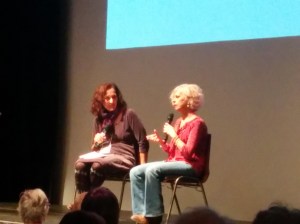
LuAnn Toth and Kate DiCamillo

IMG_20151018_081915

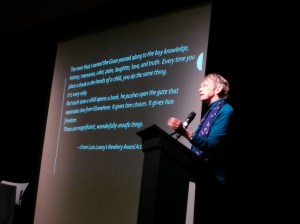
Lois Lowry

IMG_20151018_083534

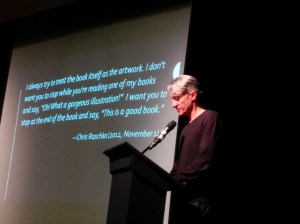
Chris Raschka

Attendees were treated to thoughtful and moving speeches by Leonard Marcus, Lois Lowry, Kate DiCamillo, David Amond, Chris Raschka, Susan Cooper and also lively and enlightening panel discussions.  Panelists included well known American children’s book creators such as Gene Luen Yang and Paul O Zelinsky, and international guests such as Roger Mello (Brazilian illustrator,) Ajia (Chinese translator,) and Lisbeth Zwerger (Austrian illustrator.)

IMG_20151017_165413~01

Graphic Novels panel

Two breakout sessions offered conference goers 24 different workshops to further examine aspects of children’s literature with the mindset of broadening one’s knowledge and bridging cultures.

My first break-out session choice was on Verse Novels and Memoirs.  Authors Holly Thompson, Padma Venkatraman, and Margarita Engle gave great talks and insights into the power of telling stories with verse and their incredible dedication on detailed researches into the characters that they were to portray.

Nami Concours 2015The second break-out session for me was an introduction to the incredible international picture book illustration concours held on the Nami Island of South Korea.  I don’t think I’ve ever seen picture book illustrations being taken so seriously, treated with such reverence, and brought to life and made so relevant to the children and adults who encounter these objects of literature and art.

Because the Nami Concours is such a unique and amazing event, I will devote an entire post on it in the coming week.  Look out for my post — or you can check out the website:

http://www.namiconcours.com/


4 Comments

Filed under Field Reports, Views

In the Ring: White Mediocrity vs Non-White Mediocrity

It seems that, within the boxing ring of White Mediocrity vs Non-White Mediocrity, Non-White Mediocrity does not stand a chance. It has always been, and will continue to be, if we don’t keep challenging the status-quo, complete Knock-Outs, round after round.  Hey, sometimes, White Mediocrity even wins against Non-White Excellence. There are even White Lousiness knocking out Non-White Mediocrity at Round ZERO.  (Think of all the unpublished manuscripts by “mediocre” non-white authors vs all the published not-so-good ones by white authors.)

This Boxing Ring imagery popped into my head this morning when I started following the recent facebook/twitter/blogsphere face-offs between YA author, Meg Rosoff, and many others, and especially after reading the words from Camryn Garrett on her blog.  The relevant quoted words are at the end of this post, but I want to first go back and track my own journey from being a harsh harsh critic of “diversity books” to one who considers them very differently on this day in October, 2015.

Recently, in Beijing, I encountered so many outstanding Chinese children’s books and I couldn’t help but ponder: why don’t American children have the opportunities to see these books? Why aren’t these books (many of them short picture books) translated and are made readily available in the United States?

Manager Li, who invited me to review the children’s book output in China, said to me one day, “Our best children’s books are as good as the best American books.” And he is right!  But, there is simply not room for these books on the American market.

Why aren’t there more foreign books available in English to American Children?

To answer this bluntly: because much of the U.S. Children’s Book Market exists to support the livelihood of Proper American Authors. Which is completely reasonable and understandable. American Children’s publishers are American. They should take care of their/our own first.  They should definitely put priority on publishing American authors: outstanding, mediocre, or even not that good.

Scouring major children’s book review publications, one can easily see how many children’s books are considered “unworthy” by critics, but are nevertheless published and promoted by the American Children’s Publishers.  (As to what effects this “taking care of our own talents” has on the worldview of the young readers, that’s a totally different, full length blog post coming your way soon!)

But who are the Proper American Authors and Illustrators?

Whom do American Publishers believe deserving priority and support?  Whom do I believe deserving my priority and support — as a reader, as a reviewer, and as an educator?

I have been a harsh judge of books written by non-white authors, especially Asian American authors. Perhaps because I am Chinese and want to feel, oh, so proud of my Chinese & Asian heritage, that I see mediocrity (or pretty much anything below stellar) as a personal disappointment.  I often point out the issues of in-authenticity or pedestrian literary quality of an OK (or more than OK) book that is actually a much needed addition to the diversity pool.  I absolutely believed that diversity topics needed to be packaged within outstanding, excellent books, otherwise, hmm…they kind of reek of hidden or overt agenda and to me, that was a no-no.

This harsh critic mentality is akin to the wisdom passed down from black parents to their black sons and daughters to “behave 200% more politely, talk 200% more eloquently, and dress 200% better” just to have a chance to be treated equally as their white counterparts.  I wanted every single book by Asian American authors to have not only solid character development, not only well-crafted passages, and not only a great plotline: I NEEDED them to be stellar in every possible way and all aspects! Because, how else could we convince the world of our worth?

Recently, I began to wonder, to doubt my former convictions.

I have noticed that any flaw belonging to an underrepresented group is often enlarged ten folds and is seen as evidence of the shortcomings of the entire group; while the flaws found among the protective multiplicity of the dominant/majority group are often made less significant and almost never viewed as the weaknesses of the entire group.  Perhaps this was why I thought that it’s totally all right for the many pedestrian, mediocre, and sometimes even downright bad “majority books” to take up precious space of the marketplace?

But not any more.  And especially not after reading these words from Camryn Garrett on her blog: For All the Girls Who Are Half Monster:

White mediocrity: This is more of a concept, but I’m happy to explain. While there are white authors who are amazing and fantastic and produce great works, there are also white authors who…are just okay. Or even bad. But they’re celebrated and given awards and praise for being mediocre.

Meanwhile, people of color are held to actual standards (that sounds rude, but whatever.) They have to work to be good, and sometimes that isn’t enough. Basically, white authors can get on the NYT Bestseller List for being “okay.” A Hispanic author has to be “fantastic” to get the same thing. White authors have to be “fantastic” to win a National Book Award. Black authors have to be “outstanding” to be considered.

I didn’t want to start any fight – not in the Boxing Ring, literal or metaphorical.  But, at the same time, things must be said, and concepts must be challenged. Let the conversation continue!

13 Comments

Filed under Views, WIWWAK

New York ComicCon 2015 – Day 4

image

Selected sights and some notes

Lucasfilm hosted a Readers Theater for Star Wars fans:

IMG_20151011_120348


Adam Gidwitz conducting a Jedi Lesson:

IMG_20151011_122209


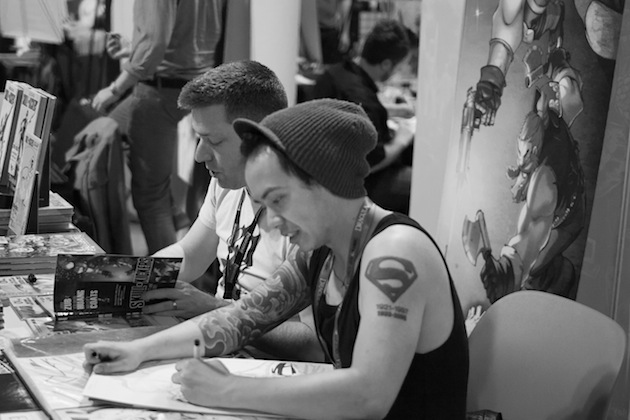
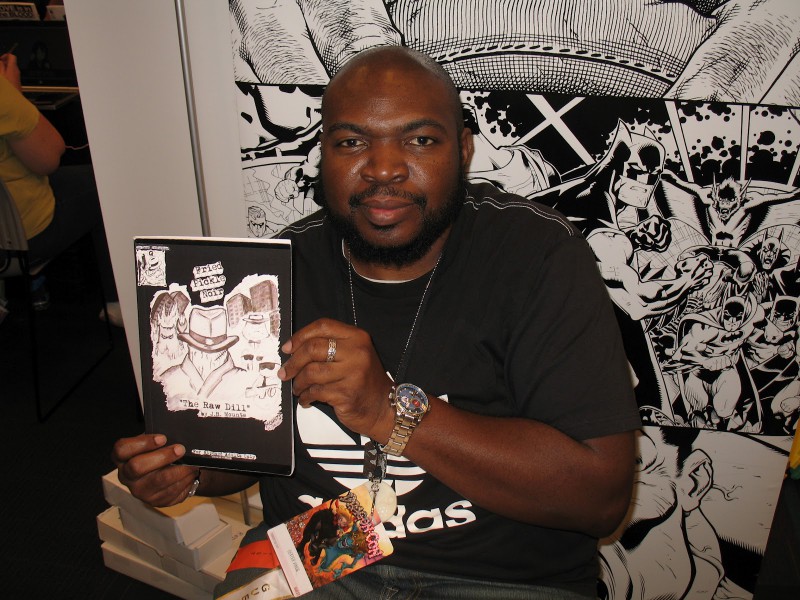
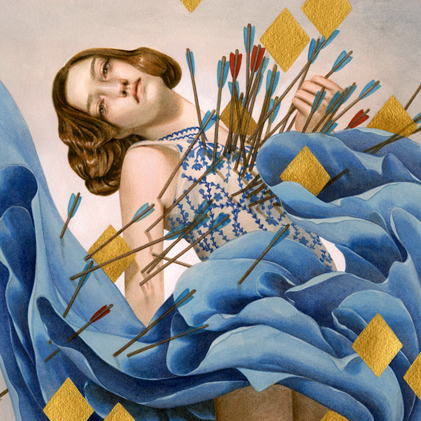
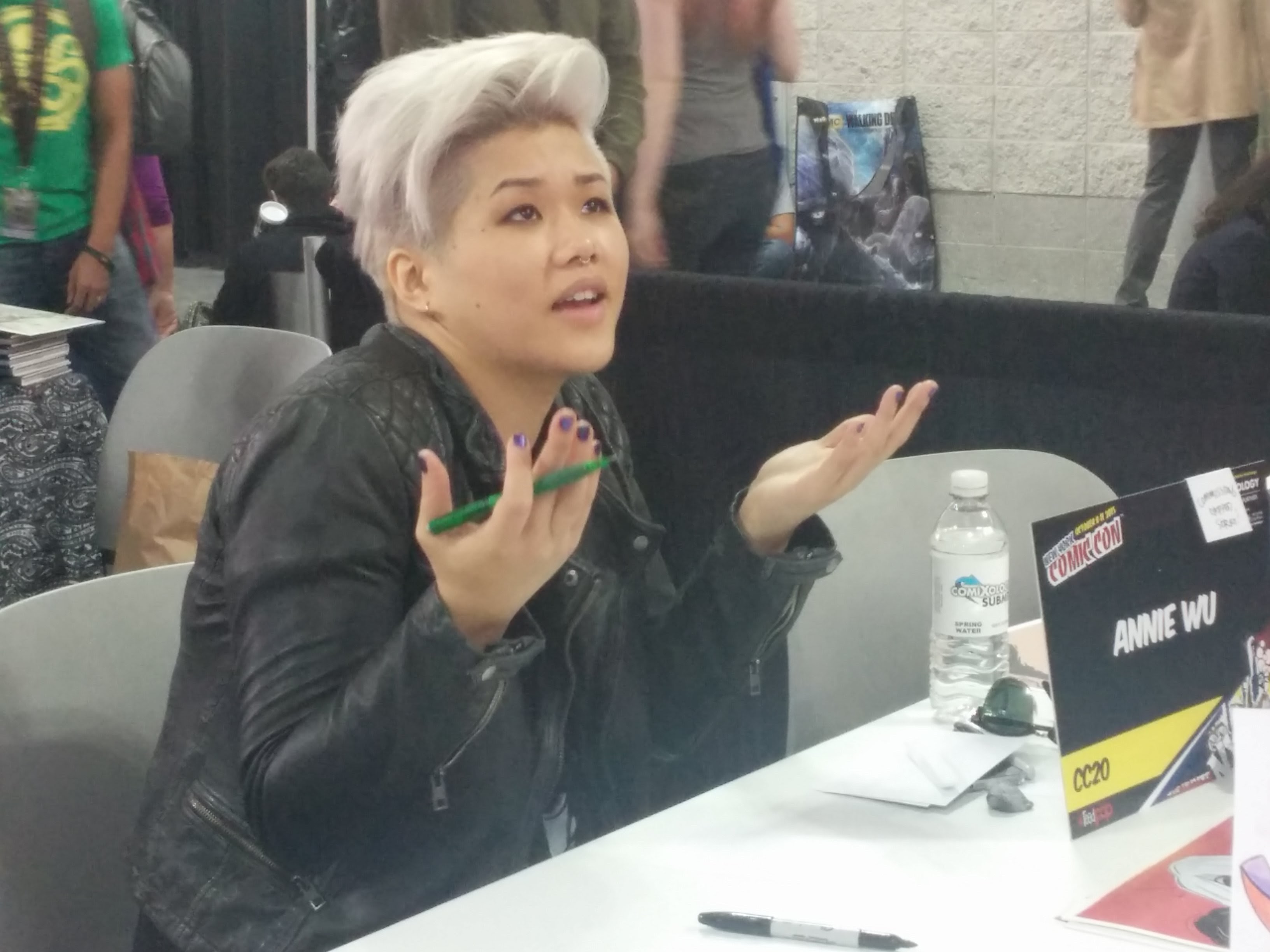
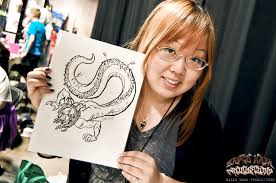
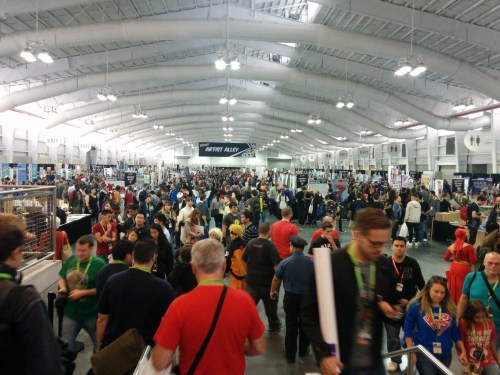
More Talented Artists from Diverse Backgrounds in the Artist Alley

Edwin Huang

edwinhuang

Screen Shot 2015-10-12 at 10.00.04 AM

Dexter Vines

Dexter_Vines

Screen Shot 2015-10-12 at 10.01.23 AM

Tran Nguyen

trannguyen

Screen Shot 2015-10-12 at 10.02.00 AM

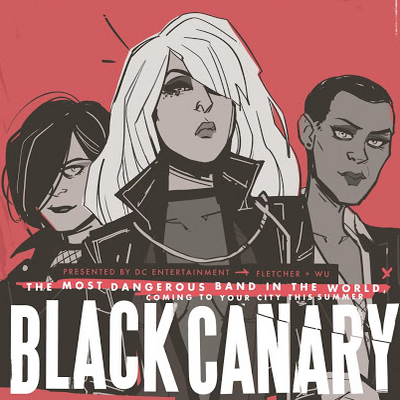
Annie Wu

Screen Shot 2015-10-12 at 10.02.55 AM

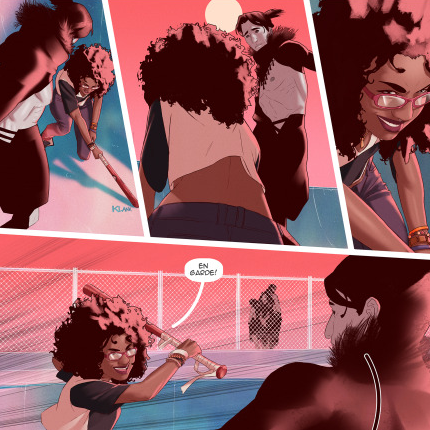
Velentine De Landro

valentinedelandro

Screen Shot 2015-10-12 at 10.04.18 AM

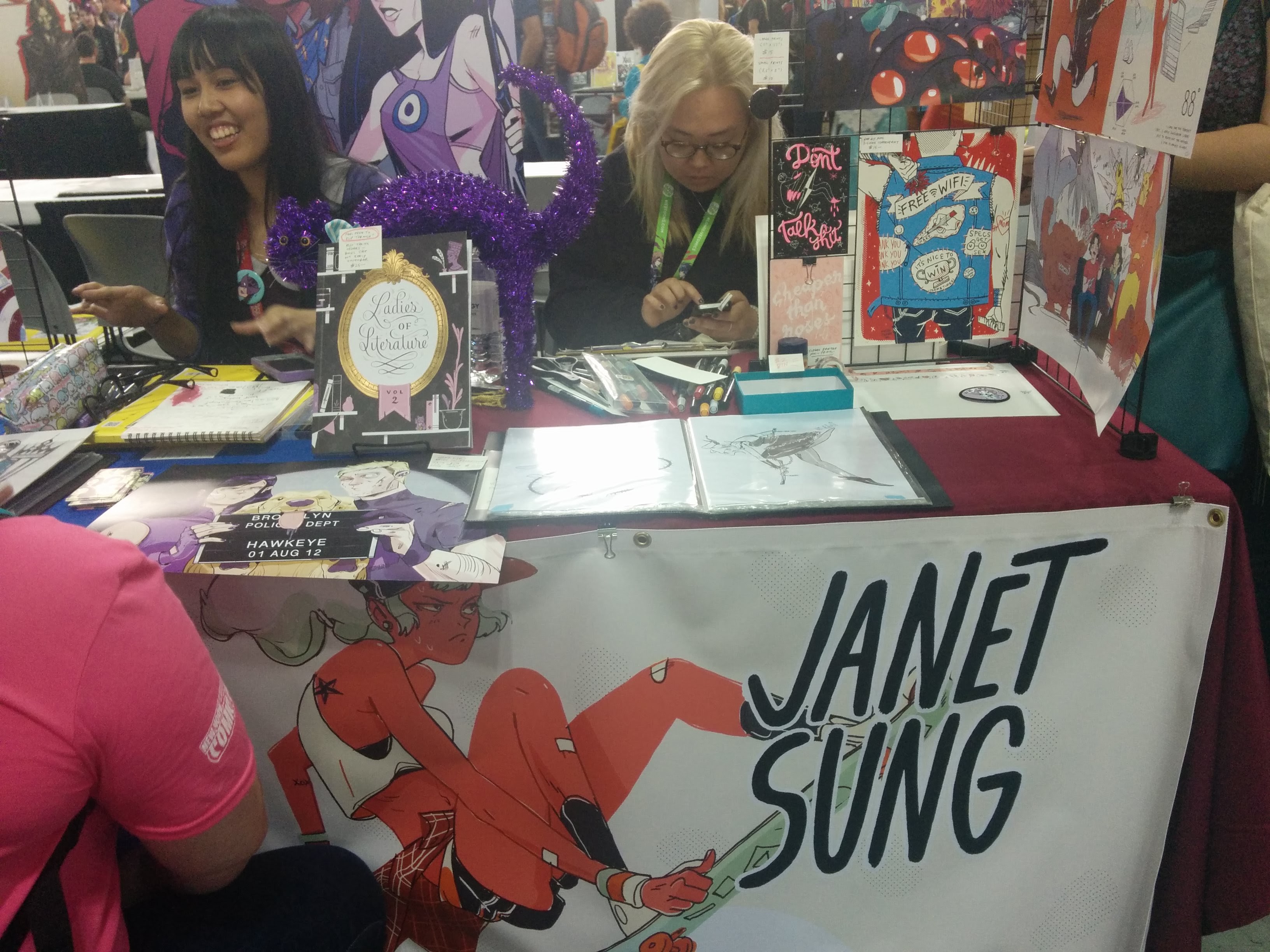
Janet Sung

janetsung

Screen Shot 2015-10-12 at 10.05.15 AM

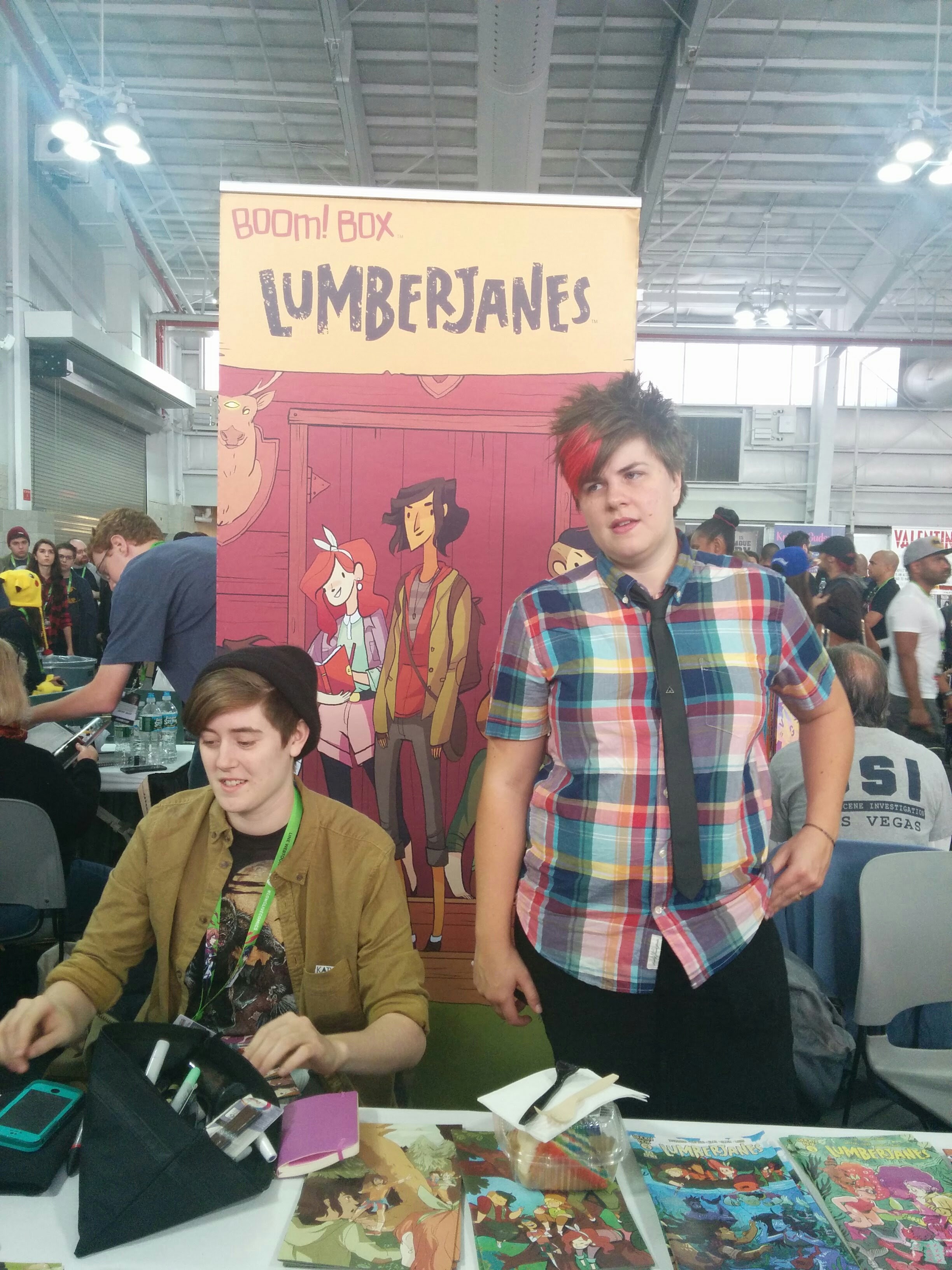
Creators of Lumberjanes: Noelle Stevenson & Shannon Watters (Grace Ellis is not pictures)

IMG_20151011_144707


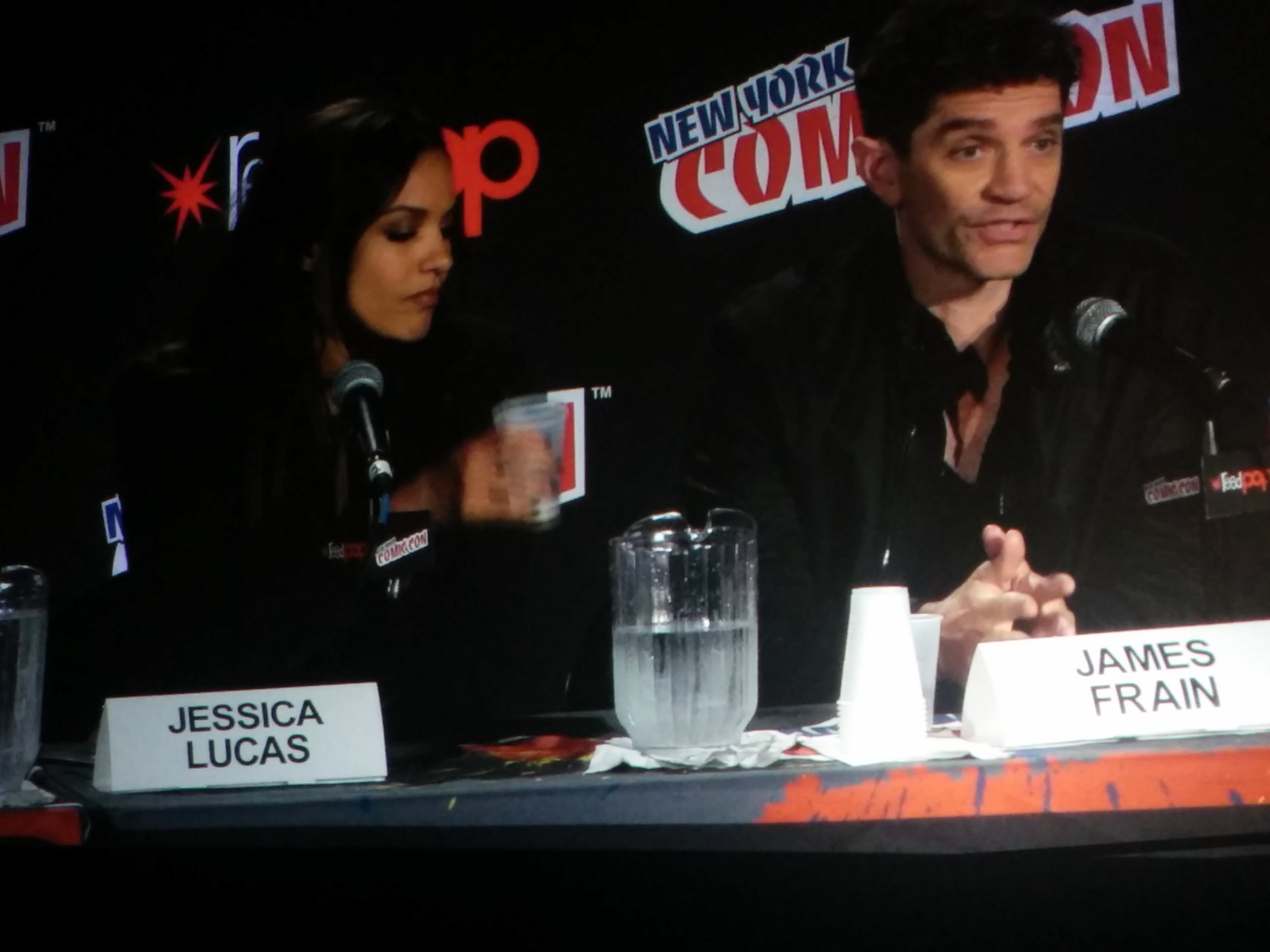
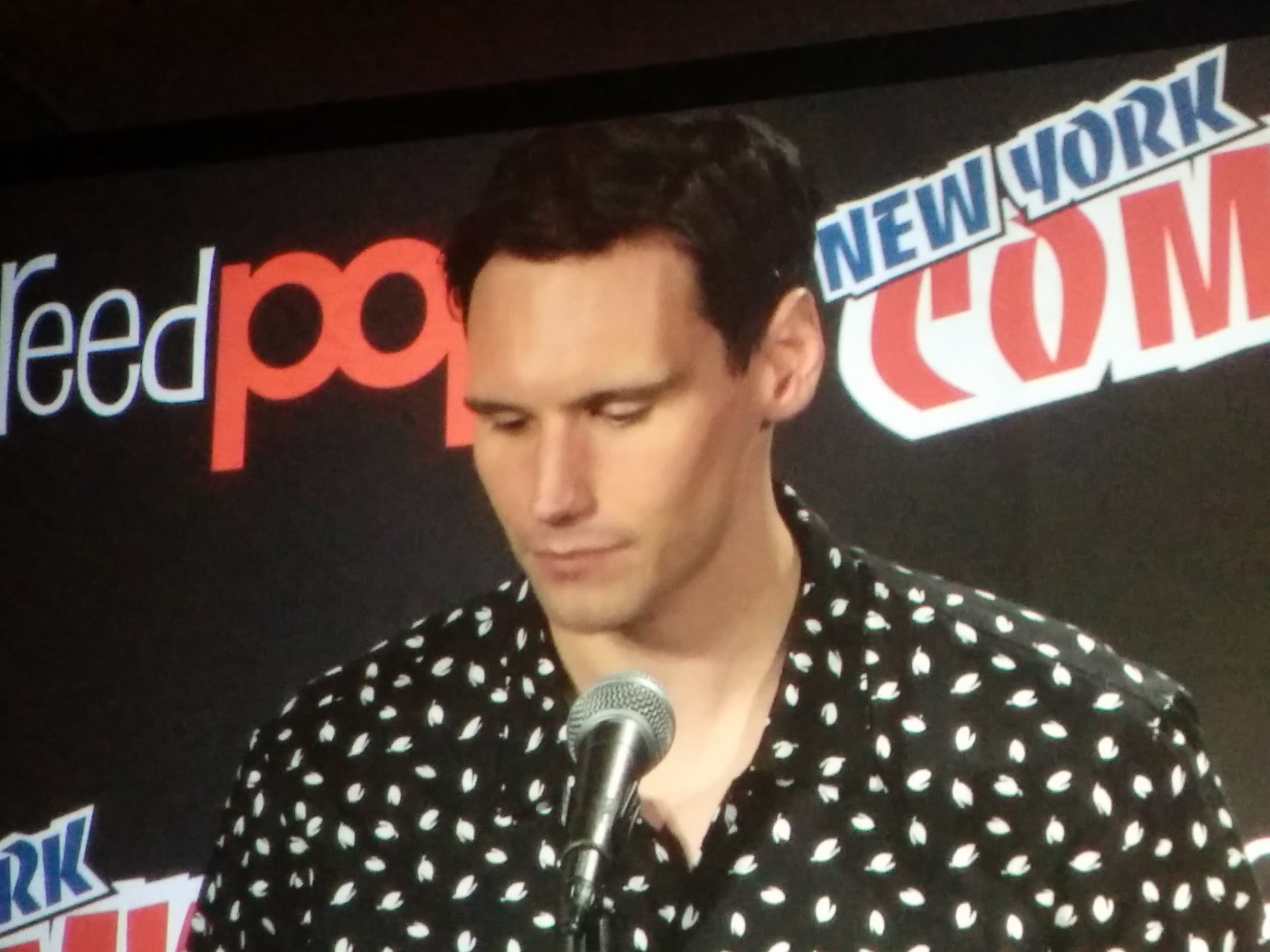
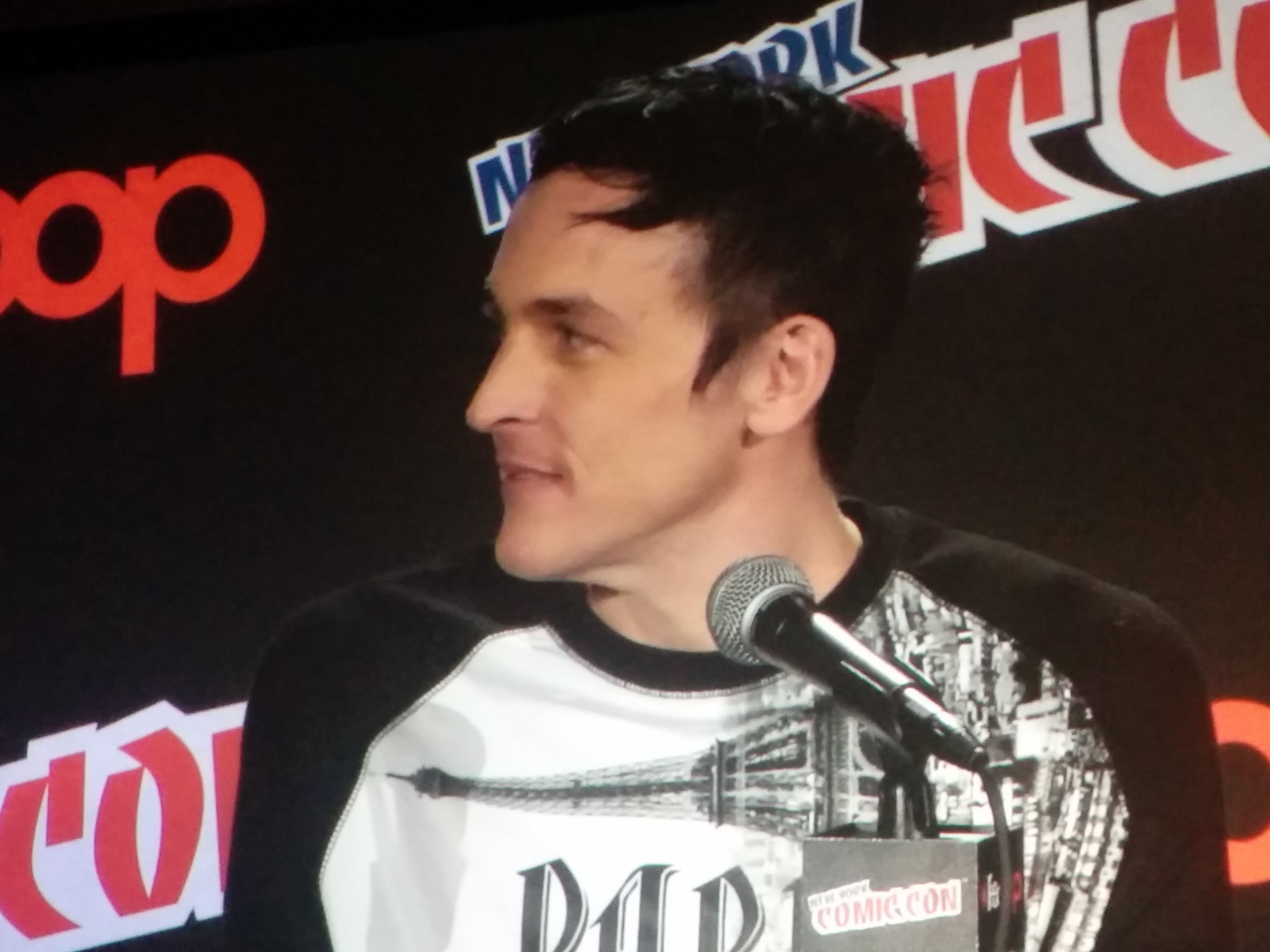
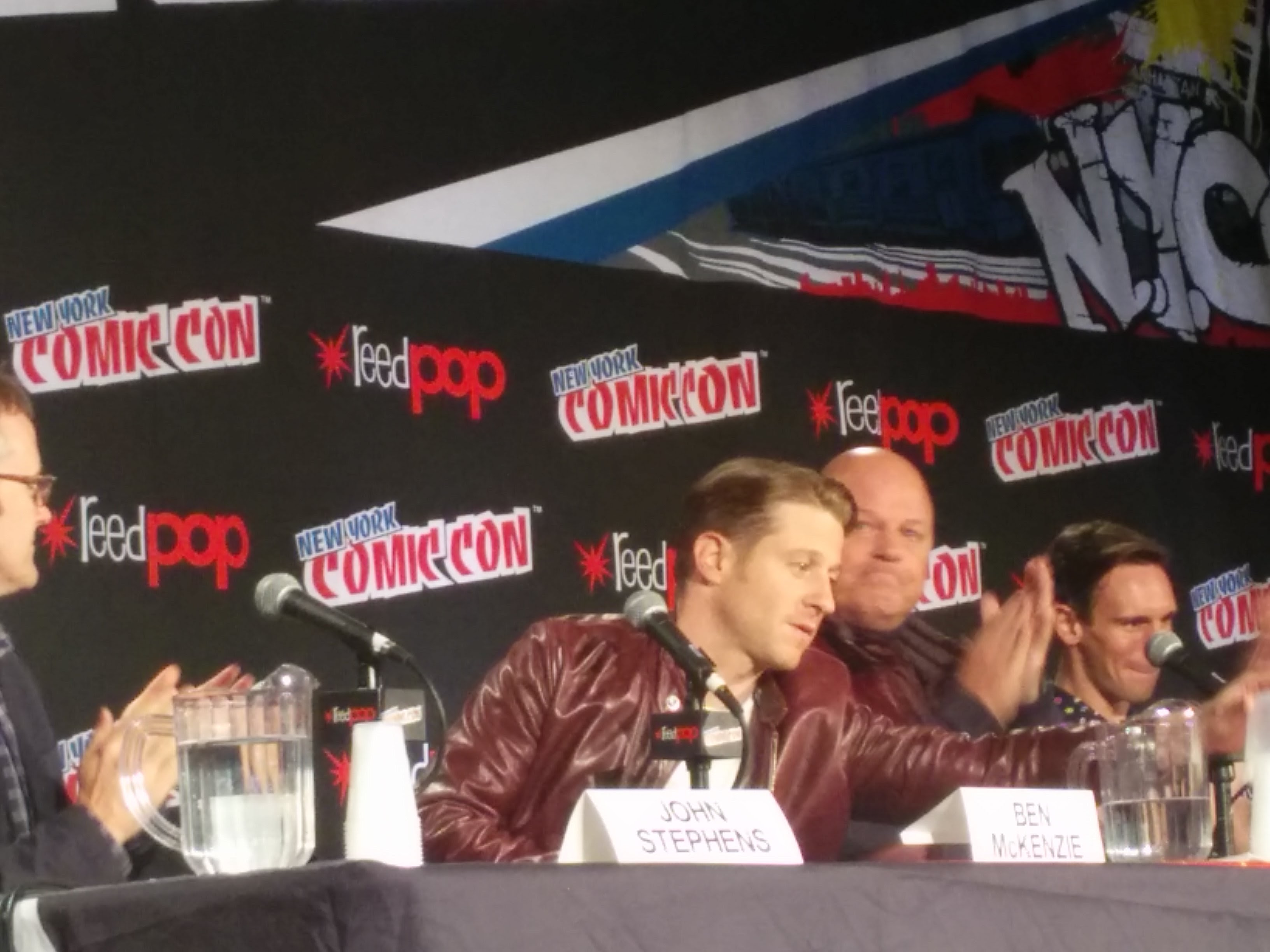
Couldn’t Leave without Seeing the Gotham Panel

with the super talented actors!

 IMG_20151011_165930-COLLAGE IMG_20151011_165412 IMG_20151011_165122 IMG_20151011_164726 IMG_20151011_164637 IMG_20151011_164129

Leave a comment

Filed under Field Reports

Sunday Select, October 11, 2015

FCLSS

Quote of the Week

Diversity Matters: …digital media today reflect the real world as children perceive it. Cultural diversity must, therefore, be built into digital media, not added later as an afterthought. Cultures should be represented richly and with integrity and dignity. This is another potential opportunity for children to learn about the world through screen media.
from “Growing Up Digital:
Media Research Symposium”
prepared by American Academy of Pediatrics

Views & Reports

Can children’s books help build a better world? by SF Said — from The Guardian

Yes, Audiobooks & Graphic Novels Count: Accepting Students’ Diverse Reading Choices by Cindy L. Rodriguez  — from Latin@s in Kid Lit

When you’re invisible, every representation matters: Political edition by Adrienne K — from Native American Appropriations

We Are a Family…Not an “Alternative” Family by Janet Alperstein — from Raising Race Conscious Children

Growing Up Digital: Media Research Symposium from American Academy of Pediatrics

Authors & Books

ALSC Around the World: Ich liebe Bibliotheken! by Andrew Medlar — from ALSC

The Hidden Depths of Sandra Boynton’s Board Books by Ian Bogost — from The New Yorker

Top 10 Science-Project Series  by Miriam Aronin — from Booklist Online

Reading Rainbow IS BACK!

I gathered these entries from various sources such as Facebook, Twitter, Goodreads, and specific sites that I follow such as Educating Alice, Pub Peeps, Book Riot, School Library Journal, The Horn Book, We Need Diverse Books, American Indians in Children’s literature, etc.

Leave a comment

Filed under Book Notes, Views, WIWWAK

New York ComicCon 2015 – Day 3

image

Selected sights and some notes

First event of the morning — a wonderful session sponsored by Scholastic where Raina Telgemeier fielded many audience requests and drew for the crowd:IMG_20151010_111738

IMG_20151010_112055


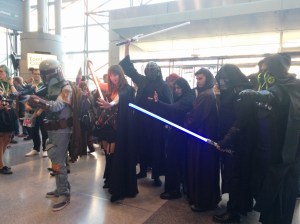
Star Wars Everywhere

Books, Crafts, Movies, TV Shows… IMG_20151010_112211

Costumes,

IMG_20151010_112455

IMG_20151010_172259

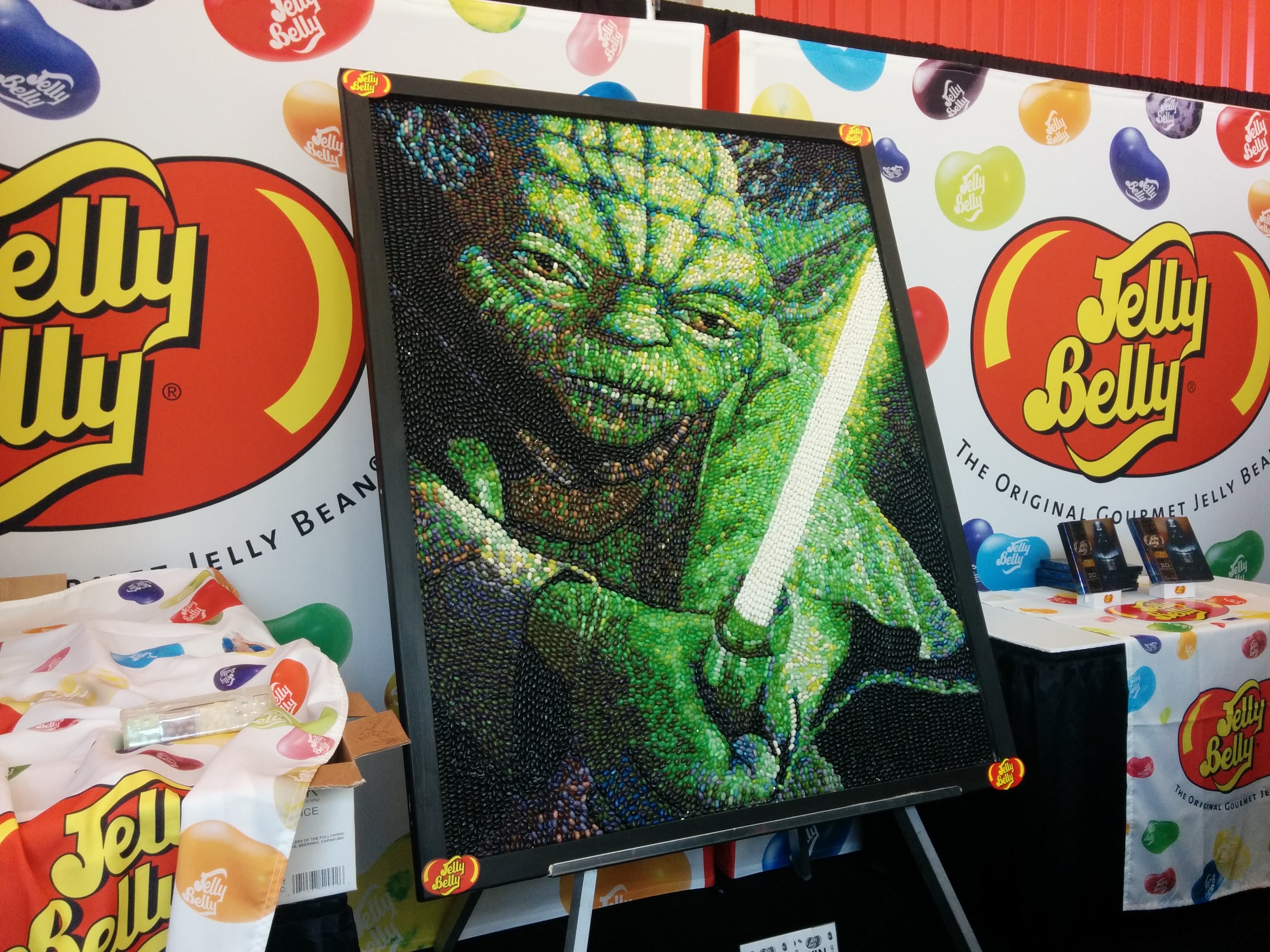
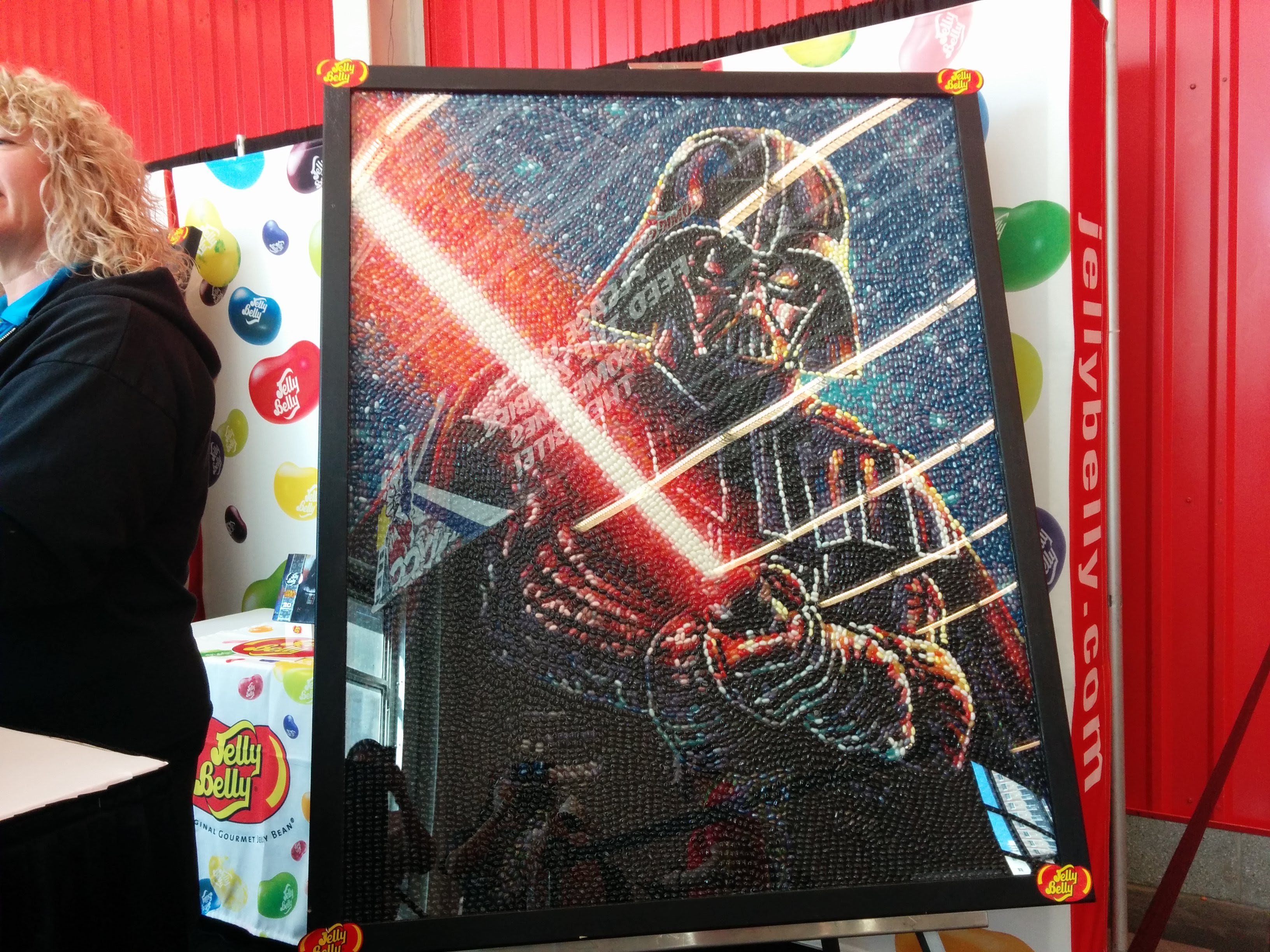
Jelly Bean ART! (Click and Enlarge to see the details) IMG_20151010_115119
IMG_20151010_115403


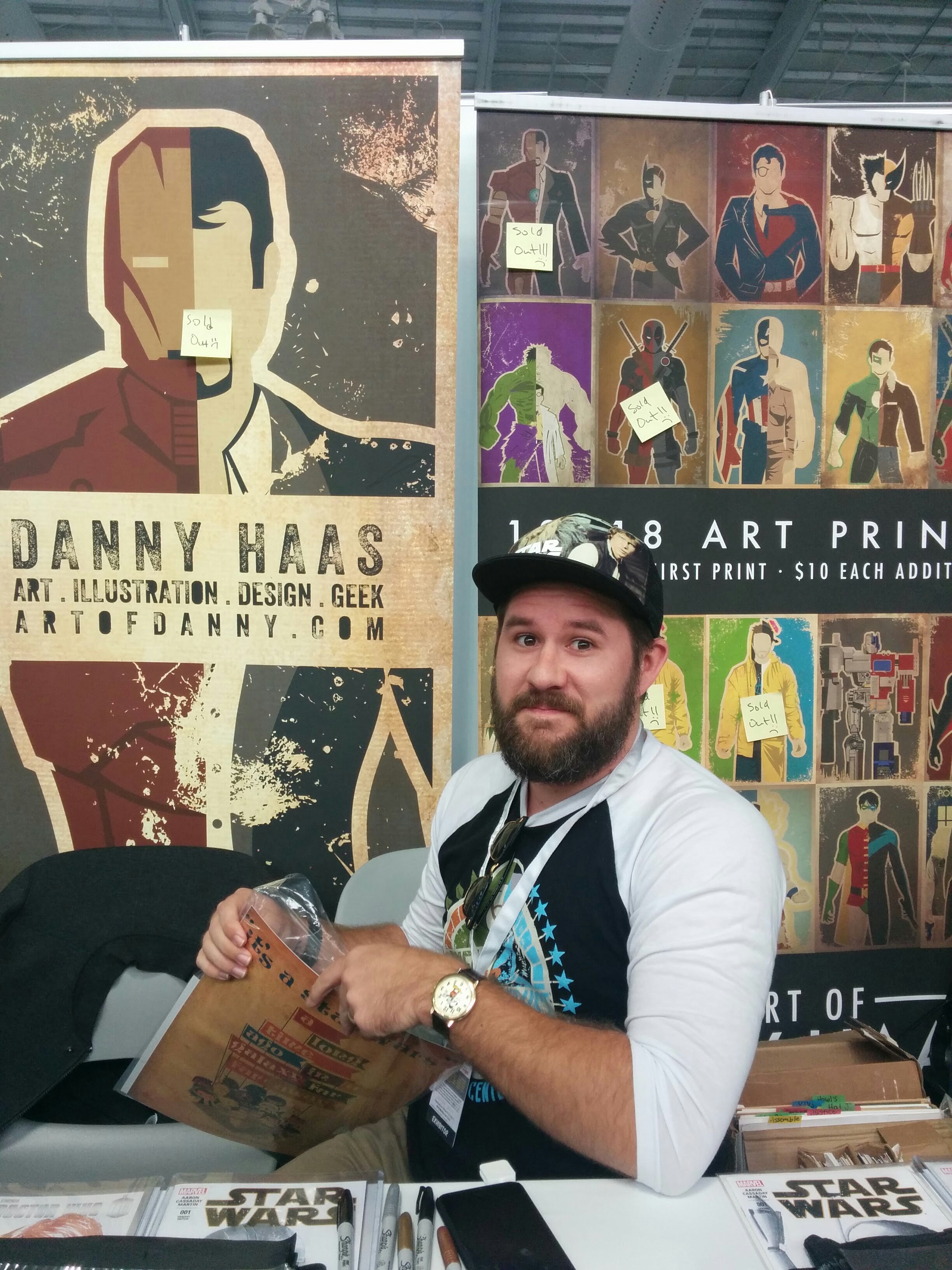
Artist Alley

Spent some time at the Artist Alley — Couldn’t stay too long… too many wonderful art, too little money… IMG_20151010_115658


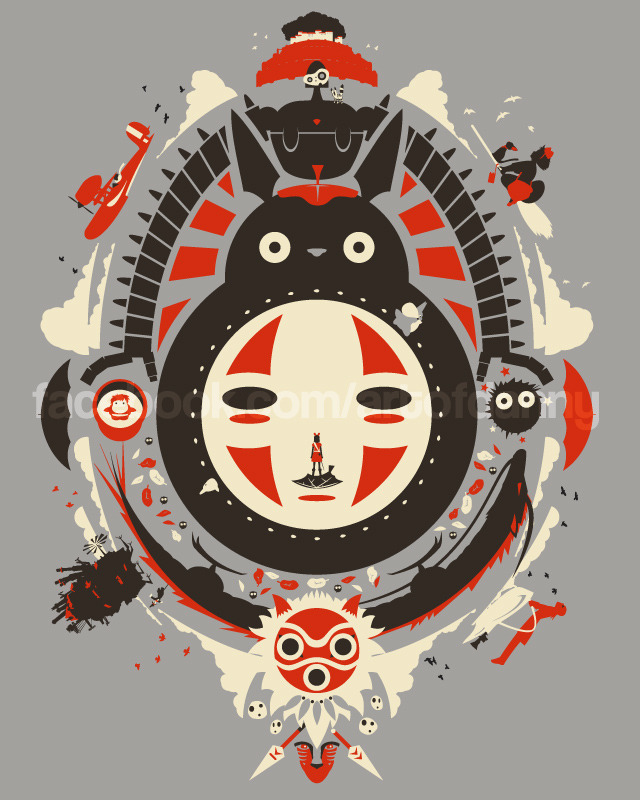
Probably my new favorite pop artist:

IMG_20151010_120953

This is an example of Haas’ art (from his website) — TOTORO!

A couple of other accomplished artists with their own distinct styles:

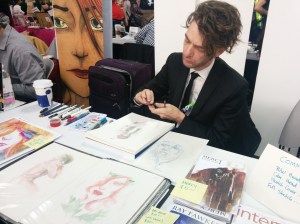
Ray Fawkes

IMG_20151010_121133

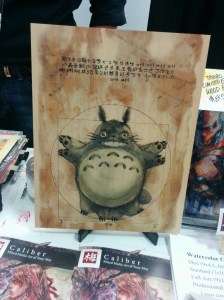
Tony Moy (梅)– TOTORO!!
IMG_20151010_121454

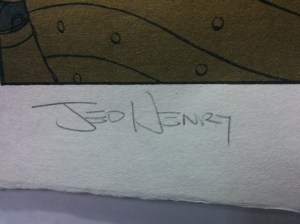
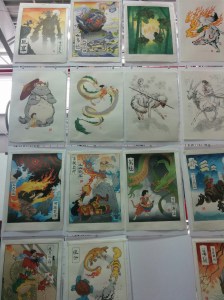
Jed Henry — inspired by traditional Japanese art (hmm… a theme here?) TOTORO!!!

IMG_20151010_122402

IMG_20151010_122151

Jiu Ge (from Beijing/Seattle) Fan Art of Buckie & Loki IMG_20151010_122740

Didn’t get this artist’s name but again, Japanese Manga/Anime inspired artwork:

IMG_20151010_123325

Jim Mahfood:IMG_20151010_124245

Dave Crosland:

IMG_20151010_124421

More Cosplay Fun

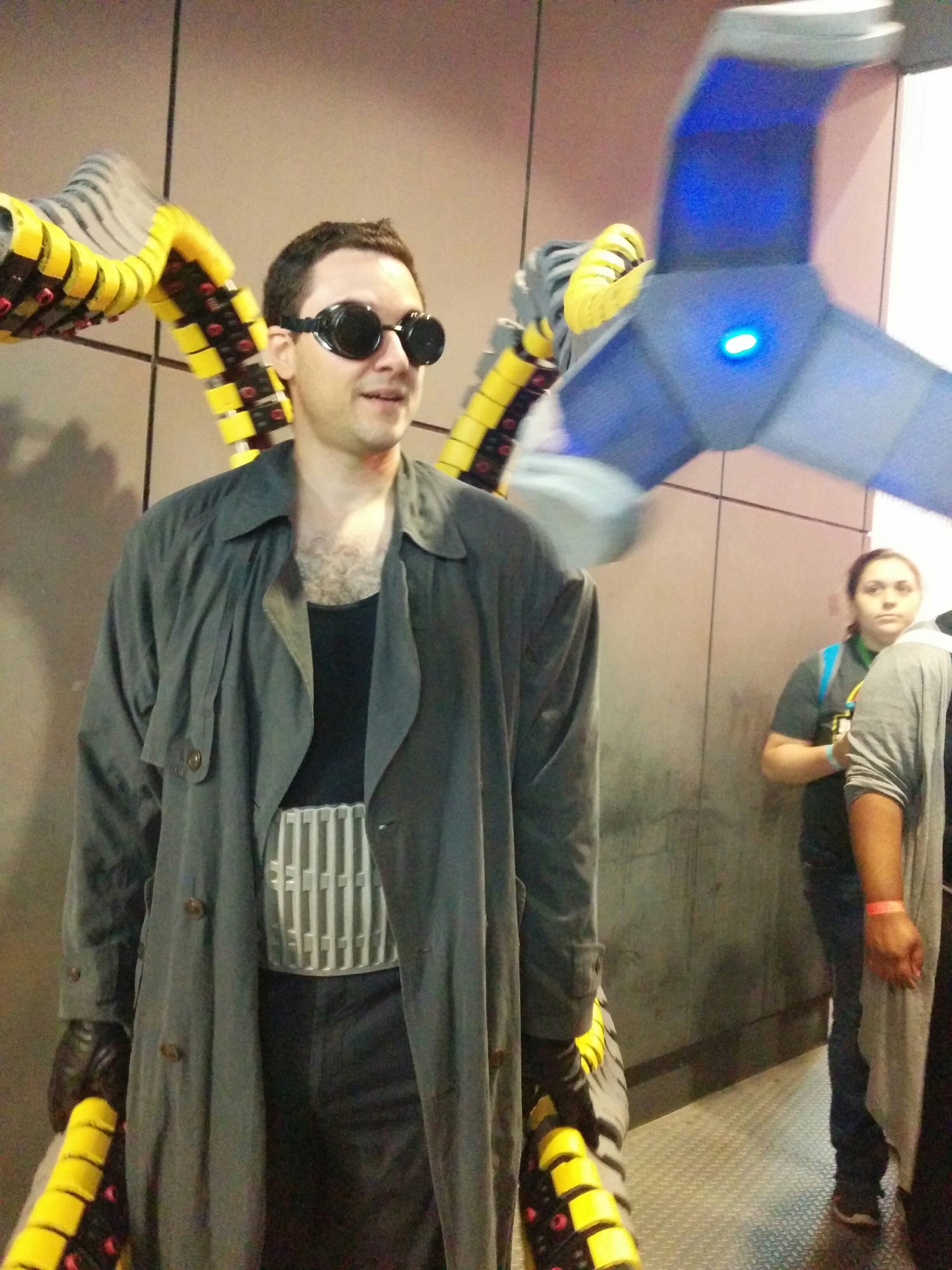
Doctor Octopus — all home made, anchored on a backpack frame

IMG_20151010_125934 IMG_20151010_125849

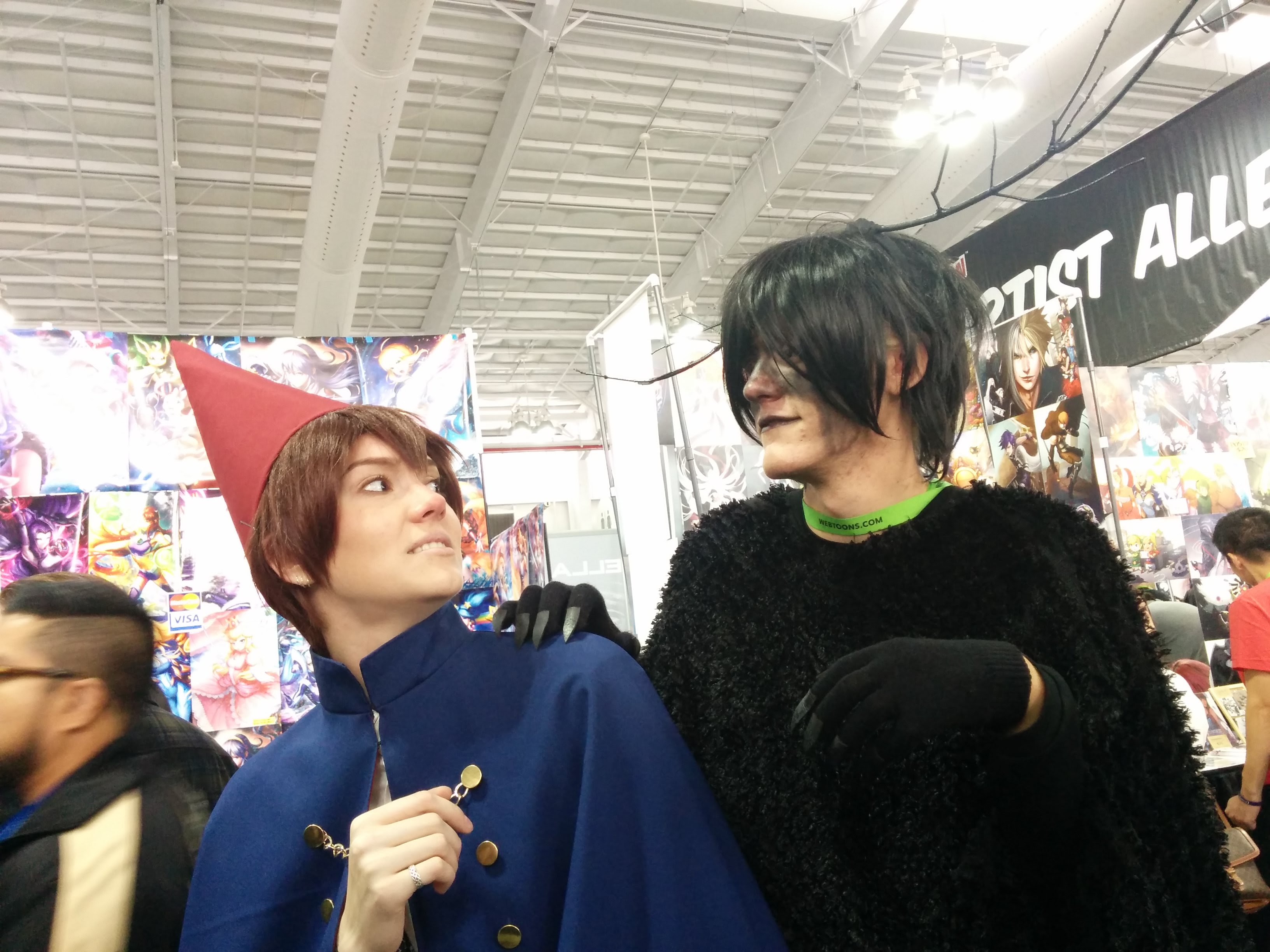
Over the Garden Wall (Cartoon Network)
IMG_20151010_123855

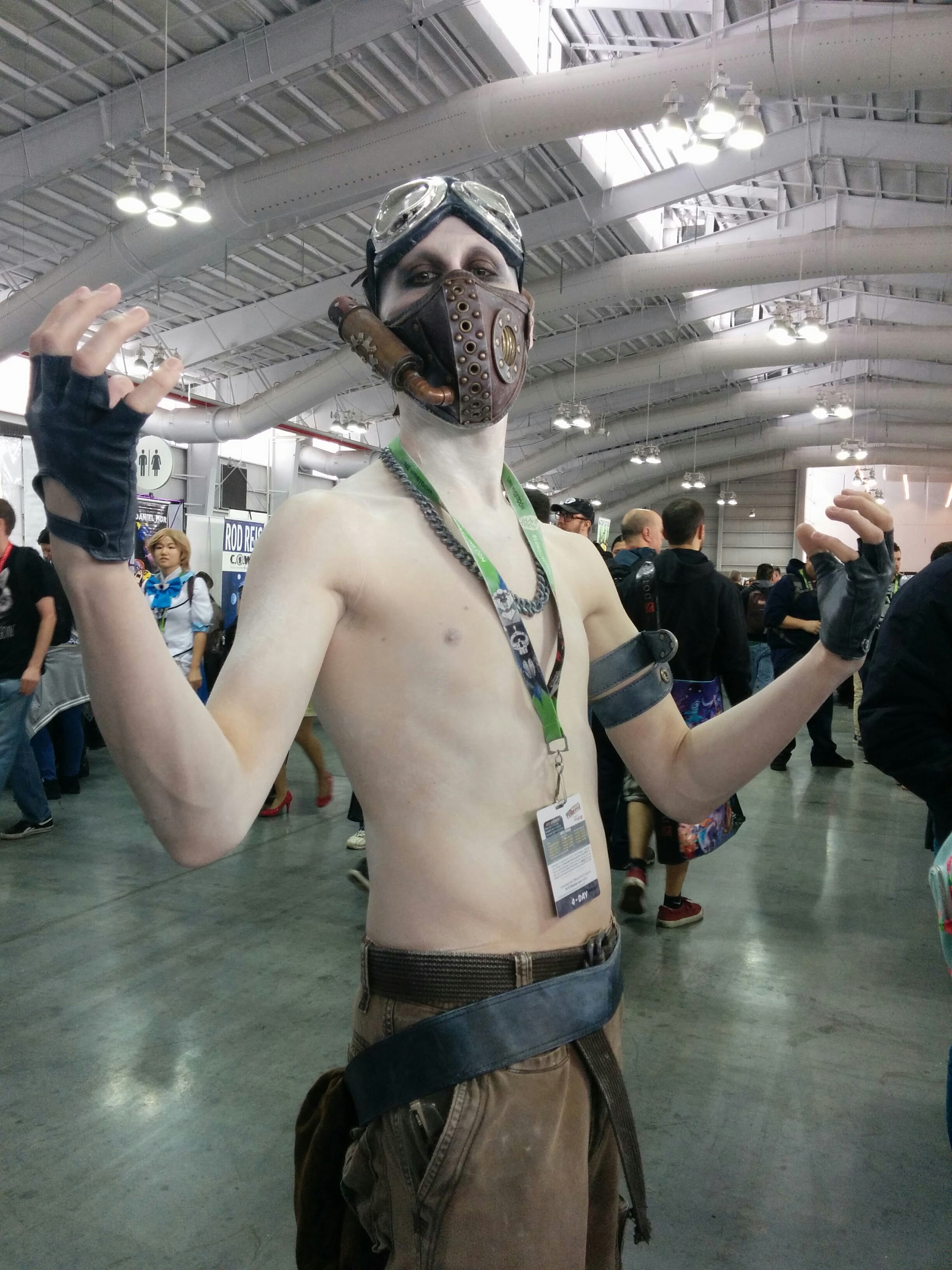
War Boy (Mad Max: Fury Road)

IMG_20151010_124830

Masters of Unreality: Heavy Metal & SFF (SciFi/Fantasy)
(AKA My Favorite Panel Today)

These three authors/metal musicians discussed their inspirations, influences, writing habits, views on popular vs canonized literature (and music,) etc.:

Myke Cole (Gemini Cell: A Shadow Ops Novel)
Michael Fletcher (Beyond Redemption)
Peter Orullian (Trial of Intentions)

One point raised by Cole resonated with me, although he was referring to contemporary music. He encouraged the American music fans to be conscious about how American music industry has always been in the “exporting business” and how we miss the gems from around the world if we just stay inside the US bubble.

IMG_20151010_140510

Michael Fletcher, Myke Cole, Peter Orullian

Leave a comment

Filed under Field Reports

New York ComicCon 2015 – Day 2

image

Selected sights and some notes

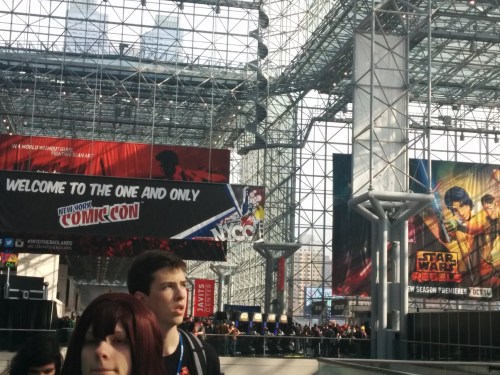
Arrival: 10:15 a.m.

IMG_20151009_101419

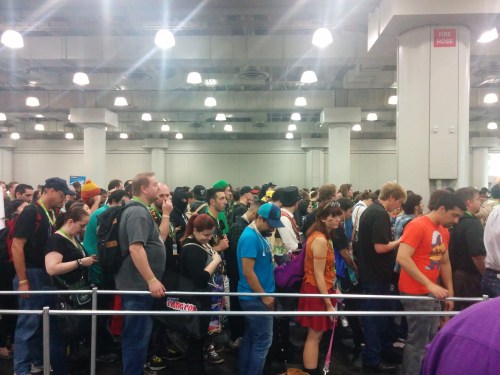
Waiting in line (in clumps) for special event wristbands:IMG_20151009_102318

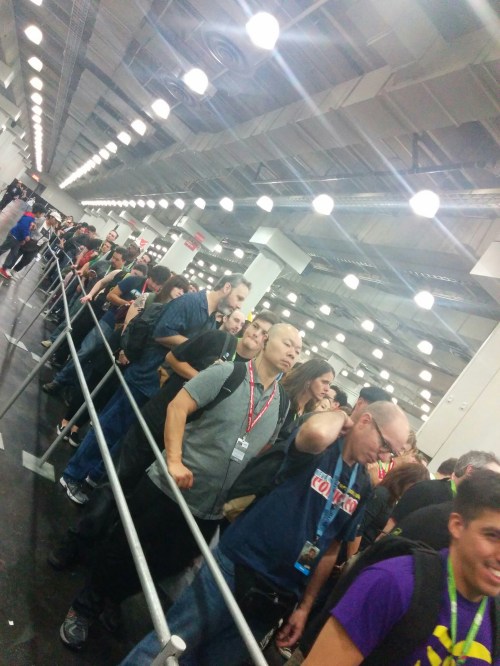
IMG_20151009_102721
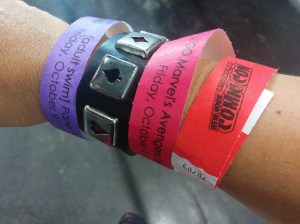
Got three wristbands — Marvel Lego Games Panel, Adult Swim Panel Block, and Batman Bad Blood Panel — IMG_20151009_104059Wound up only going to the Adult Swim event.
Some future comics from Dark Horse at the Announcements panel:IMG_20151009_110459

IMG_20151009_111758

IMG_20151009_111840

IMG_20151009_112234

IMG_20151009_112253

This kind of serendipitous encounters is why I enjoy attending the Con — an artist commissioned on the show floor to make a Boba Fett image in his own style:IMG_20151009_121100 IMG_20151009_121135 IMG_20151009_121627 IMG_20151009_121631
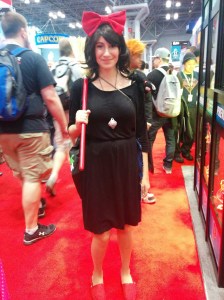
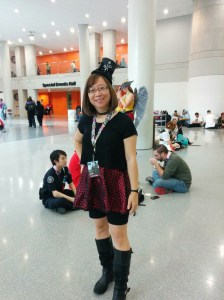
And no Con can be completed without Cosplay or random outfits (like mine):

Kiki’s Delivery Service:IMG_20151009_140538

No special anything:
IMG_20151009_125820

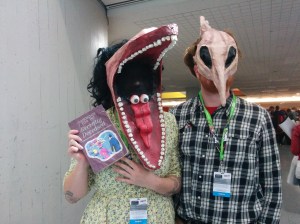
Beetlejuice — this couple made their own “faces” and even the book!
IMG_20151009_130756

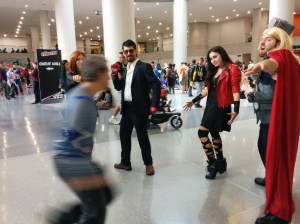
Avengers, with Quick Silver running:

IMG_20151009_130411

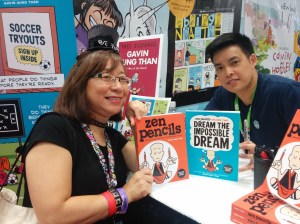
IMG_20151009_134634My #1 Goal this year — meeting the creative soul behind Zen Pencils: Gavin Aung Than, all the way from Australia!  We chatted for a bit and I wished him best of luck of his two new books and on his North America book tour.  Look for him and buy his books!  His touring schedule can be found HERE.  but I’m going to list it all here for you.  Please support him!
BOSTON
Monday, October 12
7:00pm @ Harvard Coop (B&N College)
AUSTIN
Tuesday, October 13
7:30pm @ BookPeople
DENVER
Wednesday, October 14
7:00pm @ Tattered Cover Colfax
PHOENIX
Thursday, October 15
7:00pm @ Changing Hands Phoenix
SAN DIEGO
Friday, October 16
7:30pm @ Mysterious Galaxy
LOS ANGELES (Huntington Beach)
Sunday, October 18
2:00pm @ Barnes & Noble, Huntington Beach
SEATTLE
Monday, October 19
7:00pm @ Third Place Books
SAN FRANCISCO (Berkeley)
Wednesday, October 21
7:00 pm @ Books Inc Berkeley
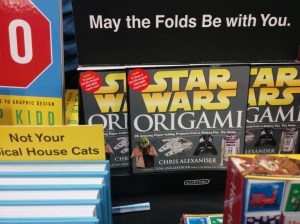
Two more fun things to report: Will buy Star Wars Origami for both the Library collection & for my Origami folding group.

IMG_20151009_135153

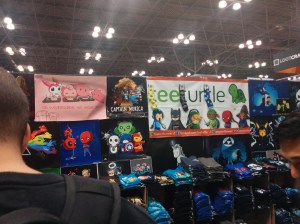
Teeturtle is a fantastic T-Shirt company with simply fun Sci-fi Fantasy designs.  They can be found HERE.

IMG_20151009_124144

Leave a comment

Filed under Field Reports

New York ComicCon 2015 – Day 1

image

Selected sights and some notes

Arrival: 1:15 p.m.

image

I decided to not visit the show floor and attended as many panels as I could fit in for the next few hours: DC Comics – Master Class/Art History; Vertigo: The New #1s; Geeks in the Stacks: Engaging Your Library Community with Pop Culture; Star Wars Rebels Season 2 Sneak Preview; Sean Bean Brings Legends to NYCC

Two of the five events were of greater interest to Graphic Novel lovers and librarians: the Vertigo panel that revealed 12 series titles and the practical advice for librarians and libraries that wish to host their own local Cons.

I am intrigued by these first issues from Vertigo coming out in the next 3 months:

image

image

image

image

image
image

And at the Geeks in the Stacks, teen librarian Ivy Weir gave some on-point practical advice on how to host a library Comic Con:

  • Keep it free to attend and friendly to all ages
  • Act like it’s the biggest Con
  • Create a brand
  • Vet your guests
  • Ask your online and real life communities for help
  • Remember this is fun!

wpid-wp-1444344497003.jpg
wpid-wp-1444344525952.jpg

Leave a comment

Filed under Field Reports

Sunday Select, October 4, 2015

FCLSS
This week’s selection is not a lengthy one but the image quote pins a moment in history that I hope to be a turning point in the United States’ public psyche: and I truly believe that children’s and young adult literature can play a big part in our communal effort to raise conscientious and compassionate next generations.

Quote of the Weekdear-congress-1b

by Jonathan Schmock
from “Dear Congress” on http://jonathanschmock.com/dear-congress/

Considering Cultural and Emotional Competency

It’s Banned Books Week again. Can we stop yelling at each other about it?: Jacqueline Woodson interviewed by Ron Charles — from The Washington Post

Big News about Hoffman’s AMAZING GRACE by Debbie Reese — from American Indians in Children’s Literature

Patterns of Immigration Excerpt by Roni Dean-Burren  — from Dean-Burren’s Facebook Post

Authors & Books

It’s a Coder! It’s a Teacher! It’s a Kick-Ass Graphic Novelist!: Is Gene Luen Yang from Kryptonby Michael Mechanicook — from Mother Jones

Alice in Wonderland: A Very Important Date by Monica Edinger — from School Library Journal

Alice: 150 Years of WonderlandOnline Exhibit at The Morgan Library

2015 Finalists: Young Readers  — from Kirkus

I gathered these entries from various sources such as Facebook, Twitter, Goodreads, and specific sites that I follow such as Educating Alice, Pub Peeps, Book Riot, School Library Journal, The Horn Book, We Need Diverse Books, American Indians in Children’s literature, etc.

Leave a comment

Filed under Book Notes, Views, WIWWAK

So You Want to Be A Jedi: Star Wars, The Empire Strikes Back by Adam Gidwitz

soyouwantobeajediSo You Want to Be A Jedi: Star Wars, The Empire Strikes Back by Adam Gidwitz, with original concept arts

Really enjoyed much of the book — many of the Jedi lessons are great fun and with the trade-mark Gidwitz caring for a young person’s mind and character. The second person narrative device worked for me and the added extended training segments made me happy. The third person narrative parts about Han & Leia are faithful to the movie but to someone like me who saw the original movie and re-watched it a few times in the past few decades, they can seem a bit bland. I could tell that the imagined audience is actually those who’re young and not exactly familiar with Episode V. Waiting to hear from my 4th & 5th graders of their view.

Leave a comment

Filed under Book Notes

Unusual Chickens for the Exceptional Poultry Farmer by Kelly Jones

unusualchickensUnusual Chickens for the Exceptional Poultry Farmer by Kelly Jones

Definitely a breezy read with some fun bits and pieces. I really like Kelly Jones’ portrayal of Sophie, level-headed, with plenty of normal kid concerns and normal kid courage. Jones included some not-too-heavy-handed tidbits about how others perceive Sophie, being half Mexican American, being viewed as poor, being “presumed” in not-so-flattering ways.

Since my taste runs more toward more saturated kind of fantasy, I wanted the chickens’ powers (and they are amazing powers) to manifest more, stronger, and add more tension to the story.  However, I can also see how this can be quite attractive to those who just want their magic to be more like everyday happenings — not too many world-altering encounters.

My narrative device-detector antenna was definitely alert for this one and wish that the letter-writing device had worked all the way through.  The really really long, as-it-happens, climatic sections did not work all that well for me: not sure when/where Sophie would have been writing to Agnes in the middle of rescuing the chickens and participating in the Poultry Show (and it is apparent that those letters weren’t written after all the excitement as a report, since Agnes would have known all that had happened and wouldn’t have needed such narration of events.)

Leave a comment

Filed under Book Notes

Circus Mirandus by Cassie Beasley

circusmirandusCircus Mirandus by Cassie Beasley

For the most part, the story works, and I did care about the main character and what he was hoping for. The ending is the kind that kid readers always want: the young protagonist actually GOT to enter the fantasy realm, rather than learning some precious lessons on how to hold the magic in one’s heart but knowing that “fantasy world” does not quite exist. So, kudos to Beasley on that front. I was hoping that once we learned the back story of the aunt, I would have had more sympathy toward her behavior but she remained a two-dimensional device and not fleshed out character all the way through. Definitely felt that the writing is a bit plain and some details could be trimmed to tighten the pacing, but totally see it appeal to certain young readers.

Leave a comment

Filed under Book Notes

Sunday Select, September 27, 2015

FCLSSQuote of the Week

Are you ready for a revolution?
As an African-American librarian, I am.
Think about it. It’s 2015, and we still need to campaign for “more diverse books.”
————-
The question we librarians need to ask ourselves is: Are you exposing your users to the full range of authors and literature out there? Are you going out of your comfort zone and reading and learning about authors and sharing that with the community you serve?


— by Shauntee Burns-Simpson,

from A Call to Action for Librarians @ BookRiot

We Need Diverse Books

A Call to Action for Librarians by Shauntee Burns-Simpson — from BookRiot

Ta-Nehisi Coates to Write Black Panther Comic for Marvel by George Gene Gustines — from The New York Times

Lying to Children About the California Missions and the Indians by Deborah A. Miranda — from Zinn Education Project: Teaching a People’s History

China Rich Girlfriend by Kevin Kwan reviewed by Pooja Makhijani — from The Rumpus

The Diversity Baseline Survey — from Lee & Low Books

Authors & Books

Top 25 Books from the 2015 NBA (Neri Book Awards) by G. Neri — from g.neri.com

Some Kids’ Books Are Worth The Wait: ‘They Do Take Time,’ Says Kevin Henkes  — from NPR

Jane Goodall, UN Messenger of Peace  by Monica Edinger — from Educating Alice

Children’s Books Interview – Horn Book Editor, Roger Sutton  — from Miss Marple’s Musings

A Manifesto for Children’s Literature; or, Reading Harold as a Teenager by Philip Nel — from Iowa Review 

I Am Marie Lu: Ask Me Anything  — from reddit.com/r/books

Nielsen Summit Shows the Data Behind the Children’s Book Boom by Natasha Gilmore — from Publishers Weekly

Something Great to Share


Size Comparison Science Fiction Spaceships by Dirk Loechel — from Deviant Art

(Click on this small partial image to see the full size, high rez original.)

spaceshipslinkimage

I gathered these entries from various sources such as Facebook, Twitter, Goodreads, and specific sites that I follow such as Educating Alice, Pub Peeps, Book Riot, School Library Journal, The Horn Book, We Need Diverse Books, etc.

Leave a comment

Filed under Book Notes, Views, WIWWAK

X: A Novel by Ilyasah Shabazz & Kekla Magoon

xX: A Novel by Ilyasah Shabazz & Kekla Magoon

So many of my esteemed colleagues have reviewed this book extremely favorably and some of them told me exactly why they love this book.  They cite the energy in the narrative, the honesty in the young man’s anger, and the eventual growth and redemption of this lost soul.

So I feel like walking on thin ice to say that I didn’t find the novel or the protagonist quite compelling all the way through.  I found the beginning of the narrative strong and powerful.  I was moved by Red’s emotional ties to his mother and siblings; I was convinced that he would find justification of he must steal.  His slow realization of his “place” in the world saddened me.  The refrain of “Just a n****r” is both chilling and makes my blood boil!  And one cannot easily forget his witnessing a lynched body and the connection to the song “Strange Fruit.”

But then… we have 200 pages more of Malcolm engaged in various illegal activities, and continuously excusing himself because of his sorrowful past, family situation, societal reality, etc. I understand that all of these are based on real events, family stories, and Malcolm’s own words. I can only speak for myself as a reader how after a while it felt more tedious than compelling. The pacing went from tight to sloppy.  I got quite impatient and did not feel empathy or sympathy toward him.  Perhaps that’s not the intent of the author but it was difficult for me to want to follow his next missteps since I stopped caring.

The final payoff of X’s enlightenment comes very late and lasts very briefly within the confine of this novel. The book ends before his important life’s work begins.  For many who already know quite a bit about Malcolm X, his personal narrative, his rage, and his complex relationship with the Nation of Islam, the ending is but a beginning — we know what he would become.  And the book includes extensive after matter to detail Malcolm X’s achievements.  I just wonder what impression this “novel” of Malcolm X leaves a younger reader.

I also wonder how the pacing feels and my emotional engagement might have been different if the narrative voice had been a more universal third person, so that I could understand his internal struggle and also observe his external charms and charisma (and not just being told by the protagonist that “people seem to be drawn to me” or “girls like me.”)

Leave a comment

Filed under Book Notes

Notes from Beijing: Chinese Children’s Books and Other Thoughts, Part 1

FCLBeijingThese thoughts went through my mind as I visited Beijing and the International Book Fair with a focus on the local books published for the Chinese young readers.

First, simply about communication and information exchanges.

It was quite an education for me to truly understand that the “WORLD” wide web as I see and use it is definitely NOT so “world wide.”   YouTube, Google-platform, Facebook, and Twitter are all inaccessible in China, unless someone has installed IP masking devices (VPN, etc.)   So, when I tweet or share something on Facebook from New York City, I cannot guarantee to reach the millions of potential internet users in China.  According to the editor of one of the publishers, Fairrosa Cyber Library site often shows up without her being able to load the included images — and no YouTube videos can be displayed either. Furthermore, since my recent reports on Newbery & Caldecott winning publishers feature Google spreadsheet graphs (pie-charts), the information, without a plain text summary, was inaccessible to the Chinese readers of my blog.

Although I always knew about the differences in accessibilities of certain sites in China, experiencing it first hand definitely made me think twice about my comfortable assumptions.

Another striking realization came after I spoke with several representatives of major children’s book publishers: either with the editors, publishers, or rights managers: each told me that they have all sold their best titles internationally.  Upon further inquiry, “internationally” means Korea and other Asian countries such as the Philippines, and France, and other European countries such as Germany.  They almost NEVER meant North America, especially The United States.  They all told a similar tale: the U.S. publishers of children’s books only wish to sell Chinese language rights and have the books available in China for sale; very rarely would a U.S. publisher seriously consider buying and translating Chinese originals into English editions for American children.  I wonder if this situation will change any time soon?

I have always noticed that translated children’s books are scarce on the U.S. market and felt sad that the U.S. children do not have the same level of exposure to world literature and diverse viewpoints and sensibilities that I had the good fortune to have, growing up in a small island country.  I read books translated from all over. Some of my all time favorite books that were re-read many times were from Italy (Heart or Education of Love), France (Arsène Lupin: Gentleman Thief series), Cuba (Malfada – a satirical comic strip series), Japan (manga) and India (Buddhist allegories.)  And while there have always been publishers who work hard at bringing books from other cultures to the U.S., there seems to be some difficulty to sell these titles when the cultural landscape and sensibilities differ greatly from the everyday, presumed mindset of the U.S. children.

Case in point: One thing I noticed was how the strong Chinese tradition of not shying away from sad endings remains evident even in picture books for fairly young children.  Tragedy is quite common in traditional Chinese literature, theater, and now TV shows and movies, and children are often familiar with many somber tales.

Take these two books by Cao Wenxuan (曹文轩) for example:

lastpatherThe Last of the Panthers shows the devastating scenario of the “last” of many species and there is no uplifting or hopeful ending when our Panther gives up on itself and falls into the perpetual sleep.  It is heart wrenching but so effective.  A young person reading the simple text and looking at these gorgeous pictures would acutely feel the pang of loss of such majestic animal and might be inspired to be more responsible in caring for our natural world.
kingofthecapAnother title is the Hat King.  A story set during the Sino-Japanese war when the boy and his grandfather (a magician skilled in “hat tricks”) had to endure the deaths of the boy’s parents at the concentration camp and even when they successfully escaped from the camp, they had no house to go back to any more.  And that’s how the tale ends. This is a story almost never told to the children in the U.S. It’s powerful and bleak — but it’s also real and full of familiar affection.

Will either of these titles, which are top-selling picture books, or dozens of other quality peers, ever find their way to the general U.S. mass market? And if and when they do, will they be translated faithfully and stay intact?

7 Comments

Filed under Field Reports, WIWWAK

Sunday Select, September 20, 2015

FCLSSQuote of the Week

American audiences are capable of so much more than some in your industry imagine. And if we can break that down to what I really mean, I mean this: White Americans can care about more than just themselves. They really can. And the rest of us? We are DYING to see ourselves anywhere.

To be clear: I’m not asking for altruism here. I worked in corporate America for 20 years before I put my book out; I know the stakes, the economics. What I am saying makes solid, actual business sense: There is a vast, untapped audience out there. You need to get to us.

— by Mira Jacob,

from “I Gave A Speech About Race To The Publishing Industry And No One Heard Me” via BuzzFeed

Race & Cultural Literacy

Why a White Blog? by Allie Jane Bruce — from Reading While White (This is the inaugural post of the new blog.)

Author Cornelia Funke Launches Own Publishing Company by Wendy Werris — from Publishers Weekly (Her decision was made due to stylistic and also cultural conflicts with Litte, Brown.)

I Gave A Speech About Race To The Publishing Industry And No One Heard Me by Mira Jacob — from BuzzFeed

Awards, Authors & Writing

The National Book Award announcement of the ten titles that made the long list for the Young Readers category — from The New Yorker

Omission: Choosing what to leave out by John McPhee — from The New Yorker

The Walking and Talking series by Steve Sheinkin — from A Fuse8 Production/SLJ

This web comic series features interviews with children’s authors conducted and drawn by Steve Sheinkin, hosted on Fuse8, since September 2014. Here are the six installments so far:

I gathered these entries from various sources such as Facebook, Twitter, Goodreads, and specific sites that I follow such as Educating Alice, Pub Peeps, Book Riot, School Library Journal, The Horn Book, We Need Diverse Books, etc.

Leave a comment

Filed under Book Notes, Views, WIWWAK