Sunday Selection, July 26th, 2015

FCLSS

Jimmy Carter and Jacqueline Woodson on Race, Religion and Rights – from The New York Times

It’s Time to Get Real About Racial Diversity in Comics – from Wired

A Historic Week for the Fight to #EndMassIncarceration! But Will President Obama Play It Safe or Courageously? – from Huffington Post

Actor Jesse Williams Breaks Down Sandra Bland and Racist Hypocrisy in 24 Tweets – from ColorLines

Leave a comment

Filed under Field Reports

The Ever Expanding Bubble of Knowledge and Facts

A former student shared this article by Jef Rouner, “NO, IT’S NOT YOUR OPINION. YOU’RE JUST WRONG” on facebook and I reshare this here.

It is definitely a quick and worthwhile read, especially for those who are in the profession of educating young minds and often struggle with how to guide young people toward more fact-based opinion forming, something that I have to face frequently.  As mentioned in the article, young children often believe that what they know is the totality of certain area of facts (about dinosaurs, about Star Wars, about the Civil Rights movement, etc.,) and thus they easily believe that their opinions, based on all that they know, are 100% accurate and valid, even sacred, and cannot be challenged: by peers or teachers whose knowledge bases are a lot bigger.

But my students are in their pre-teen and early/mid-teen years and are still quite flexible in becoming better informed. I just have to keep pointing out (and sometimes bursting) the bubbles they find themselves in.  In fact, we all operate within our own knowledge/information/social bubbles.  All our knowledge bases have to have some sort of limitation, even when we are well-informed.  In order for me to be less limited, I need to keep identifying the boundary of each bubble and see how to expand the size of that bubble to include more facts and thus strengthen or even alter my opinions.  I hope I can continue modeling this behavior in front of my students so they can accept when their bubbles are being challenged or burst!

Leave a comment

Filed under Field Reports, Views

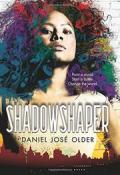
Shadowshaper by Daniel José Older

shadowshaperShadowshaper by Daniel José Older

The young urban teen characters in this novel feel and sound authentic — they are the artsy crowd and use their talents to navigate their lives.  Mural art is highlighted and so is spoken word poetry.  The blend of the real world with the spiritual/ghosty world also feel convincing with much respect paid to the cultural traditions and family ties with some vividly creepy scenes.  This is not a epic fantasy but a story of urban magic, much like a fairy tale where chance meetings and helpful beings are common devices to advance the plot and solve the protagonist’s problems.  And thank goodness we have a wonderful strong young woman, who is not white, whose full face is shown to the readers on the beautifully designed cover!

Leave a comment

Filed under Book Notes

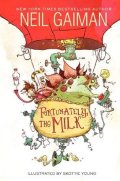
Fortunately, The Milk by Neil Gaiman

fortunatemilkFortunately, The Milk by Neil Gaiman,
illustrated by Scottie Young

A fun and funny romp into the land of wild imagination with a warm, Where the Wild Things Are ending.  The father-children relationship is full of heart, too.  I can see it being read aloud in many classrooms as a way to insert entertaining moments during a stressful day.


Leave a comment

Filed under Book Notes

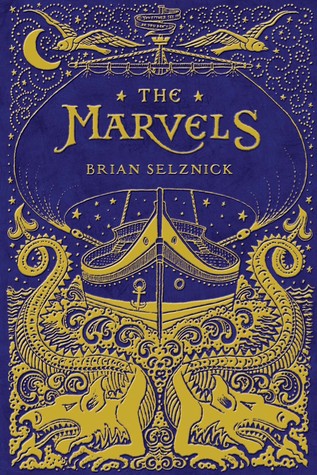
Marvels by Brian Selznick

marvelsThe Marvels by Brian Selznick

In this third installment of a loosely connected (by form, by theme, and by narrative progression) literary trilogy, following the previous two marvelous titles: The Invention of Hugo Cabret and Wonderstruck, Brian Selznick once again pours his artist’s soul and a writer’s heart into the tome and brings readers a moving tale. Much like the other two picture-novels, The Marvels features instant and fast friendship among two young characters, a cross-generational relationship that grows from suspicion and uneasiness to faithful loyalty, and the deep and palpable connection a person can have with history.

I had a grand time looking through the pictures and reading the story and was unbelievably moved (to a whole lot of tears) as the truth of the story of the Marvels family was revealed. And also by the fact that Brian’s portrayal of the gay characters is without additional fanfare: subtle and yet you can’t misinterpret.

I imagine the book an instant hit with all my students when it’s published on September 15! Can’t wait to hear their reactions!

Leave a comment

Filed under Book Notes

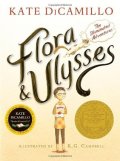
Flora and Ulysses: The Illuminated Adventures by Kate DiCamillo

floraulyssesOne of the most delightful books I’ve encountered!

So much of it is sparkling, like gems — the humor, the humanity, the friendship, and even the heartaches.  And there’s a special twinkle of absurdity: the squirrel poet, the hysterical blindness, the kind but weird neighbor with the “living” painting, etc.

Read this two years ago but never got to put the book note up and so much of the book is still vivid in my mind.  Indeed a great Newbery choice!


Leave a comment

Filed under Book Notes

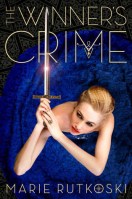
Winner’s Crime by Marie Rutkoski

winnerscrimeWinner’s Crime by Marie Rutkoski

I enjoyed the first installment quite a lot but this second volume left me frustrated and annoyed every few chapters. Even when I genuinely want to see what happens next and how Kestrel and Arin’s torturous love affair pans out, I am fatigued by these two high position political figures acting so impulsively on their “love” for each other and by their constant misunderstanding of each other. They put themselves and everyone around them at huge risks: which is convenient for plot-advancement but inconsistent to the characters’ traits and talents at being sophisticated gamers (as laid out in the first book.) I also simply could not buy all their sneaking about, being so readily aided by the servants when neither Kestrel nor Arin are being portrayed as having gained any loyal followers by their talents in winning trust or sympathy.

The “games” element that were the breath of fresh air and made the tale stand out in the first volume (Winner’s Curse) were also woefully lacking in this one.

The ending, though, was a well-placed fruit, just out of reach, and enticing enough for me to read the final book when it comes out next year.

Leave a comment

Filed under Book Notes

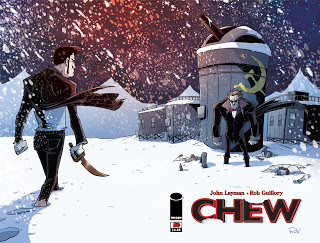
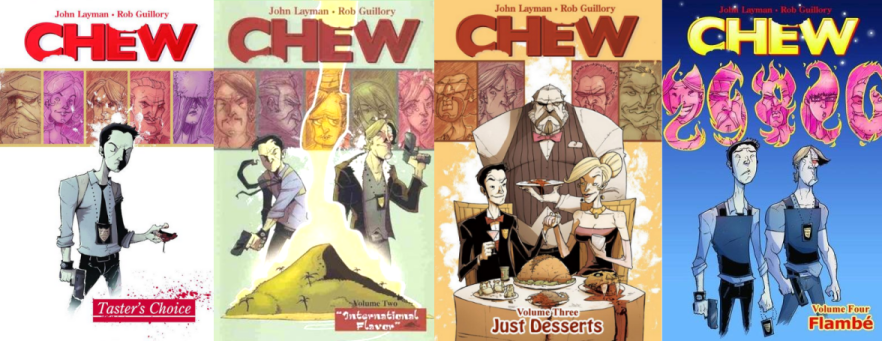
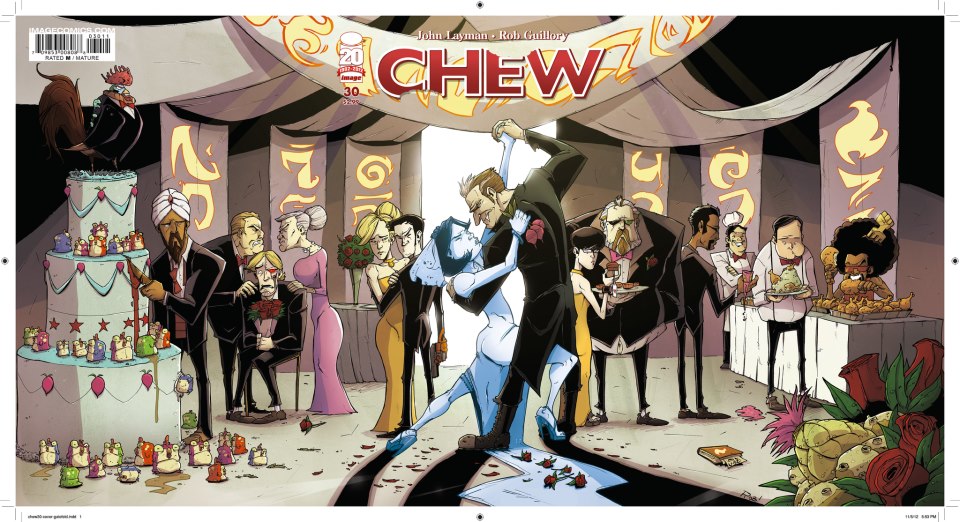
Chew (Series) by John Layman & Rob Guillory

Taster's Choice (Chew, Vol. 1)

Chew by John Layman, artwork by Rob Guillory

Not for the faint of heart or queasy of tummy. There are laugh-out-loud scenes and almost-puke-my-guts-out scenes. Definitely cannot read this and have a meal at the same time.

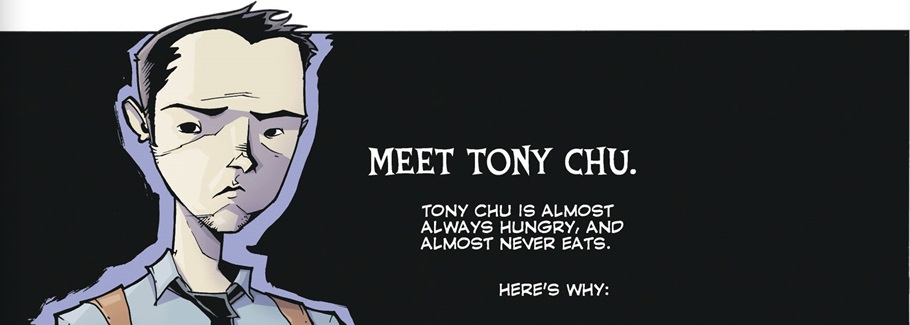
Since 2009, the series creative duo, Layman & Guillory, have brought us 50 installments and 10 collective volumes (August 2015) of this bizarre tale of a Chinese American FDA detective Tony Chu with a superhuman ability: Tony can bite into any once living organism and have vivid “recollection” of the scenes in that living organism’s life, including the circumstances surrounding its death.  So, when he arrived on a murder scene, he is required to take a bite out of the corpse…   But, wait, others also have strange abilities like, a food critic able to write reviews that make the readers actually “taste” the meal (including the terrible ones), a chocolate sculptor who can recreate any landmark in 100% accurate details, etc.

And then you have the U.S. Government’s top secret weapon, Poyo, a rooster with nuclear weapon power, other political conspiracies involving NASA and the aliens they deal with, and enough family and love drama to satisfy any soap opera aficionado. Yup.  A crazy smorgasbord of gross but hilarious scenarios.  I absolutely adore this series and can’t wait to read the rest of the collected volumes (planned 12, by mid-2016.)

One of the main reasons that I love Chew is my fondness of Guillory’s artistic style.  And now I think of it, the series definitely fits #weneeddiversebooks movement very well — for older teens.

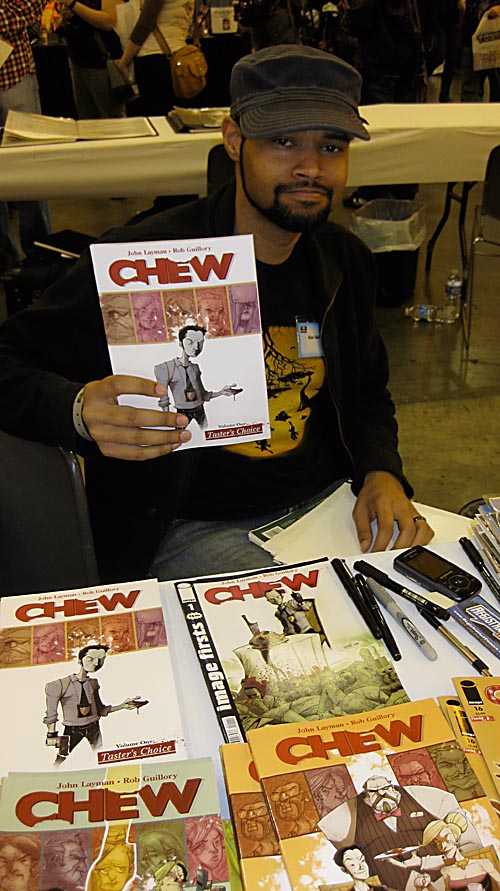
Meet the artist, Rob Guillory:

robguilloryphoto

And Meet Tony Chu:

meettonyAnd see some of the unusual scenes for yourself:

chewspecial chewcovers chewweirdwedding

Leave a comment

Filed under Book Notes

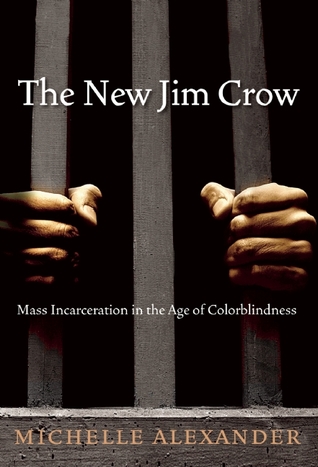
Not Just a Book, The New Jim Crow is a Call for Real Action and a Movement

newjimcrowThe New Jim Crow: Mass Incarceration in the Age of Colorblindness
by Michelle Alexander

audiobook read by Karen Chilton

It took me a long while to finish listening to this.  My heart would shrink a little when the thought surfaced that it’s time to listen to the next chapter or section.  Why would I want to torture myself knowing more aspects of how UNJUST the United States Criminal Justice System has been to our black fellow citizens — especially black men, especially black young men?  Why would I want to hear more stories that confirm how color-blindness, racial indifference, and lack of information of myself and millions of kind-hearted Americans contributed more to the creation of a lower racial “caste” in our society (convicted felons for minor or nonviolent drug offenses) than overt racists.  Why would I want to feel powerless when informed of the institutionalized sanction so our law enforcers may commit atrocious acts (seizing and keeping of properties of those who might or might not have committed a crime, for example and the incentives to use military grade weapons and tactics against unarmed individuals.)

But I kept at it.  And kept learning.  And kept finding more supporting evidences from the chatters and opinions in social media and other information sources.  And kept talking to whomever would listen.  Until the book was done.

And I promptly bought the paperback copy of the book so I can refer back to it whenever I need.

The book was published in 2010.  And in 2015, we read about president Obama’s bipartisan-sanctioned plans for Justice Reform and listen to reasons behind his granting clemency to unjustly sentenced minor drug offenders.  It will be great to see new policies that address the long-time injustice in the Criminal Justice system.

Watch Obama’s speech at the 2015 NAACP Annual Convention.

A collection of videos about this topic can be found on CNN: http://www.cnn.com/2015/07/14/politics/obama-naacp-speech-philadelphia-justice-reform/


1 Comment

Filed under Book Notes, Views, WIWWAK

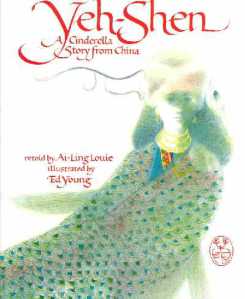
Investigating Yeh-Shen and the Chinese Cinderella Myth

yehshenYeh-Shen

Retold by Ai-Ling Louie
Illustrated by Ed Young

Original Pub. Date: 1982
Publisher: Putnam (HC); Puffin (PB)

Country of Origin: China

This title appears to be a fairly straightforward translation/retelling of the original text found in an old Chinese book. In the foreword, Louie states that the story can be traced back to 850 A.D., in the Tang Dynasty. This is widely regarded by the western and Chinese folklorists as accurate.

Although the actual 9th century text seems to be forever lost and the current tale was copied and compiled much later, in the 17th century. The story of Yeh-Shen is in volume one of the Appended text. The original text’s standard English title is You Yang Za Zu — Columbia University’s East Asian library rare book collection owns two editions of the 19th century reprints.

Even if this tale was originally recorded in the 9th century, whether it is the “original Cinderella story of the world” is still up for much debate in the academic world. I found a source that collects many different theories (unfortunately, all in Chinese) and one of the revelation is that Yeh-shen is a highly unusual name for a Chinese girl and it shares similar sound to the word “Aschen” which means ash, and Aschenputtel is the original Grimms fairy tale title for the better known Cinderella. This seems to indicate to some scholars that Yeh-shen was a retelling of a Western story, brought over to south west China by Arabic traders or via current day Vietnam.

Although Louie’s translation is fairly faithful, she chose to leave out the last part of the original story. Here’s the last part of the translation done by Arthur Waley, a famous East Asian scholar, although he never set foot in any Asian country in his lifetime. It’s published in Folk-lore, vol. 58 (London: The Folklore Society, 1947.):

The step-mother and step-sister were shortly afterwards struck by flying stones, and died. The cave people were sorry for them and buried them in a stone-pit, which was called the Tomb of the Distressed Women. The men of the cave made mating-offerings there; any girl they prayed for there, they got. The king if T’o-han, when he got back to his kingdom made Yeh-hsien his chief wife. The first year the king was very greedy and by his prayers to the fish-bones got treasures and jade without limit. Next year, there was no response, so the king buried the fish-bones on the sea-shore. He covered them with a hundred bushels of pearls and bordered them with gold. Later there was a mutiny of some soldiers who had been conscripted and their general opened (the hiding-place) in order to make better provision for his army. One night they (the bones) were washed away by the tide.

Cultural Analysis:

Cave: The Chinese word for Cave, DONG, could have meant also a small village. It seems that the Cave People might have been Villagers. Evidence of such terminology is prevalent in Korea today.

Worshiping the two dead women: It is not uncommon for many spirits of the deceased to be deified (taken as an object of worship/made a god/dess of.) It is unclear, though, from the original Chinese text whether the people were praying for girl friends, as Waley’s text states, or praying for birthing of baby-girls. The text only used one work — NU, female — (However, given the importance of boys over girls in most Chinese cultures, it might not be praying for baby-girls.)

Costume/Illustration:

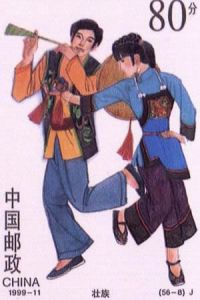
Supposedly, the southern tribe in where Yeh-Shen came from was probably Zhuang Zu (壮族) — from the modern Guang Xi province. This image from a Chinese stamp shows the traditional outfits which echo Ed Young’s illustration.

It is important to keep in mind that this is a minority group and the traditional costume is not the same as the majority, Han, group.

zhuangzu

Costume of the minority group (design found on a Chinese stamp)

(This was posted, by me, on another blog a few years back.  Reposted.)

Leave a comment

Filed under Book Notes, WIWWAK

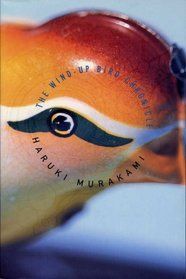
The Wind-Up Bird Chronicle by Haruki Murakami

Wind-Up Bird ChronicleThe Wind-Up Bird Chronicle ( (ねじまき鳥クロニクル) by Haruki Murakami
translated by Jay Rubin
read by Rupert Degas

I felt so lost when the recording of this book ended. A small part is due to the sense of irritation by the vague and unresolved ending. But that was easy to get over with: as a reader, I never need tidy endings. Indeed, if all the loose threads and baffling aspects all get tied up and connected neatly, I would probably have been quite disappointed.

The real reason of the sense of loss is that now I no longer “live” in that hyperrealistic, half-true and half-dreaming world Murakami created for his readers.  Starting with a very small story of an insignificant person, the narrative slowly opens up and expands to encompass both History (especially the Sino-Japanese War) and the unexplainable force of the entire Universe.

My admiration of Murakami’s philosophical exploration of what it means to be alive and to be connected to the rest of the humanity did not sway me from questioning one assertion of his ideology: That BOTH the Chinese and the Japanese were engaged in fighting a Senseless War. In theory, I believe that War is evil and senseless.  But, growing up Chinese (and with my mother’s entire family in Fake Manchu murdered by the Japanese) made me also realize that China’s RESISTANCE against Japan’s INVASION into our country might not be so senseless after all. On a scale of Japan on one side and China on the other, the weight of who’s responsible of all the senseless killings and deaths should definitely tilt heavily on the Japan side.

I finished the book back in April.  Three months later, I can still hear and feel some of the scenes and dialogs in my mind.  However, I will not recommend to listen to this particular audio recording: I found Degas’ voice acting as the young girl, May, more distracting than enhancing and I wish that he could have pronounced the Japanese names with more accurate intonations.  One day, I will go back and read the book itself and who knows, I might be able to teach myself enough Japanese to read in its original form!

Leave a comment

Filed under Book Notes, Views, WIWWAK

New Star Wars fictions, Chronicle Books and More

From June 26th to 29th, I enjoyed the many festivities at American Library Association’s 2015 Annual Conference in San Francisco.  Here are some photos with captions (click on the first photo to see the slideshow with full captions!)

Star Wars retold for Middle Grade readers — from Disney Publishing Worldwide.  The four authors of the upcoming (and already published) books are: Tony DiTerlizzi, Alexandra Bracken, Adam Gidwitz, and Tom Angleberger.

Chronicle Books invited us to check out their amazingly beautiful, open, and creative work space!  I found out that there is an entire Industrial Design department, creating merchandise connected to the books they publish.  Too fun!

Of course, there were many other events, sessions, workshops that I didn’t take a lot of pictures of — The Coretta Scott King Awards Breakfast, the ALSC Preconference highlighting and celebrating this year’s Honored books (Caldecott, Newbery, Sibert, Geisel, Carnegie), Newbery/Caldecott/Wilder Banquet, and the ALSC Awards ceremony (Sibert, Geisel, Carnegie, Batchelder.)

Leave a comment

Filed under Field Reports

The INjustice in the U.S. Criminal Justice System

Screen Shot 2015-07-09 at 8.04.06 AMI posted this to Facebook just now, thinking that it has little to do with Children’s or YA literature so the paragraphs do not belong on this blog. However, when I consider the reason for We Need Diverse Books movement and the imagery of young black males portrayed in some “gritty” modern teen novels, I found myself compelled to post my facebook update here as well:

Facebook asks, “What’s on your mind?” for status update. What’s been on my mind so much lately (because I’m listening to Michelle Alexander’s book The New Jim Crow) is the INjustice in our Criminal Justice system. Looking to verify some of the scenarios she cites in her book, I looked up the current prison fact sheet and found this (and other facts) on the NAACP site:

Drug Sentencing Disparities

  • About 14 million Whites and 2.6 million African Americans report using an illicit drug
  • 5 times as many Whites are using drugs as African Americans, yet African Americans are sent to prison for drug offenses at 10 times the rate of Whites
  • African Americans represent 12% of the total population of drug users, but 38% of those arrested for drug offenses, and 59% of those in state prison for a drug offense.
  • African Americans serve virtually as much time in prison for a drug offense (58.7 months) as whites do for a violent offense (61.7 months). (Sentencing Project)

What I now realize is that — these African American prison inmates do not just serve time and endure unfair punishment, they also lose many of their civil rights: including the basic right to vote to change the societal bondage of such unfair conditions.

We need to be aware and demand and SEE change in our Criminal Justice system and not allow the local and federal governments to keep funnel precious resources and huge amount of money into maintaining a penal system that does nothing to improve our society for all (building more prisons instead of training teachers and supporting education, for example!)

Link to the CRIMINAL JUSTICE FACT SHEET

Link to the PDF of “Reducing Racial Disparity in the Criminal Justice System: A Manual for Practitioners and Policymakers” by The Sentencing Project

1 Comment

Filed under Views, WIWWAK

Whom To Thank? Considering The Caldecott/Newbery Acceptance Speeches

Sunday evening, June 28th, was a highly anticipated night for those involved in Children’s literature:  the Newbery/Caldecott/Wilder banquet at the American Library Association’s annual conference where honor authors and illustrators were recognized and received their official citations from the Association of Library Services to Children (ALSC) and the three winners gave their acceptance speeches.

The speeches have always been the highlight of the evening — they are often enlightening, finely crafted, and always genuine.  This year was no different.  We heard how Kwame Alexander wooed his wife with sensual poetry, how Dan Santat turned down a cushy job at Google to continue his passion as a children’s book illustrator, and how Donald Crews collaborated with and still misses his late wife, the brilliant Ann Jonas.

Screen Shot 2015-07-07 at 10.41.11 AMAnd of course, they thanked many people.  Their agents, editors, publishers, loved ones, and the librarians who bring books to young people.  The usual.  And they thanked the Committees for their collective work. But this time, as I sat in the room, listening with rapt attention to Dan Santat: his Google story, his conquering of the relentless self-doubt, his Asian identity (Dan is Thai,) I also noted the way he thanked several bloggers and twitterers (is this even a word?) who publicly supported his work through the years, personally acknowledging those individuals by name. In contrast, his appreciation of the Caldecott Committee, although heart-felt, seemed formal and definitely not personal.  Later on, I was reminded by a friend that in 2013, “my own” Newbery winner, Katherine Applegate, also specifically and heartily thanked the same group of social media children’s book promoters by name in her acceptance speech.  (I myself had no recollection of this and had to read the speech in the Horn Book to confirm.)

I have been pondering this in light of the author/reader relationship (especially via social media) ever since.

It is simply natural for the authors or illustrators to want to thank people whom they consider champions of their books, and with whom they have formed close bonds via social media and real life interactions.  However, I do hope that naming book champions (and sometimes it feels like they are also “author champions”) does not eclipse the fact that public opinions or support from certain individuals or blog sites have absolutely no influence over the Award Committees or Committee Members in selecting winners and honor books.  I also hope that all who listened to or read the speeches realize that just because most librarians or teachers do not promote specific titles on public forums such as blogs or twitter feeds or interact with authors directly on social media, it does not mean that the front-line librarians are not also champions of the winning titles, before or after the award announcement.  (Librarians are usually also thanked collectively in the formal and generic “you’re good people who bring books to children, yay” way.)

I am probably one of those who straddle a bit of both worlds: when I I LOVE love love a book (which I do, a lot!) I might write a really positive review of the book and tag “highly recommended” here on this blog.  And then, I go into my real life, school librarian mode and “push” the book like mad. The beloved book goes on my summer reading lists, it is purchased for a bunch of teachers who attend my monthly faculty children’s book club, and gets recommended whenever I book talk or conduct one on one reader’s advisory. It might even make its way to become a finalist of SLJ’s Battle of the Kids’ Books.

The difference?  I simply do not record all these enthusiastic actions in details on my blog or twitter feed.  I also rarely become close friends (online or in RL) with children’s book creators, even when I absolutely admire all their work with all my heart.  Partly because I’d like to maintain my objectivity when reading and writing about their next books.  Thus, I know that I will probably never be thanked by name as a champion for a particular book or book creator in an award acceptance speech.

My name will especially not be cited individually if I have served on that year’s Newbery or Caldecott Committee.  Why?  Because serving on these major children’s literature award committees means to go into a sort of review hiatus and anonymity.  According to ALSC regulation, during the year of service, Committee members can not publish personal opinions on eligible books (as blog posts, tweets, or in published reviews with bylines.)  There are multiple reasons for this regulation. One is to avoid public perceptions of inappropriate lobbying of any specific title.

After serving on two wonderful Newbery Committees with great Chairs, I came to truly value the process.  I value that we collectively examined hundreds of books in a wide range of genres, themes, age brackets, styles, and forms, from large and small publishers (and self-published work.)  I value that we always adhered to the criteria and discussed the literary merits and drawbacks of each and every nominated title with care.  I value that we all understood that the discussion would change our original thoughts on many books and that not one single book was a shoo-in, ever.  I especially value that we all went into the discussion without knowing much (if any) of each other’s opinions on the group of books we had to discuss, so we could really listen without preconceived biases. This is why I came to value ALSC’s tough rule against reviews, online or in print, by Award Committee Members.  Since social media have greatly enabled instant, and continuous, connection between readers and book creators, it is much easier for an author or illustrator to note what has been the reception of his or her book and who is or isn’t supportive of that title.  It does not help the process (or the perception of the process) if some of the Committee members appear to have close ties with certain authors or have shared strong opinions on eligible titles in the public arena.

Newbery or Caldecott award committee members must come to terms with the fact that in the winners’ minds (and in the acceptance speeches) we are just that: a collective whole.  In 2012-2013, I served, along with 14 other dedicated, thoughtful, passionate book champions, on the Newbery Committee.  We voted and decided that the Newbery Medal would go to Katherine Applegate for The One and Only Ivan.  I could not have interacted with Applegate when Ivan was published (early in 2012) or when it gained wide appreciation through the year in the blogsphere. I could not have told her how I might have thought her skill in getting inside Ivan’s mind stunning. Or how much attention I might have paid to the rhythm of the sentences.  Or how I might have felt that everyone, regardless of age, should read this book because it is important and because it possesses layers of meanings.  And I could not have shared with her how lovingly my students might have reacted to Ivan.

So, it was only natural that Katherine thanked the Committee as a whole and thanked individually a few bloggers who were free to gush publicly and to tell of their acts of admiration for her to witness and appreciate.

No one can dictate whom the authors or illustrators feel compelled to thank in their speeches.  In the formal speeches, the Committee as a whole often comes across as a collective, impersonal, cool headed group who sit in judgment of books.  I simply wish to emphasize that Award Committee members are just the opposite of cool or impersonal: they are as warm and passionate and would incessantly push books wherever they go (much like the individually thanked bloggers and twitterers) even if they do not publish blog posts, tweet, or form close individual relationships with the award winners.

Leave a comment

Filed under Views

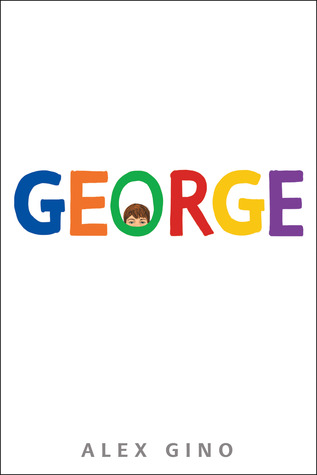
George by Alex Gino

georgecover George, by Alex Gino

Alex Gino achieved something extraordinary in giving the world GEORGE: they (Gino’s choice of pronoun) created an authentic main character struggling with gender identity (she, George) and a credible scenario with an appealing plotline that speaks directly and honestly to young readers in 3rd, 4th, or 5th grade. No extra unnecessary drama, just realistic reactions from those around George/Melissa. Very pleased to have read this short middle grade fiction.

1 Comment

Filed under Book Notes

Coretta Scott King Book Awards Breakfast: A Most Memorable Morning from ALA 2015, San Francisco

We always grumble about it being too early (7:00 a.m. on a Sunday during a long weekend of festivities and after a couple of really late night parties); we always know that once we get there, something magical will happen so all our sleepiness will be swept away: when the entire room sang Lift Every Voice and Sing together, when the morning invocation calls to attention of the importance of this award in our still trying time for African Americans, and when the award winners give their heart-felt, thought-provoking speeches.

This year felt like it was the BEST yet!  From Jason Reynold’s tribute to his mother and the power of community, to Kwame Alexander’s rousing spoken words; from Kekla Magoon’s insistence of telling the world the multi-faceted truths behind the single-angled reporting of the media, to Frank Morrison’s belief of encouraging all children to be who they truly are; from Marilyn Nelson’s quiet reminder of the power of words to Christian Robinson’s (and Patricia Hruby Powell) dancing like Josephine Baker!  And of course, to the dreaming and frustration and dreaming again by Jacqueline Woodson and Christopher Myers.

Jackie’s and Chris’ speeches in their printed form can be found on the Hornbook site.

Dream Keepers by Jackie and This untitled speech by Chris are must reads!  Don’t miss this moving tribute to Chris by John Steptoe (new talent winner): Giant (for Christopher Myers)

That entire breakfast was at once extremely somber and electrifying.  These talented African American authors and artists have joined a long line of creative souls who continue to inspire and inform young readers.  Bravo!

(Christian Robinson & Patricia Hruby Powell – illustrator/author duo for Josephine even danced for us.)

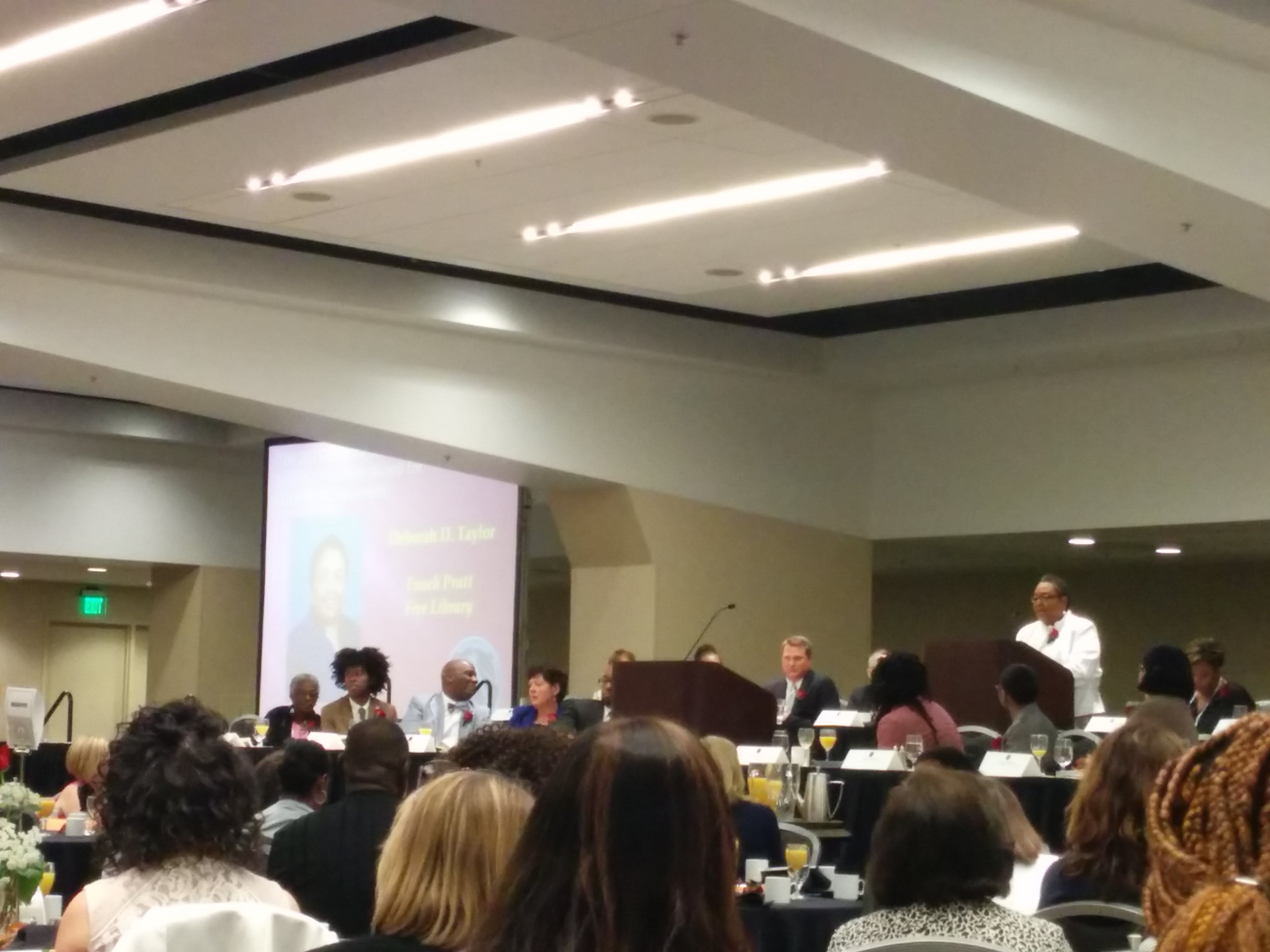
Another noteworthy honoree of the day is Deb Taylor (my fellow 2002 Newbery member,) of the Enoch Pratt Free Library in Baltimore for her Distinguished Services over the years!  Here’s a picture of her giving her passionate speech —

IMG_20150628_093432


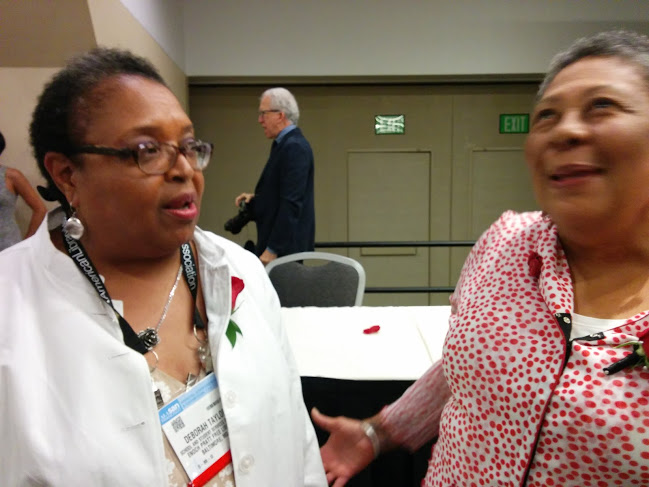
and her talking to Marilyn Nelson, author of Carver: A Life in Poems, (2002 Newbery Honor book winner):

IMG_20150628_100728

More pictures and reports of this past weekend at ALA can be found on the SLJ site.  And my own photo documentary of the weekend is forthcoming!


2 Comments

Filed under Field Reports

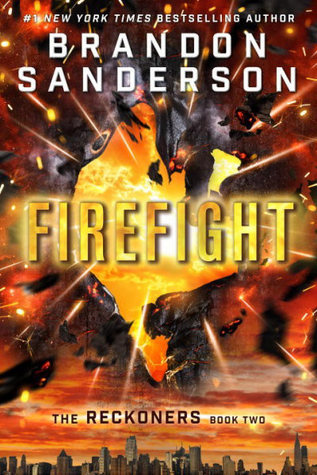
Firefight

firefight Firefight by Brandon Sanderson (Reckoners, #2)

This second book in the Reckoners series reads like a complete story — with it central villain(s) being dealt with by the last chapter and secrets revealed. It also sets up the next book nicely, because those secrets will propel the conflict into grander scales. A thoroughly enjoyable book that did not go beyond my expectations, even when some “shocking truths” are exposed. Perhaps because I have been binging on Agents of S.H.I.E.L.D. as I read this book, and the two storylines share a lot of similarities especially when it comes to how the perceived good characters and those supposedly bad characters might turn out to be very different from what you have originally believed. So, I learned to mistrust all characters (even the narrator himself) until proven otherwise. This makes me wonder about the recent wild popularity of dystopian novels for young people and the central conflict rooted in a strong distrust of one’s government (or team, family, or friends, etc.)

I am all for critical thinking and questioning authority and demanding clear reasons and transparency when we are asked to behave in certain ways (and when we ask young people to follow certain rules and paths.) However, I often fear that we (as educators) are encouraging generations of young people to question everything every step of the way and mistrust those around them as the default form of interaction with the wider world. Once in a while, it would be so nice to simply just trust since I do believe that large portion of humanity is good.

Leave a comment

Filed under Book Notes

Invisible Man

invisibleman by Ralph Ellison, Audiobook read by Peter Francis James.

This is a book that I wish I had read it in a class, with a passionate teacher and a group of classmates that would share their reactions and opinions with me. So many ideas bounced in my head as I listened to an excellent rendition of the book by Peter Francis James and I immediately wanted to re-read it and to jut down the numerous memorable quotes since, alas, many still applicable when it comes to race relations in the United States. Shouldn’t this be required reading in ALL high school English classes across America?

1 Comment

Filed under Book Notes

My One and Only BEA

My first BookExpo America happened this past Friday, May 29, and they are moving it to Chicago next year!  So, this might be my one and only BEA.

My first impression upon approaching the Javits Center was, “This is no where near overwhelming as so many people had told me.”  (My experience with Javits is mostly ComicCon with 151,000 unique attendees in 2014; BEA had about 11,000 last year.)

Around 9:15 a.m, I entered the building:

IMG_20150529_091546

The exhibits floor was actually not that empty and by 9:30, there were definitely a lot of people excited about meeting authors and getting their books signed.  Long lines for John Grisham and other authors.  I learned that there’s the thing called “the Galley Drop:” You stand in line for a specific ARC give-away at a certain hour.  Brian Selznick’s Marvels had more than one galley drop times!

Of course, the Expo is not really for “common book fans.”  It’s where a lot of business meetings were taking place amongst industry professionals and deals got made.  I acted as a fan briefly but devoted most of my day scouting possibilities and finding ways to bridge the Chinese and American children’s publishing worlds.

It was definitely thrilling to meet Marie Lu and to tell her how much my students and I have enjoyed all her work: The Legend trilogy and the new Young Elites.  So looking forward to The Rose Society this fall!

IMG_20150529_093302IMG_20150529_103019

Most of my day was spent on going through the China Pavilion where this year’s Honored Guests, dozens of Chinese Publishing companies, displayed their wares and where special events featuring editors, authors, and publishers took place.  The space was set up beautifully, if a bit sterile, but I imagine that most display must have felt quite impenetrable to American buyers, with little or no English explanation of what they are seeing.

IMG_20150529_115428

By sheer good luck, I discovered some middle grade titles that capture contemporary Chinese life that could be introduced to American young readers.  This promising series: Colourful Ravens: Original Stories in Chinese, features fiction around 120 to 145 pages long, with colorful illustrations and high production value, is from the 21st Century Publishing House.  I talked to the editor of the series and the company’s Rights manager and can’t wait to read through their entire output this summer!

IMG_20150529_113259 IMG_20150529_112913

Another memorable event was the dialog between two young writers, Xu Ze Chen, author of Running Through Beijing and Dale Peck, author of Sprout, moderated by Eric Abrahamsen, a translator from Seattle currently living in Beijing and the publisher of Paper-Republic.org (website and print magazine for translators of Chinese literature.)  The audience who were not fluent in both languages were given headsets, tuned to the correct language channel, and two interpreters simultaneously provided accurate translation for the audience AND for the two authors.  This allowed for the two of them to have a completely seamless and meaningful conversation mostly about contemporary Beijing, generational gap, writing for a perceived audience, and the time-sink that is self-promotion, etc. even with the language barrier.  It’s a beautiful thing to behold!

I ordered Running Through Beijing right then and there.  It will arrive soon.  Book report forthcoming!IMG_20150529_141944

I also attended an off-site meeting with a newly established Children’s Publisher in China and will report when there are concrete things to cover.

Overall, a superbly productive day!

Leave a comment

Filed under Field Reports

What is Akimi's mother?

Finally got around to reading a book favored by many of my students.  So far, the writing is crisp and fluid, the storyline is intriguing, and the main character is easy to like. Then, I ran into a sentence that caught me by surprise: “Akimi’s mother is Asian, her dad Irish.”  I tried to imagine why the narrator decided to name the COUNTRY of origin of this character’s father — IRELAND, and to name the CONTINENT of origin of this character’s mother?  The symmetry would have been, “Akimi’s mother is Asian, her dad European,” or “Akimi’s mother is Japanese, her dad Irish.”  (Akimi is a unisex Japanese name.)

By naming the father’s specific country, we acknowledge that different European countries have different cultures and traditions and also different background/immigrant stories.  By naming the mother’s origin as from one generic and vast continent, we erase the differences of the diverse cultures and heritages, and fail to acknowledge the different background/immigrant stories.

Of course, one cannot know what went into writing and editing such sentences: I don’t know whether the author originally put in the ethnicity of the mother and was advised to change it; I don’t know whether there are reasons I am unaware of that naming the mother’s heritage might be offensive; I don’t know that it is not just so common a narrative convention that no one on the editorial team would be able to catch the inconsistency and correct it.  

Few people would even notice this unessential sentence unless they are like me who reads statements like this and see the bright neon sign of frustration: when will American, non-Asian writers start realizing that Asians and Asian Americans belong to many different sub-groups, all carrying with them drastically diverse beliefs, traditions, and histories? And if they’d like to put in some ASIAN characters to “diversify” their stories, perhaps some more understanding of where those characters came from, what kind of back stories they and their forefathers might have would have helped to raise the authenticity meter? And also perhaps consider: whether they behave more like those from their countries of origin or more like your “common” Americans… (by the way, what IS a “common” American?)

Leave a comment

Filed under Views, WIWWAK